



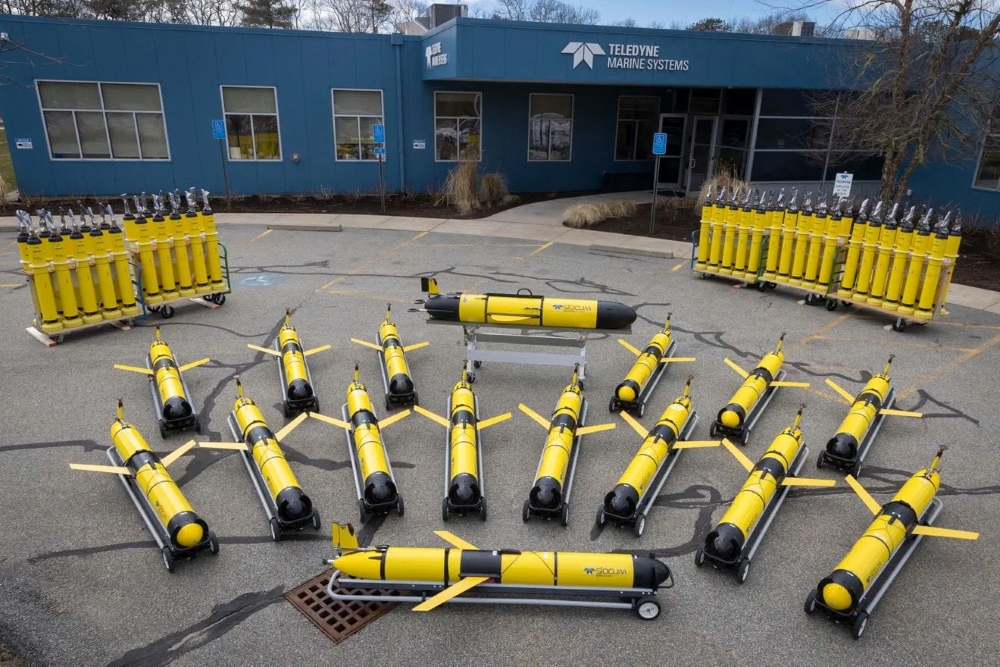
The Royal Navy has celebrated at the end of March the activation of a new contract, worth more than £6.6 million, with Teledyne to replenish and expand the fleet of APEX floats and SLOCUM gliders used for uncrewed oceanography data gathering.
The contract start date was actually 16 march and with options it could run until 31 march 2028. Its aim is to expand and sustain a fleet of uncrewed data gathering platforms which is already operational and has been for a few years now. For the Royal Navy, the purpose is the delivery of “a sovereign, scalable, and autonomous glider and float solution to close critical gaps in oceanographic data collection and Tactical Exploitation of the Environment (TEE)”.
The contract deliverables are 12 to 15 new SLOCUM G3 gliders with associated accessories, support and swappable payloads plus a single, larger, newer SLOCUM SENTINEL which will be equipped, optionally, with an unspecified towed array sensor. Also included are 56 APEX floats, 50 of which in “base” configuration and 6 with additional sensors, plus associated support and accessories.
The APEX floats are disposable, drifting profilers gathering a variety of useful lectures such as temperature and salinity in the water column. They are also capable, when fitted with adequate extra systems, of ice monitoring and passive acoustic measuring. They represent a cheap way to make a massive number of measurements across the Atlantic and Arctic, gathering information useful to fine tune sonars and ASW operations, for example.
The G3 gliders are circa 70 kg, 1.5 meter uncrewed vehicles that can travel for months moving between 4 and as many as 1000 meters of depth, gathering data. Back in 2009, a Slocum glider, modified by Rutgers University, crossed the Atlantic in 221 days.
The Royal Navy appears to have begun using APEX floats and SLOCUM G3 gliders during 2021, with their usage being publicly disclosed in 2022, when details of some long duration data gathering sorties were unveiled, along with the release of “49 floats since May 2021” with “30 more to follow” to seed the Atlantic. Repeated follow-on orders have appeared in MoD contract notifications since. Most notably, in January 2023 a contract notice was released detailing an order for 125 APEX floats and 6 G3 gliders. Another 6 G3 gliders were ordered in March 2025.
The introduction of these novel solutions for oceanography was initiated under Project HECLA and made all the more important by the decision to withdraw from service the Survey vessels HMS ECHO and ENTERPRISE. Drones have had to take on a much larger share of the data gathering work, in a vast reform of the entire capability branch within the Navy which has also resulted in the split between MIWG and Hydrographic eXploitation Group.
MIWG is the primary user of the ocean-going APEX and Gliders, while the Hydrography Group employs VAHANA-class survey boats (11 to 15 meters), OTTER uncrewed surface vehicles, Teledyne GAVIA autonomous underwater vehicles and SEABER UUVs for more inshore, shallow water data gathering.
Teledyne declares over 2700 employees in the UK across 17 main sites. Most recently, at the end of 2025, it opened a new repair facility in Fareham, co-located with Teledyne Raymarine, augmenting the already operational Slocum glider facility in Southampton at the National Oceanographic Center.
Another facility is being added in Plymouth as well to better support the Teledyne platforms employed by the forces based locally in His Majesty’s Naval Base (HMNB) Devonport.




Privacy Policy

Powered by © Mobilbyte s.a.s. Information Technology