



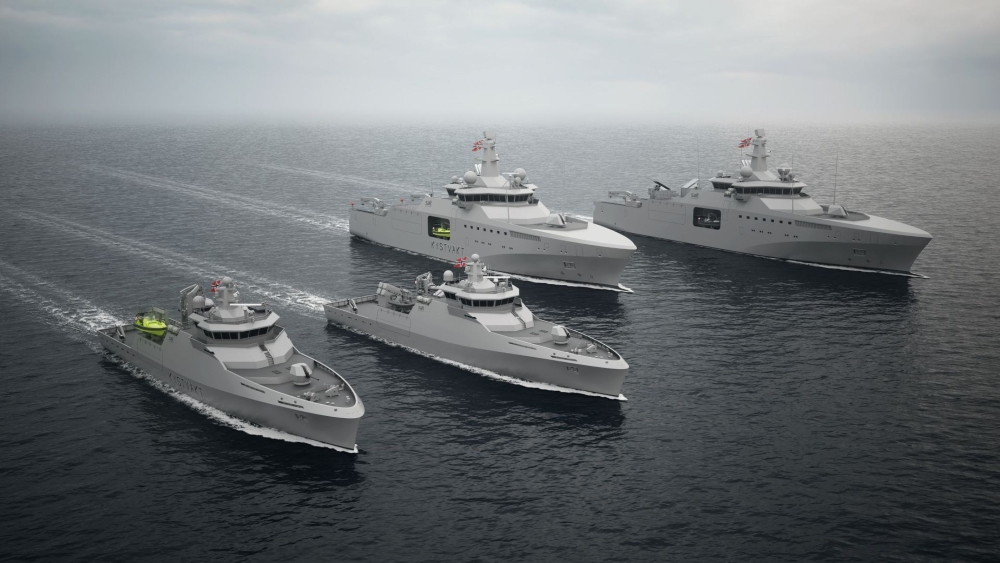
The Norwegian Defence Materiel Administration (FMA) has awarded a contract to the consortium Salt Ship Design AS and Kongsberg Defence and Aerospace AS for the design of the Standardized Vessel, a crucial component in Norway’s plans for the modernization of its Navy.
The goal of the Standardized Vessel project is to develop a new class of vessels, coming in 2 sizes, ocean-going and coastal, which will cover large parts of the needs of both the Navy and the Coast Guard. Norway plans to acquire 18 medium and 10 large vessels of this new type, which will cover a wide array of roles thanks to their modularity and adaptability.
Their large cargo space and mission deck will enable, in particular, the embarkation of modern, modular mine countermeasure solutions. It is primarily to use them as motherships for its Mine Hunting Capability program that the UK also plans to acquire some of these vessels. At least 3 large hulls are expected to be ordered as part of MHC Block 2 plans.
Norway confirms that plans in this sense have been agreed within the wider arrangement centered on the acquisition of 5 (with a sixth option) Type 26 ASW frigates from the UK for the needs of the Norwegian Navy.
The vessels are meant to be affordable and “will be based to the greatest extent possible on civilian standards and commercially available technology, following the principle of "as civilian as possible, as military as necessary". At the same time, they will facilitate modular solutions, interoperability with autonomous systems and high operational flexibility”.
The first vessel is planned to be delivered during 2030, although the latest Norwegian defence paper cautions that some risks exist in achieving that aim.
The selection of the Kongsberg-Salt team has been the result of a national competition which originally saw 11 design houses participate in the qualification, 6 of which were then invited to proceed. 3 suppliers then submitted final offers.
The Norwegian Director of Defence Materiel, Gro Jære, says that “the expertise and capacity of Salt & KDA are crucial” to fit the demanding timeline for the project.
Once the design baseline is defined, by the end of this year, another competition is due to open to decide which Firms are going to build the vessels. This phase is expected to start in the Fall of 2026 and conclude in Spring 2027. Before 2027 is over, the first ship is meant to be in build to achieve delivery in 2030.
The Royal Navy had until recently hoped to start putting the MHC motherships (Offshore Support Vessels, officially) into service beginning in 2029, to better match the current expectation that the last SANDOWN-class minehunter will decommission by 2030 and all 6 remaining HUNT-class ships will also bow out between 2029 and 2031. It is likely the plan will require a further tweak.
The Royal Navy had already awarded an initial study of its own to Kongsberg, relating to the Firm’s VANGUARD concept design for modularity. It had been the first hint of a Norwegian way for the MHC mothership needs.
The Royal Navy is understood to have one main wish for the new ships, being a cargo/mission space of 1000 square meters or more, having already concluded that modular, drone-based solutions are only going to become larger and more comprehensive over time. Going into Block 2, MHC systems anticipate the embarkation of 3 11-meter USV, for example, plus air drones and all supporting equipment.
Follow us on Telegram, Facebook and X.




Privacy Policy

Powered by © Mobilbyte s.a.s. Information Technology