



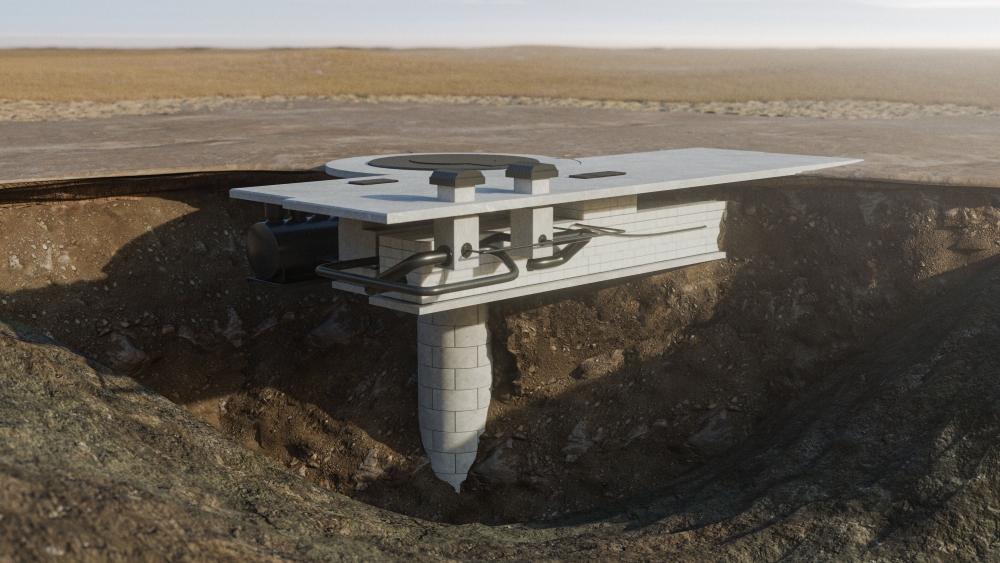
Representatives from the US Air Force, from Northrop Grumman and from industry partner Bechtel have jointly broken ground in Promontory, Utah, for the first, prototype missile silo for the new LGM-35A SENTINEL intercontinental ballistic missile (ICBM).
Developed in partnership with prime contractor Northrop Grumman, the silo prototype will validate a modular, repeatable construction approach that can then be applied to the full rate construction effort. Having decided to proceed with new build structures rather than attempting to convert existing MINUTEMAN III silos, the program will need to build 450 of these new underground structures.
New build, rather than refurbishment, was ultimately selected to enable development of a modern, adaptable architecture while ensuring uninterrupted alert coverage. The USAF, which is in charge of the ICBMs, plans the procurement of 634 SENTINEL missiles, plus an additional 25 missiles to support development and testing. This stock is meant to sustain a deployed force of 400 weapons at all times.
Each SENTINEL air vehicle consists of boost propulsion subsystem (a 3-stage solid rocket) and a post-boost propulsion subsystem comprising a liquid-fueled rocket propulsion system integrated into a post-boost attitude control module (PBACM) structure, as well as all guidance, navigation, and control components. The SENTINEL air vehicle’s ultimate purpose is to carry the MK21A Reentry vehicle, which carries the W87-1 nuclear warhead back into the atmosphere to its target.
The SENTINEL project has been plagued by delays and cost growth which determined a massive breach of the Nunn-McCurdy law, which sets an hard ceiling on cost growth per unit by defining a “significant” (15% growth) and a critical (25%) thresholds. By statute, a Critical breach means the respective program must be terminated unless the Under Secretary of Defense for Acquisition and Sustainment (USD(A&S)) certifies to Congress that the program meets established criteria to continue.
In good part because of the need to completely change approach and cost estimates for the launch infrastructure, SENTINEL experienced a breach of over 80% over the initial (2020) estimates. The program fate was decided on July 8, 2024, when it was re-certified because of its critical importance.
Since then, there has been progress. Construction is underway on a new Wing Command Center at F.E. Warren Air Force Base, in Wyoming (90th Missile Wing), one of 3 main sites for the SENTINEL bed down, with the other 2 bases being Minot AFB, North Dakota (91st Missile Wing); and Malmstrom AFB, in Montana (341st Missile Wing). The program has also demonstrated, separately, all propulsive elements, test firing stages-one, two and –three and completing a hot fire test of the post boost propulsion system. The first flight test for the complete missile is scheduled for 2027, in order to achieve an initial operational capability “in the early 2030s”, against a previous target of 2029.
The infrastructure plan includes, apart from the 450 individual silos, 24 Launch Centers and 3 new Wing Command Centers (WCC), all interconnected with over 5,000 miles of fiber optics.
Follow us on Telegram, Facebook and X.




Privacy Policy

Powered by © Mobilbyte s.a.s. Information Technology