



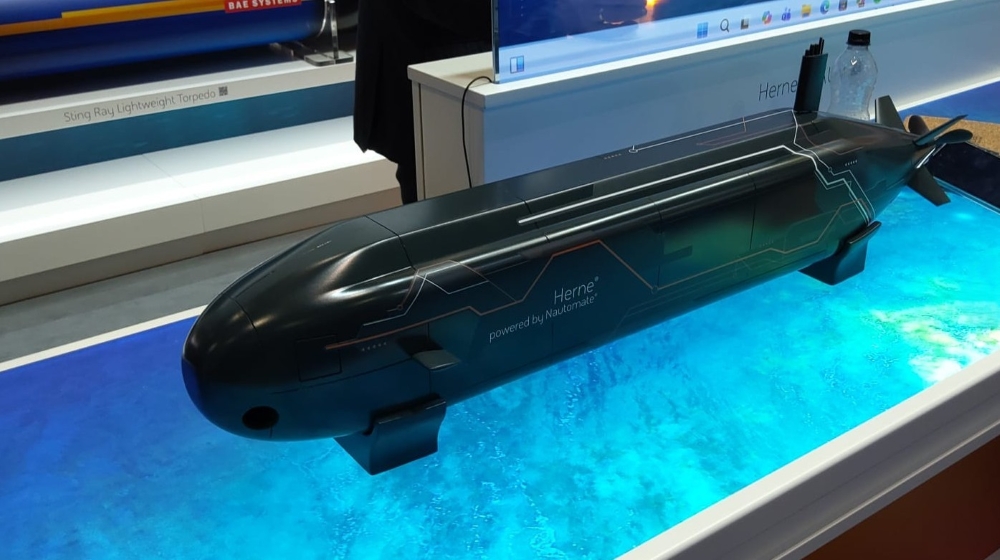
Undersea Defence Technology (UDT) 2026 opened yesterday at London’s ExCeL with a programme and show floor that make one trend unmistakably clear: unmanned and autonomous systems now sit at the heart of the undersea conversation, cutting across operations, sensors, and the wider strategic discourse around alliances such as AUKUS.
The event’s official theme, “Advantage through Undersea Technology”, frames this shift around autonomy, rapid application to evolving threats, and agility in bringing capability to scale. In practice, that translates into a dense concentration of exhibitors and briefings on AUVs, USVs and advanced processing, with companies such as BAE Systems, Kongsberg, Saab, and others using London to showcase how unmanned assets can expand reach, persist in contested waters and carry increasingly complex payloads. DRASS and EUROATLAS are among those positioning their offerings squarely in this unmanned-centric space, reflecting a maturing market that sees these platforms as core force multipliers for future undersea forces.
Being in the UK, UDT 2026 is also very much an AUKUS show. The conference schedule is threaded with high profile interventions from British and Australian officials, including keynote remarks from the UK Prime Minister’s Special Representative on AUKUS and senior Australian representatives, as well as multiple panels on SSN-AUKUS delivery, combat system integration and North Atlantic transformation. A dedicated opening AUKUS panel, and subsequent sessions examining collaboration within the SSN-AUKUS enterprise into the 2030s and 2060s, underline how the trilateral pact now structures much of the strategic and industrial conversation around submarines and undersea warfare in the Anglosphere.
By comparison with last year’s edition in Oslo, traditional naval armaments are visibly less prominent on the floor, with fewer conventional weapons systems in the spotlight and more space given to sensors, autonomy, data and infrastructure. Yet one of the more striking shifts is conceptual rather than physical: the taboo surrounding naval mines is clearly eroding. Discussions that, a few years ago, might have stayed firmly in the classified domain are now handled openly in conference sessions and booth briefings, especially when framed through the lens of unmanned systems. Mining – once euphemistically bundled under “seabed effects” or “area denial” – is now routinely presented as a normal, even expected, mission set for AUVs and USVs, both in terms of mine countermeasures and, increasingly, in the planning and execution of offensive mining operations. This normalisation is especially visible in the mission profiles assigned to large and extra large UUVs and surface drones, where concepts of operations routinely include covert deployment of smart mines, seabed sensor mine hybrids and distributed barriers designed to shape adversary behaviour in choke points and littorals. Exhibitors with strong positions in mine warfare and EOD – including those presenting compact unmanned platforms optimised for UXO and mine identification and neutralisation – emphasise how such vehicles can now be retasked across the full spectrum of mining and counter mining without exposing crews. The net effect is that mine warfare, once something of a niche specialism, is becoming an integrated, “normal” part of wider unmanned undersea operations doctrine.
On the sensor side, sonar technologies continue to progress steadily but significantly. ELAC Sonar and other players are highlighting how digital architectures, compact arrays and modular processing chains can now be scaled down for smaller hulls, midget submarines and UUVs, without sacrificing performance in cluttered or shallow-water environments. This direction of travel is echoed by the broader programme: papers such as SEA’s presentation on modular sonar processing architectures and the presence of multiple compact towed and hull-mounted solutions for small platforms indicate that navies are intent on pushing credible acoustic capability onto ever smaller, more numerous assets.
Experiences drawn from NATO experimentation campaigns such as REPMUS loom large in the background: allied officers and industry representatives repeatedly cite these exercises as laboratories for validating multi UUV and USV sonar concepts, distributed sensing frameworks and human–machine teaming approaches in realistic conditions. NATO’s institutional perspective is also visible in dedicated keynotes on undersea initiatives, seabed warfare and the protection of critical underwater infrastructure, which tie operational lessons from REPMUS and other trials back into alliance-level concepts and capability planning.
A session on seabed warfare emerging technologies, led by NATO CMRE and industry partners, underscores how sonar, non acoustic sensing and autonomous platforms are converging to support persistent surveillance of cables, pipelines and other strategic seabed assets.
Across all these strands – unmanned platforms, mining, sonar and seabed operations – two cross cutting issues dominate the technical discussion: communications and autonomy. The conference framing explicitly stresses the need to turn advanced technologies, from AI and autonomous platforms to distributed sensing, into deployable and affordable capabilities at scale, and this places robust, secure and bandwidth efficient communications at a premium. Multiple sessions focus on assured data, GNSS denied navigation, blue laser underwater links and the fusion of heterogeneous sensor inputs into coherent tactical pictures, all with the aim of enabling unmanned systems to operate further, deeper and with less dependence on continuous human control. Autonomy, meanwhile, is treated less as a buzzword and more as a spectrum of practical solutions, from onboard processing that lightens operator workload to higher order mission autonomy that allows swarms and distributed constellations to coordinate in complex environments.
Whether in AUKUS submarine programmes, NATO multi domain trials or the latest commercial UUV offerings, the same question keeps resurfacing in London: how to blend human judgement, machine intelligence and resilient communications into undersea systems that can keep pace with rising threat complexity and compressed decision timelines. If UDT 2026 is any indication, the undersea community’s answer is to double down on unmanned assets, smarter sonars and data centric architectures – and to speak more openly than ever before about the full range of missions, including mine warfare, that these systems will be expected to undertake.




Privacy Policy

Powered by © Mobilbyte s.a.s. Information Technology