



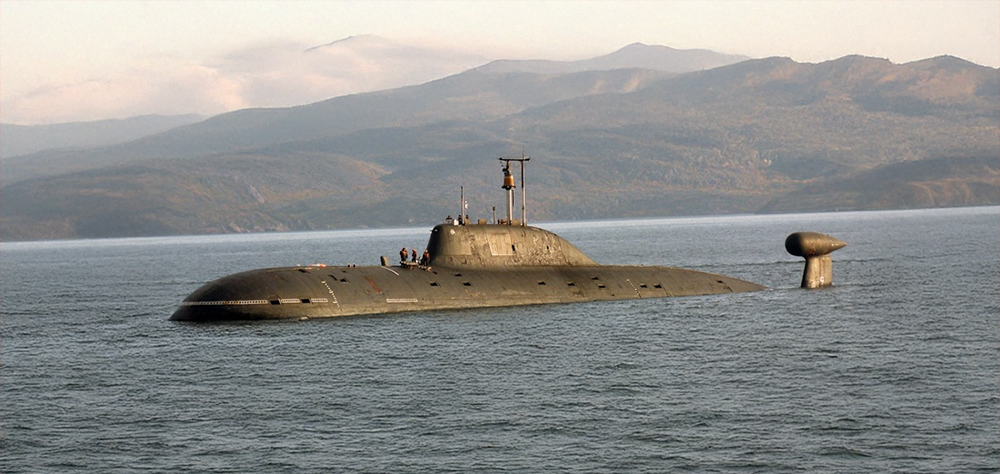
On 9 April 2026, the British Ministry of Defence released details of an operation conducted in the maritime areas surrounding the British Isles.
The operation involved a Russian AKULA-class nuclear attack submarine, supported by at least 2 "research" midget submarines assigned to the GUGI (Glavnoye Upravlenie Glubokovodnikh Issledovanii), the elite military organisation based at Olenya Guba on the southern coast of the Barents Sea, specialised in deep-water submarine operations and seabed activities.
The Russian submarine had been identified and continuously monitored for several weeks by British and Norwegian naval units and aircraft as it navigated submerged at the limit of UK territorial waters. Through careful analysis of its movements and on the basis of additional intelligence, London's authorities established that the vessel was providing "cover" for the GUGI midget submarines, which were in the meantime inspecting and monitoring critical underwater infrastructure in the Norwegian Sea and the North Sea.
Although no specific information has been disclosed, given the operational distances involved, it is reasonable to assume that the midget submarines were transported and deployed by the submarine PODMOSKOVYE or by the ORENBURG: both are purpose-modified DELTA-class vessels configured to serve as "mothersubmarines", also homeported at Olenya Guba.
The counter-operation reached its peak when the frigate ST ALBANS (operating in the role of Towed Array Patrol Ship – TAPS), the fleet replenishment vessel TIDESPRING, MERLIN helicopters, and an RAF P-8A POSEIDON maritime patrol aircraft established sustained contact with the AKULA and its underwater "escorts." Through the systematic deployment of sonobuoys, British forces sent an unambiguous signal to the Russian units, demonstrating awareness of their position and intentions, and pressing them to cease their activities.
Faced with this pressure, the AKULA and the midget submarines reversed course to return to base — probably without having completed their assigned mission, or maybe after having tested the response capabilities of British assets.
Commenting on the incident, British Defence Secretary John Haley, addressing Russian leadership directly, stated that London has full awareness of Moscow's underwater activities near its energy and communications infrastructure, stressing that any attempt at sabotage or damage will not be tolerated and will carry extremely serious consequences.
The episode, officially disclosed by Whitehall, comes at the end of a prolonged period of surveillance conducted by the Royal Navy against Russian naval assets (both surface and subsurface) transiting waters of national interest, the English Channel, and the North Sea. Specifically, the frigate SOMERSET and the patrol vessel MERSEY, supported by the replenishment ship TIDEFORCE and WILDCAT helicopters, recently escorted a destroyer, a frigate, a landing ship, and a KILO IMPROVED-class submarine engaged in redeployment activities between the Baltic Sea and the Mediterranean. It is also worth recalling that as early as 2025 the British military apparatus had been tested by GUGI activities, when the well-known Russian oceanographic research vessel YANTAR — de facto a spy ship — was intercepted at the limit of territorial waters. On that occasion, the vessel had been shadowed by a British frigate and a pair of RAF POSEIDONs, whose crews reported being "harassed" by laser beams directed at them from the YANTAR itself.
In light of this growing tension, attributable to a particularly aggressive hybrid warfare strategy in the underwater domain, numerous British observers and military experts have called for an acceleration of the ATLANTIC BASTION programme.
This initiative aims to radically enhance the Royal Navy's defensive capabilities, focusing on deeper technological integration between autonomous drones, advanced sensor networks, and next-generation surface vessels.




Privacy Policy

Powered by © Mobilbyte s.a.s. Information Technology