



The Strait of Hormuz is doing what decades of summits could not: forcing a solution to Europe’s strategic dilemma. For years, Europe has wrestled with a seemingly insoluble conundrum: how to build a European defence pillar sufficiently ‘NATO’ to preserve the transatlantic bond, yet sufficiently autonomous to protect interests the United States no longer sees as its own. A balance endlessly invoked, never quite achieved. It was not an elegant geopolitical theory that resolved it, but a brutal crisis.
Iran’s disruption of traffic through the Strait of Hormuz struck at the core of the global energy system. Roughly one fifth of the world’s oil passes through that corridor, and even partial disruption triggered immediate shockwaves - rising prices, supply chain stress and the risk of broader regional destabilisation.
Meanwhile, Tehran has slightly adjusted its posture, easing direct interference with shipping while signalling openness to negotiations, while tying any durable de-escalation to ceasefires in Gaza and Lebanon. The Strait has become not only a military lever, but a diplomatic one. Until days ago, Europe held back - watching, discussing mandates and technical reinforcements, careful not to be drawn into the conflict. Hormuz made that position untenable.
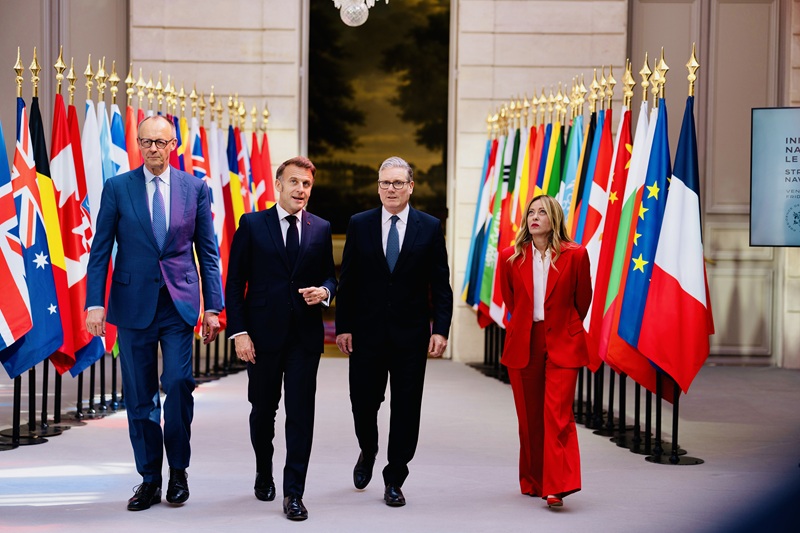
The Paris Summit of 17 April marked the shift. France and the United Kingdom launched an international coalition - involving more than 30 countries, with participation reaching close to 50 - to secure the Strait through what leaders explicitly defined as a “defensive” mission, to be deployed once conditions allow. This is not a classic military intervention. It is a focused operational package - mine-clearing, naval escorts, intelligence-sharing and protection of energy routes - tied to a ceasefire context so as not to derail fragile diplomacy.
The language used in Paris was telling. In their joint statement, Emmanuel Macron and Keir Starmer called for the “unconditional, unrestricted, and immediate re-opening” of the Strait and stressed that “the right of transit passage… is the bedrock of international trade.” Starmer framed the effort as a global responsibility, warning that reopening the Strait is essential “to get global energy and trade flowing freely again.”
Italy has offered naval assets and minehunters - a recognised national speciality - with Giorgia Meloni describing participation as a matter of “national responsibility.” Germany remains more cautious. Friedrich Merz has insisted on a clear legal framework and maintained that coordination with allies remains “desirable.” But that is not the main point. This is not the usual coalition of the willing. Largely composed of NATO members, it operates outside the Alliance’s political framework, without direct US involvement. It is not a challenge to Washington, but a form of substitution - one that bypasses the Atlantic framework where necessary without breaking it.
The main internal divide concerns the role, if any, the United States should play. France and others argue that excluding belligerents is essential to preserve neutrality; Germany and parts of Eastern Europe are more cautious. The pivotal actor is the United Kingdom: despite remaining Washington’s closest ally, London has chosen to co-lead with Paris, making the operation difficult to frame as anti-US. It is, rather, the product of an America that has become unpredictable.
Donald Trump is far from irrelevant. His pressure, threats and oscillation between escalation and disengagement are central to the picture. Yet this very unpredictability has had a paradoxical effect: it has unlocked the European dilemma. When the traditional guarantor becomes a source of uncertainty, the choice is no longer between autonomy and loyalty, but between action and paralysis.
Here, the circle closes. Europe appears to have found a form of autonomy that does not oppose NATO, but complements it. It relies on capabilities developed within the Alliance and deploys them through flexible formats not bound by unanimity. A de facto European NATO, without the label but with many of its instruments. The operational dimension makes this even clearer. European navies - particularly from Italy, France and the United Kingdom - possess advanced mine-countermeasure capabilities that are, in some areas, more developed and readily deployable than those of the United States, giving the mission a concrete, not merely political, rationale. However, clearing Hormuz cannot be done overnight: mines must be detected, identified and neutralised one by one, often in conditions where even those who deployed them lack precise control over their locations. Only then can energy flows resume with a reasonable degree of safety.
It is no coincidence that the two central figures in this shift helped set the stage: Macron long arguing for European strategic autonomy, Trump pushing a unilateral redefinition of the transatlantic relationship. Two opposing trajectories that, intersecting under pressure, have opened a new space. The breadth of participation is equally significant. Global partners - many traditionally under the US security umbrella - have joined a Europe-led initiative, sending a signal that the management of global security can partially shift as a hedge against fragmentation.
At the same time, European diplomacy is running on two tracks. In Luxembourg, the Foreign Affairs Council will gather all 27 member states, while a more restricted format among key countries will define operational details before seeking broader political endorsement. Decision among a few, legitimacy among many. The outlook remains uncertain. Iran may use its calibrated de-escalation as leverage or harden its stance. Maritime traffic remains fragile, and parallel US measures continue to shape the security environment.
Something has already changed, though. Europe has not simply waited. It has acted - not against the United States, but without their blessing, despite the contingencies of their current leadership. Not to replace NATO, but to show it is no longer the only available instrument. The “squaring of the circle” was not theorised. It was imposed by events.And, for now, it is holding.



Privacy Policy

Powered by © Mobilbyte s.a.s. Information Technology