



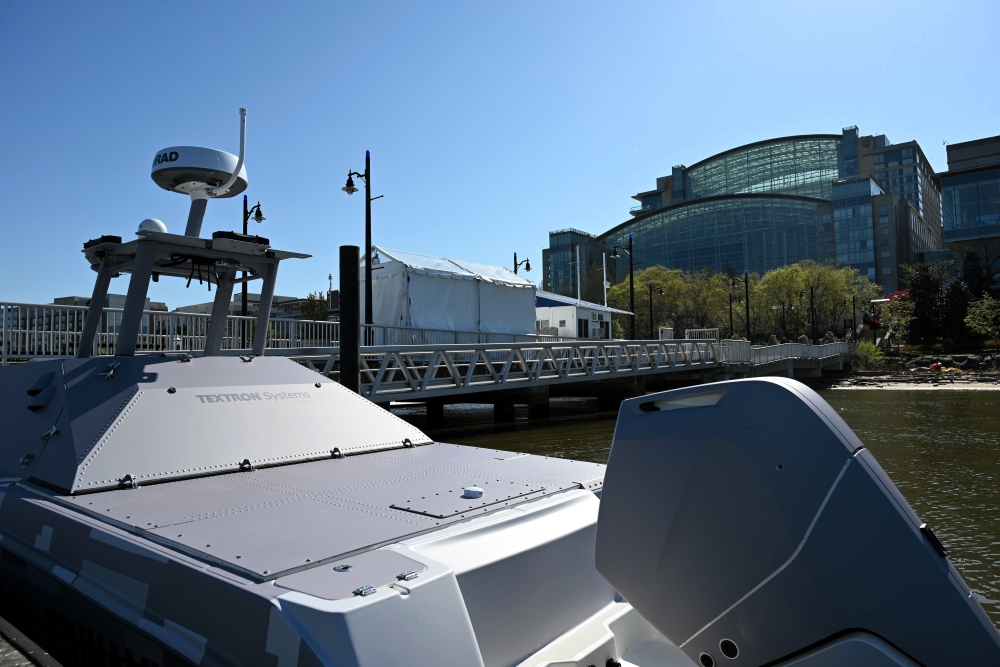
Sea-Air-Space 2026 opens at National Harbor at a moment when maritime power politics are hardening and the US Navy is under mounting pressure to do more with finite platforms, people and budgets. The Navy League’s flagship exhibition has a real-time barometer of how Washington and its allies intend to contest an increasingly crowded sea, air and space domain.
The geopolitics framing this year’s edition are stark. From the Western Pacific to the Black Sea, navies are preparing for sustained operations in contested littorals, under constant surveillance and persistent missile threat. Panels on readiness, contested logistics and information warfare echo the Pentagon’s preoccupation with deterring peer adversaries while managing the continuing demands of presence missions and crisis response.
Allies and partners - from Europe, the Indo-Pacific and Australia to Canada - use the exposition to align their own naval modernisation paths with US priorities, whether in undersea warfare, missile defence or maritime domain awareness. Behind the formal messaging lies a harder-edged conversation about industrial capacity and political will.
US and allied leaders are candid that shipbuilding backlogs, munitions stockpiles and recruitment shortfalls now carry direct strategic consequences in any high end maritime confrontation. In that sense, Sea Air Space is as much about reassuring partners and deterring competitors as it is about unveiling the next generation of kit.
Procurement programmes in the spotlight
Across the 400+ exhibitors and sprawling demonstration floor, several procurement axes are already emerging as anchors for US and allied spending. Among them, three take the centre stage.
First, major surface combatant and amphibious shipbuilding remain a central draw, with US prime shipyards using the show to reinforce their role in delivering the future fleet and to argue for steadier, multi year funding profiles. Parallel discussions on naval electrification, advanced propulsion and integrated power systems underscore a shift toward platforms designed from the outset for high energy weapons and power hungry sensors.
Second, undersea warfare (both crewed submarines and autonomous undersea vehicles) is prominent. Exhibitors are showcasing solutions that link large-displacement unmanned vehicles, seabed sensors and manned platforms into coherent kill chains, a reflection of how crucial control of the undersea battlespace has become in both the Atlantic and Indo-Pacific theatres. These programmes dovetail with allied efforts such as Australia’s submarine enterprise and NATO investments in anti submarine warfare, making the exhibition a convenient hub for programme to programme engagement.
Air and missile defence, meanwhile, cuts across almost every stand and panel. From new shipborne radar concepts to vertical launch-compatible interceptors and directed energy point defence, industry is racing to keep pace with the proliferation of anti ship missiles and the lessons emerging from recent conflicts, where cheap drones and loitering munitions have saturated legacy defence architectures.
Technology trends shaping future fleets
Beyond the platform level programmes, three technology strands dominate Sea Air Space 2026: unmanned systems, digital integration and resilient communications. Together, they cut across and increasingly define the show’s main procurement priorities, thus creating a dense web of combinations: crewed ships hosting unmanned teams, digital first design for legacy hulls, and secure networks binding U.S. and allied fleets into a single, distributed force.
Indeed, unmanned and autonomous systems - surface, subsurface and aerial - are no longer presented as exotic adjuncts but as routine elements of future force structures, tasked with everything from mine countermeasures and anti submarine patrols to logistics in contested littorals.
Digitalisation is the second pillar. Exhibitors and service leaders alike emphasise model based systems engineering, digital twins and integrated combat system architectures as essential to accelerating acquisition and managing the complexity of multi domain operations. Under the banner of “information warfare”, the conversation extends into cyber secure networks, common data standards and software driven upgrades that can be pushed across fleets in months rather than years.
The third trend is resilient, multi layered connectivity, spanning space based links, line of sight networks and tactical edge computing. The integration of space services into naval C2 is now a core theme, with industry pitching architectures designed to survive jamming, spoofing and kinetic threats while still enabling targeting-quality data sharing across coalitions.
Taken together, these strands point towards a fleet that is more distributed, more software defined and more dependent on a tightly coupled industrial digital ecosystem than any previous generation. Setting up a deeper series For defence professionals, Sea Air Space is about tracing these underlying currents through the noise.
As Sea-Air-Space’s media partner, FW MAG will unpack the exhibition in greater depth through a series of focused articles: from US Navy shipbuilding priorities and the state of the autonomous maritime systems market to the evolution of naval information warfare and the role of small and medium enterprises in filling critical capability gaps.




Privacy Policy

Powered by © Mobilbyte s.a.s. Information Technology