



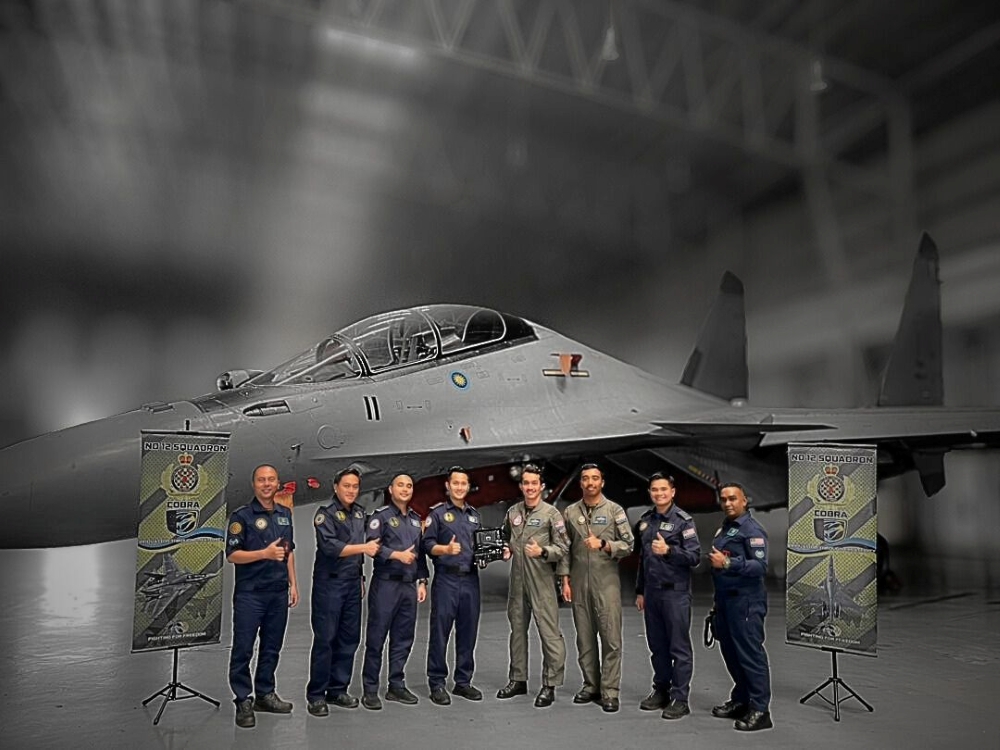
The Royal Malaysian Air Force (RMAF) has developed and deployed an indigenous air intake screen modification for its SU-30 MKM fleet, that is aimed at reducing the risk of foreign object damage (FOD) during the aircraft’s take-off and landing phases.
The modification designated the air intake screen modification (AIS-MOD), was showcased at the recently concluded Defence Services Asia (DSA) exhibition in Kaula Lumpur.
The RMAF’s air intake screen modification innovation project (AIS-MOD) is an engineered enhancement to the SU-30 MKM’s air intake protection system. The engineering effort towards reducing FOD damage for the two Saturn AL-31FP turbofan engines powering the SU-30 MKM was first revealed at the 2025 LIMA Airshow. Additional details were provided in January this year by the RMAF in a social media post.
The AIS-MOD has prevented at least six bird strike incidents since entering service in 2025. The air force estimates the cost savings in preventing engine damage and repair at MYR 150 million. The retrofit was undertaken by the RMAF in response to a known vulnerability associated with air intake design of the SU-30 MKM which is prone to bird strikes and FOD, an issue also encountered by other SU-30 operators, including the Indian Air Force (IAF).
The baseline engine air intake screen on the SU-30 MKM is designed to operate only when the aircraft is on the ground to protect the AL-31FP turbofans from FOD. The screen retracts immediately on take-off, typically when the aircraft is at one feet above the ground. As a result, does not prevent bird and debris ingress at any altitude greater than 1 feet.
With the AIS-MOD configuration, the modified air intake screen now remains deployed up to significantly higher altitudes between 500-700 feet after take-off, preventing low-altitude bird ingress and debris ingestion in the air intake. The screen retracts at an altitude of 656 feet.
The AIS-MOD was designed and manufactured at the RMAF's Aerospace Engineering Service Centre (Pusat Penyelidikan Pertahanan Nasional, PUSPEKA). Three AIS-MOD prototypes were developed along with a final air intake screen which was installed on an SU-30 MKM belonging to No. 12 Squadron.
The test effort involved simulation testing, stress testing, displacement testing, deformation testing and electrical load analysis. G load tests were also undertaken to test the structural integrity of the AIS-MOD components. First delivered in 2007, the RMAF has a fleet of 18 SU-30 MKMs, which are slated to remain operational till 2035.



Privacy Policy

Powered by © Mobilbyte s.a.s. Information Technology