

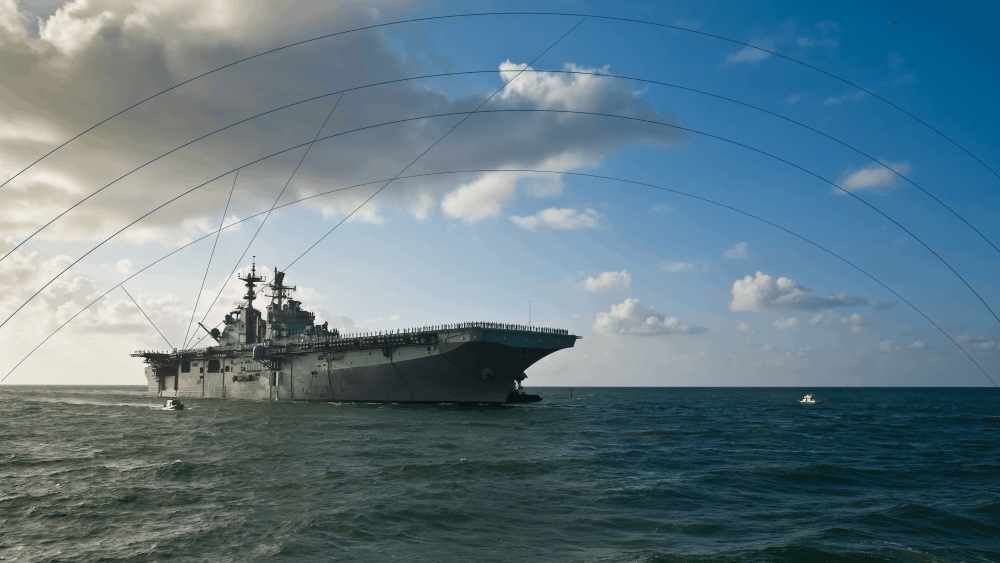
The development of major naval technologies, such as warships and submarines, tends to dominate the news cycle. However, niche technologies are just as important for helping the fleet operate effectively. FW MAG spoke with several defense companies prior to and during the recent Sea Air Space (SAS) summit outside Washington, DC, about new systems and contracts for high-tech technology to support the US Navy.
Kymeta Government and Defense has won a three-year contract with the US Navy’s Office for Naval Research (ONR) to further develop its multi-band, multi-beam antenna architecture. According to the company, this technology aligns with ONR’s Communications and Networking Program within the C5ISRT Department (ONR 31).
The company explained to FW MAG that the system encompasses simultaneous dual-band (Ku/Ka) full-duplex beams from a single antenna aperture in the KuKa 8 Series terminal, enabling true multi-band connectivity. “The prototype is expected to be released to key customers for testing and evaluation from mid-2026, with commercial availability targeted for mid-2027,” a company spokesperson told FW MAG exclusively.
Kymeta also announced a partnership with Bascom Hunter to develop a prototype single-antenna, multi-band, multi-orbit SATCOM terminal. The prototype is scheduled to be ready for testing and evaluation in Q2 2026, as part of Kymeta’s existing relationship with the US Navy. (FW MAG recently wrote about KYMETA’S NEW KESTREL U5 satellite communications terminal, which was unveiled at the recent Satellite 2026 expo).
Meanwhile, the Texas-based company Terradepth announced at Sea Air Space that its Absolute Ocean operating system has been “formally moved” into the Rapid Capabilities Cell (RCC) Hopper at Naval Information Warfare Center (NIWC) Atlantic. The company’s AO Onboard is an on-vessel, browser-accessible computing capability for a ship’s crew to monitor and understand changes to the seabed.
FW MAG spoke with Terradepth CEO Joe Wolfel at Sea Air Space about the company’s OCEAN OPERATING SYSTEM. To summarize, the system collects, processes, and integrates ocean data, then presents it to the operator in an easy-to-understand, browsable format. The system has defense capabilities, Wolfel explained. For example, navies can compare images of the seabed to look for marks from trawlers which were engaged in illegal, unreported, or unregulated fishing. Moreover, as navies around the globe seek to expand the use of uncrewed underwater vehicles (UUVs), mapping the uncharted seabed is critical to understanding what lies beneath. Terradepth’s Ocean Operating System helps collect data from UUVs and present it to operators aboard a warship, for example. “We are building an ecosystem to help the Navy make better decisions,” Wolfel explained.
Wolfel confirmed that the company is interested not only in software but also in hardware. Terradepth is developing its own large UUV (LUUV) to chart the global oceans, tailored to a customer's requirements. A prototype is expected to be delivered within the next 12 to 18 months, Wolfel added.
Another company present at SAS was ThayerMahan, which has a broad portfolio of systems for maritime security and undersea surveillance. At the recently concluded expo, the company spoke with FW Mag about Outpost, a towed acoustic monitoring system that can operate independently for up to 90 days; SeaPicket, an autonomous, energy-harvesting platform designed for shoreline surveillance and exclusion zone monitoring; and SeaGuard, a modular, scalable non-kinetic UUV defeat system.
The company declined to discuss current clients and upcoming deliveries but confirmed that “multiple allied NATO nations” operate ThayerMahan’s solutions. Moreover, the company spokesperson explained that Outpost is easy to integrate, and confirmed the system has been integrated into the Australian Navy’s fleet of Bluebottle USVs.



Privacy Policy

Powered by © Mobilbyte s.a.s. Information Technology