



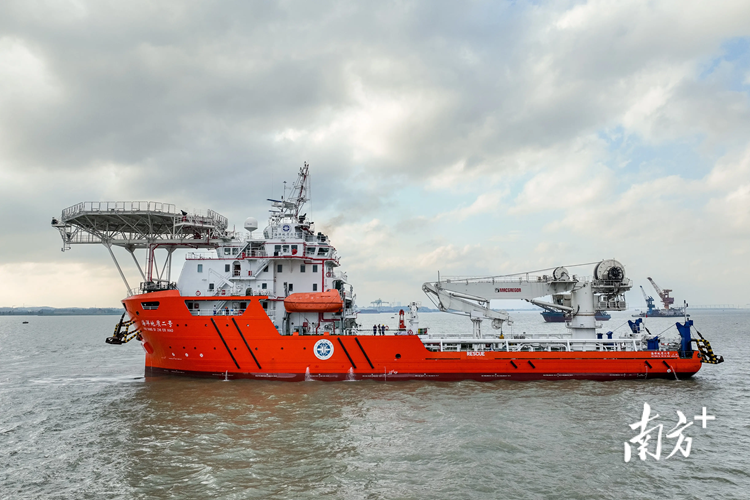
China has announced the successful testing of a new tool capable of cutting underwater cables at a depth of 3,500 m.
The Ministry of Natural Resources has reported that in mid-April 2026 the underwater research vessel HAIYANG DIZHI-2 (literally "Marine Geology-2", an 85 m vessel displacing 7,200 t at full load) completed a "scientific mission" that included the testing of an innovative electro-hydraulic actuator capable of cutting the large "armoured" cables used for data communications, at a depth of 3,500 m - a depth never reached before. Approximately one year ago a technical publication had revealed that development of this toolkit was underway; that development has now evidently been completed and a real-conditions test has been carried out.
Officially, the system is intended for use in the repair and construction of underwater infrastructure. What has caused a stir, however, is the announcement of a capability - for now unique in the world - to damage Critical Underwater Infrastructures (CUI) at any depth, given that this is a working tool with obvious applications in the military and security domain as well.
The system integrates pumps, valves, and controls into a single unit, eliminating the need for external hydraulic supply lines. The vehicle also incorporates 2 hydraulic gripping jaws to clamp onto the cable, preventing the vehicle itself from beginning to rotate as a reaction - with the consequences that are easily imagined. The power output exceeds 1 kW, but the truly remarkable aspect is above all the ability to operate at those depths, with all fixed and moving components withstanding pressures of 35 MPa.
From a military and security standpoint, it should be noted that on several occasions damage and breaks have occurred that were officially attributed to "accidents" caused by Russian or Chinese merchant vessels. Until now such incidents had been limited to shallow stretches of sea, but a potential act of sabotage could now reach abyssal depths as well, where restoration operations would be considerably more complex.
Unfortunately, International Law offers little help: if the damage is caused in international waters - that is, beyond 12 nautical miles from the coast - jurisdiction belongs exclusively to the flag state of the vessel, or to the state of nationality of the commanding officer, leaving no authority whatsoever to coastal states or to the owners of the telecommunications infrastructure.




Privacy Policy

Powered by © Mobilbyte s.a.s. Information Technology