



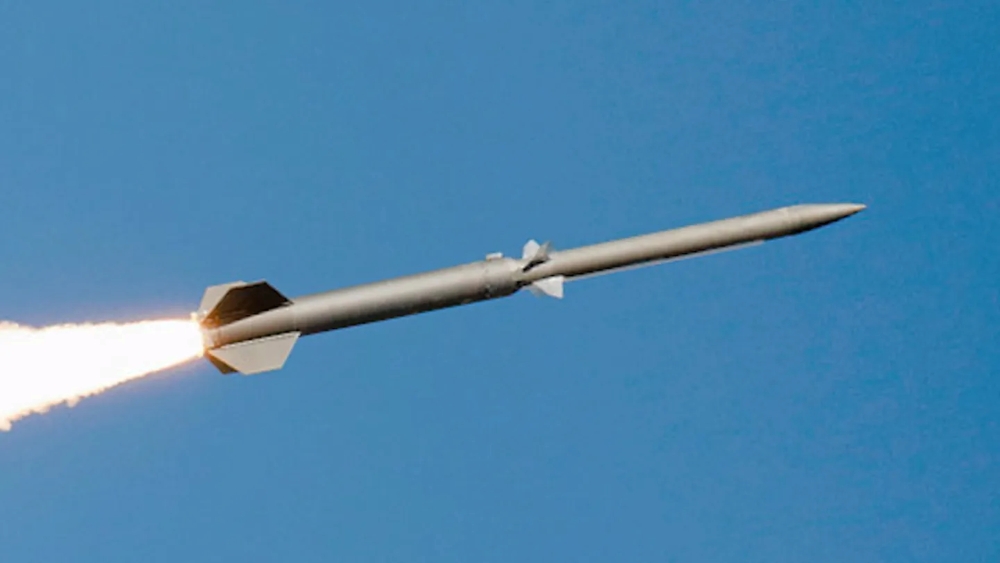
On April 24, Castelion was awarded a 104.9 million USD contract modification that “exercises an option in support of Small Business Innovation Research Phase III effort, topic AF231-D026, entitled “Low Cost Highly Manufacturable Long Range Strike Weapon Production”, to provide final early operational capability requirements, provide test and integration configurations of the Blackbeard Hypersonic Weapon, and complete live fire test events in the Indo-Pacific Command area of responsibility”.
As Castelion confirmed soon after publication of the contract award notice by the Department of War, this award covers completion of BLACKBEARD integration onto the F/A-18 and transition the system to an Early Operational Capability in 2027. The new award covers system safety and certification testing, flight testing, and other integration activities related to carrier-based operations.
The new award follows a $49.9 million U.S. Navy contract awarded back in February 2026 to take BLACKBEARD from prototype to production phase.
While the US Navy budget documents for FY 2027 as published do not identify the vendor responsible for the program, it is understood Castelion’s BLACKBEARD is the weapon solution for the Multi-mission Affordable Capacity Effector (MACE) program.
MACE was first unveiled in February 2024 when a Request for Information was published calling for an air-launched weapon with “adequate” stand-off ranges. It had to complement the more capable, larger and much more expensive AGM-158C LRASM (Long Range Anti-Ship Missile). At the time, the RFI did not openly require hypersonic speeds, instead naming as requirements the compatibility with carriage on F/A-18E/F as threshold platform and dimensions compatible with subsequent “internal carriage of 4 All Up Rounds (AURs)” in the weapon bays of F-35C and F-35A. The warhead requested was small (75 lbs); MACE was required to have terminal guidance capable of detecting moving targets, a unit cost of under $300,000 per All Up Round (AUR) at a minimum production capacity of 500 AURs per year, with Early Operational Capability by Fiscal Year 2027.
In the Fiscal Year 2027 budget, $156 million of Mandatory funding are requested for the procurement of 353 lot 1 MACE AURs and associated production engineering, logistics, and program management support. It is noted in the text that “in response to MACE requirements, the NAVAIR Rapid Capability Cell (NRCC) is utilizing Rapid Capability Office (RCO) authorities to accelerate the integration, test, and certification of the Hypersonic Weapon solution via Small Business Innovative Research (SBIR) competition for a low-cost air-launched hypersonic missile onto F/A-18E/F carrier-based aircraft”.
While the vendor, as mentioned earlier, is not named, the connection is obvious.
Plans for MACE, again as of FY 2027 budget request, are ambitious, with 4510 weapons planned over the 5-year planning period: 353 in 2027 (all with Mandatory funding), 691 in 2028, 976 in 2029, 1115 in 2030 and 1375 in 2031.
It should also be noted that the US Army is funding development of the Ground Launch variant of BLACKBEARD for use from the GMLRS-family-of-munition launchers, in particular M142 HIMARS and the future Common Autonomous Multi-Domain Launcher (CAML) platforms.
In the meanwhile, the US Navy has also started looking for an accelerated path towards fielding hypersonic weapons compatible with existing MK41 VLS vertical launchers on ships. It has launched an Innovative Naval Prototype initiative known as Flight Advancement of Structures for Hypersonics (FLASH), aiming to prove a “surface-launched, tactical range, hypersonic strike capability” compatible with 41 VLS cells and VIRGINIA-class vertical cells (in Multiple All-up round Canisters, the 7-cell modules that fit in the large diameter tubes).
The aim is to field Boost-glide weapons in the existing launchers, potentially including MK70 containerized launchers, avoiding the need for extensive refits. Obviously, the solutions for FLASH will need to be already at a high level of technical maturity and BLACKBEARD could again find itself in a good position.




Privacy Policy

Powered by © Mobilbyte s.a.s. Information Technology