



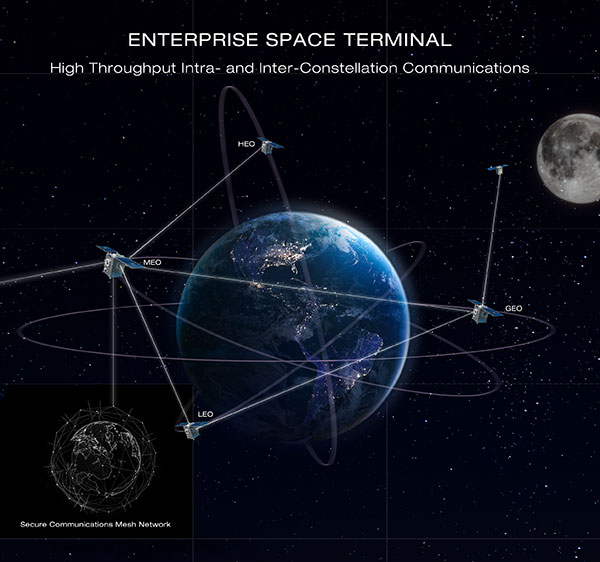
General Atomics Electromagnetic Systems (GA-EMS) has announced that it has been selected to progress into Phase 3 of the U.S. Space Force’s Enterprise Space Terminal (EST) program. The selection follows a successful independent verification campaign which saw Government confirm the Company’s Optical Communications Terminal’s performances at MIT Lincoln Laboratory’s Optical Terminal Verification Testbed (OTVT).
The EST program aims to enable on-orbit crosslink compatibility among future space systems via the use of a standardized enterprise waveform implemented in a long-range space optical communications terminal that is low size, weight, power, and cost (SWaP-C).
The use of EST optical links is seen as key in wider plans for the space data network known as MILNET, which intends to build a space mesh network for resiliency and information path diversity.
EST leverages prior investments by both the Department of War and commercial developers to operationalize a new enterprise waveform designed to communicate in the Beyond Low Earth Orbit (bLEO) regimes.
In May 2025, the US Space Force had awarded Phase 2 contracts to 3 different firms: GA-EMS, CACI and ViaSat to continue the development of the respective space laser communication terminal prototypes, building on Phase 1 work. The contracts were awarded through the Space Enterprise Consortium (SpEC) Other Transaction Authority (OTA).
GA-EMS is Prime Contractor, leading a team that comprises L3Harris for the modem subsystem and Advanced Space to provide performance modelling.
The success in Phase 2 trials led to the new award, which will see the prototype terminal integrated and tested in flight. The standardized Optical Communication Terminal to emerge from EST is meant to “enable spacecraft from multiple programs and vendors to exchange data directly using a common enterprise waveform”. By enabling high-capacity laser crosslinks beyond low Earth orbit, the architecture reduces reliance on ground relay stations and accelerates the delivery of time-critical information for joint forces and national security missions.
Follow us on Telegram, Facebook and X.



Privacy Policy

Powered by © Mobilbyte s.a.s. Information Technology