



Europe has responded to Washington’s pullback by moving quickly to take control of its own strategic destiny, pairing a push for 'strategic autonomy' with a rapid embrace of burden shifting (taking on previously US-led operational risks). This is not an ideological choice, but a forced adjustment under pressure. Strategic autonomy, long debated in Brussels as a distant goal, has suddenly become an operational necessity.
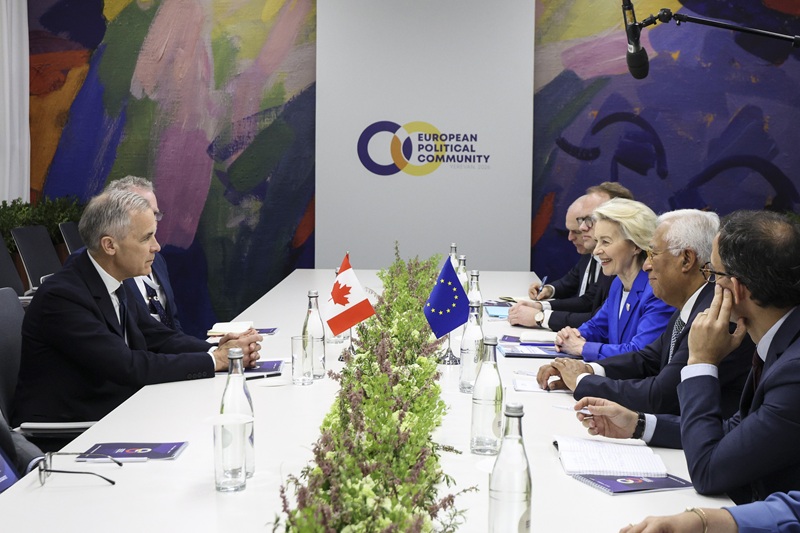
In Yerevan, European leaders are gathering for the European Political Community (EPC) summit, widely described by diplomats as a ‘NATO without Washington.’ In a historic first, EU and NATO members sit alongside Canada amid escalating tensions with Iran and growing uncertainty over US commitments.
This comes days after US President Donald Trump’s abrupt decision to withdraw 5,000 troops from Germany, coupled with threats to reassess deployments elsewhere in Europe. What had been a debate for coordination has turned into immediate crisis management.
Now, the European response is unfolding along two parallel lines: greater autonomy in defence and security, but also partnerships and procurement of critical resources, and accelerated Burden Shifting (the transition where Europe starts taking on the operational responsibility and risks of missions previously led by the US). In other words, Europe is stepping up not only to defend itself, but to keep the United States engaged, as a forum typically focused on coordination turns into crisis management.
As British Prime Minister Keir Starmer put it: “It has to be Europe now that leads the way.” He acknowledged that alliances are under unprecedented tension, noting that while tactical coordination - from Ukraine to the Strait of Hormuz - has shown that “Coalitions of the Willing” can act quickly, the deeper issue is structural: Europe has fallen behind and must strengthen its role across defence, trade, and energy, as part of a stronger European element in NATO.
French President Emmanuel Macron warned that Europe is “experiencing the cost of our overdependencies vis-à-vis the American umbrella,” acknowledging “a sort of a doubt” about US reliability. He has broadened the concept of autonomy beyond defence to include semiconductors, space, and supply chains, arguing that 100% dependency is the end of sovereignty. Meanwhile, EU Commission President Ursula von der Leyen echoed the same concern, insisting that standing up for ourselves is “long overdue.”
According to Italian Prime Minister Giorgia Meloni, new crises require new approaches. She framed the challenge within a wider ‘policrisis’: “all these crises are linked… and feed one another.” In her words, Europe must move “from our capacity to react to our capacity to anticipate.”
“Loud and clear” message from Trump
Meanwhile, NATO leadership is direct. NATO Secretary General Mark Rutte stressed that allies have “gotten the message loud and clear,” a message that if Europe wants to keep the US umbrella, it must take on more costs and responsibilities to ensure that this happens.
Rutte detailed how countries including Portugal, Romania, Greece, and Italy are implementing bilateral basing agreements - providing the logistical backbone requested by Washington. He added that allies are “pre-positioning essential logistical support… minehunters, sweepers… close to theatres so that, for the next phase, they are ready.”
This operational shift is being realized through a "variable geometry" approach. By relying on flexible Coalitions of the Willing, Europe is replacing and retaining the United States at the same time, bypassing traditional bureaucratic deadlocks to strengthen its own pillar while conceding enough operational space to keep Washington invested.
Beyond Nostalgia
Finally, the presence of Canadian Prime Minister Mark Carney - the first non-European at an EPC summit - signals a shift toward diversification. Carney framed it clearly: “Nostalgia is not a strategy.” In a world of geopolitical "rupture," Canada positions itself as a "trusted partner" for critical minerals and energy, helping Europe reduce its dependency on volatile axes.
Europe is not choosing between autonomy and alliance. It is building its own capabilities while simultaneously paying the price - through bases and logistical commitments - to hold together an increasingly conditional Atlantic order.



Privacy Policy

Powered by © Mobilbyte s.a.s. Information Technology