





Keep autonomy technology simple and focus on logistics: that was the overall message at the Autonomy/ Collaborative Autonomy/ Autonomy Afloat panel at the recently concluded Modern Day Marine (MDM) expo in Washington, DC. The speaker, US Marine Colonel Kenneth Jones, Division Director for Science & Technology at the Marine Corps Warfighting Laboratory (MCWL), specifically referred to uncrewed ground vehicles (UGVs) and how industry should start by focusing on logistics and then evolve the technology.
Jones explained that there are "no shortcuts" to achieving full autonomy. Moreover, he explained that the "holy grail" of uncrewed technology is the ability to control "multiple systems across multiple domains," as industry is challenged by bandwidth constraints, and by "having several APIs [application programming interfaces] with different software applications."
Today, "logistics is the goal," Colonel Jones stated. His ambitions for this first stage of autonomy UGV technology are to "put logistics on a flat bed, [aboard] a wheeled vehicle, and move the vehicle from Point A to Point B." He also added that another short-term goal is the ability for one operator to control two or three UGVs.
A reliable UGV can be very helpful for transporting ammo, food and water, medical supplies and other equipment, significantly lightening the loads that dismounted marines or tactical vehicles need to carry. A logistics UGV can also be used for casualty evacuation; troops can continue fighting while the UGV transports the casualty on a flatbed.
During his presentation at MDM, Jones compared uncrewed technology and the quest for autonomy to the development of a manned aircraft by the Wright Brothers and the development of smartphones by Steve Jobs. "The original iPhone had no social media or an app store, it had a calendar, a phone, text messages, and a browser," the Marine Colonel said. Jobs focused on the "basics and the simplicity of the device," which then matured.
In the same way, industry should focus on making an effective UGV today that can be tested and fielded for logistics operations, and then experiment with adding different payloads tomorrow. "To get to autonomous systems employed by the US Marines, we have to keep things simple," Jones said, adding, "I want to give Marines something familiar at first. Afterwards, we can work on autonomy, like putting cameras on the vehicle, we can work on integration like [adding a] C-UAS or a machine gun."
At Modern Day Marine, a couple of companies showcased prototypes of new UGVs.
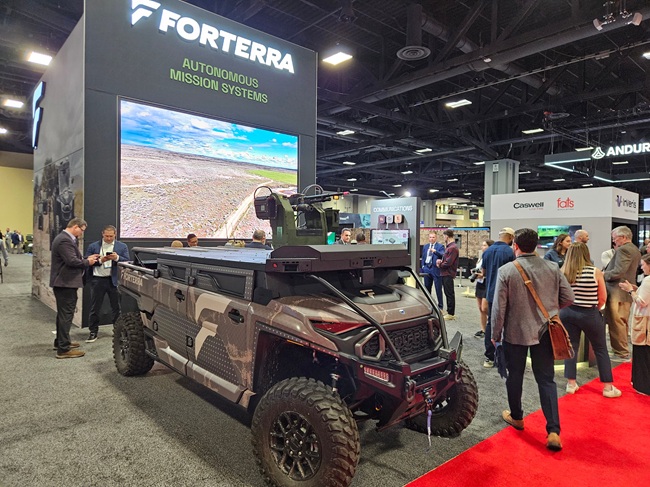
Forterra displayed a UGV, dubbed MESA. Robert Lau, a Senior Director in Mission Operations at Forterra, spoke with FW Mag; he described the system as "a workhorse." The platform can carry up to 907 kg (2,000 pounds) of payload. At MDM, the prototype featured a Kongsberg RS2 remote weapons system as an example of a payload for counter-UAS missions, along with a goTenna EdgeRelay payload to demonstrate mesh networking capabilities.
However, Lau explained that the UGV can also be used to transport cargo and conduct casualty evacuation across various terrains, including off-road missions, as it is built on the Polaris Ranger XD 1500 chassis. The autonomous mission system is powered by Forterra's AutoDrive autonomy stack, which delivers advanced perception, navigation & execution, even in denied environments, FW Mag was told. MESA also integrates the Vektor Communications suite, which enables "resilient connectivity in contested conditions."
AM General displayed a prototype UGV based on the 13-series chassis currently on the HUMVEE platform, developed in partnership with Carnegie Robotics and Textron Systems. The autonomous UGV has a payload capacity of 2,721 kg (6,000 pounds). The system displayed in MDM included the Moog Reconfigurable Integrated-Weapons Platform (RIWP) as a payload, but the UGV could also carry other C-UAS capabilities and systems, including for missions such as intelligence, surveillance, reconnaissance, and medical evacuations.
Company executive Shatiel Edwards told FW Mag that the US Army has requested a prototype, which is on track to be delivered by January 2027. Edwards explained that the UGV can operate on various challenging terrains, such as wooded areas.
The UGV market is becoming increasingly congested. Integration of new payloads is a constant goal for industries, as new capabilities can increase the range of what a UGV can do: combat, C-UAS, air defense, electronic warfare, perimeter defense, and ISR, among other missions. Hence, modularity and open architecture are key. However, at Modern Day Marine, the US Marine Corps sent a clear message back: keep things simple. A basic UGV with a flat bed and a high cargo capacity, which can also be utilized for casualty evacuation, will be immensely helpful to their missions.



Privacy Policy

Powered by © Mobilbyte s.a.s. Information Technology