



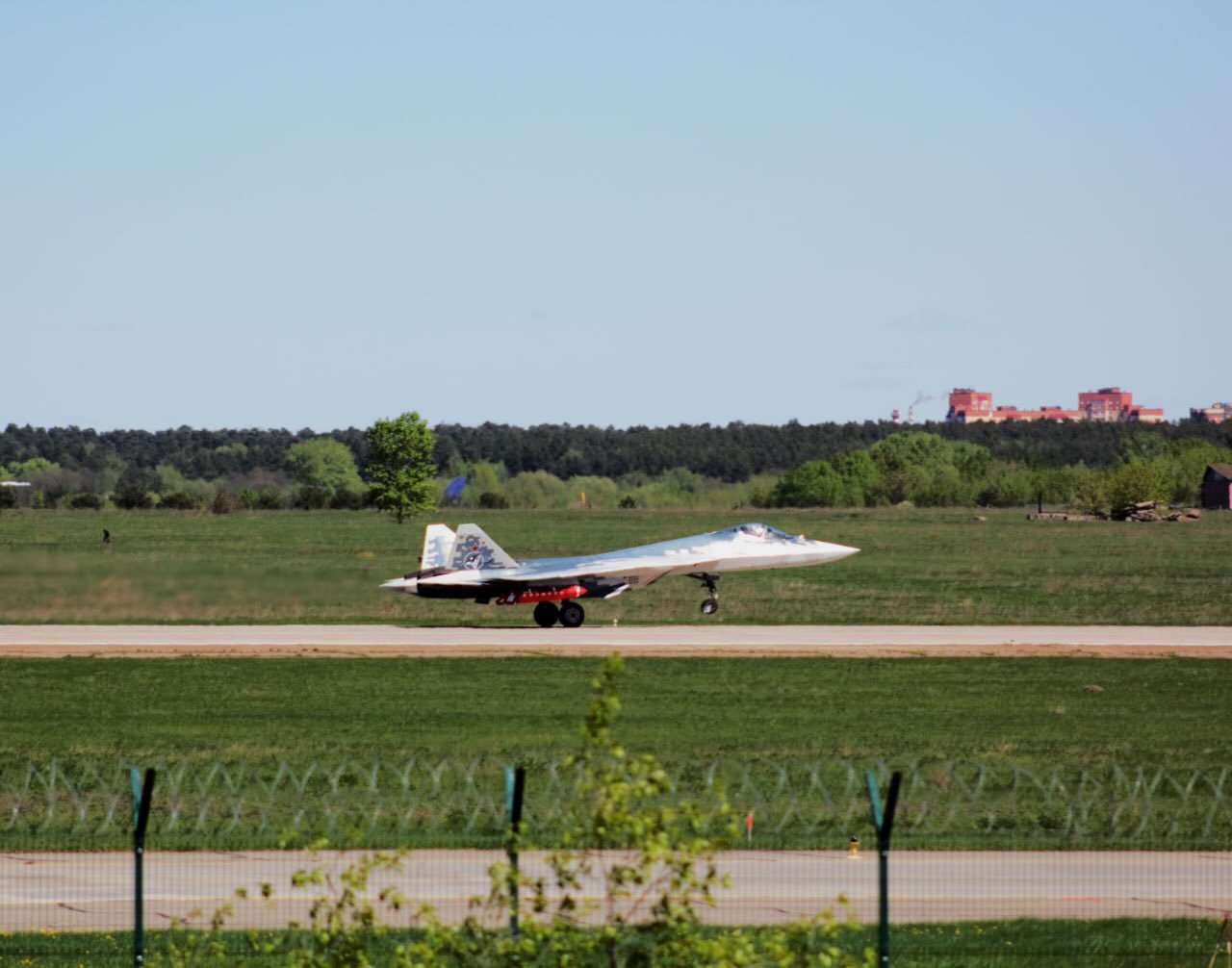
On 27 April, the Main Directorate of Intelligence of Ukraine's Ministry of Defence disclosed technical details on the new Russian air-launched cruise missile S-71K KOVYOR which, according to Kyiv, has been employed in combat since late 2025. The continued development of weapons in this class highlights how Russia is seeking alternatives to its more established and costly air-launched cruise missiles, whose current production is struggling to meet wartime demand.
According to the Ukrainians, the new missile — developed by the United Aircraft Corporation (UAC) in one of the company's first missile programmes — was conceived specifically for the Su-57 FELON (on which it has been tested since 2024) and, in particular, to provide it with a stand-off strike capability as part of a broader Russian effort to adapt advanced combat aircraft — and unmanned platforms — into long-range missile carriers, with the aim of expanding launch options and reducing exposure to ground-to-air threats. Rather than treating the Su-57 simply as an air-superiority fighter, designed for low observability, sensor fusion and BVR air-to-air combat, the KOVYOR missile would point to a Russian commitment to transform the FELON into a stand-off strike platform.
According to Ukrainian estimates, the munition's range is around 300 km, which could allow it to be launched from areas outside several short- and medium-range air-defence engagement zones, depending on altitude, launch geometry, radar coverage and the disposition of Ukrainian surface-to-air missile systems. The missile's range is made possible by 3 separate internal fuel tanks — a main tank and 2 lateral tanks — a configuration that places the S-71K closer to a classic air-launched cruise missile than to a glide bomb, as it can continue its flight after release and potentially approach a target from a trajectory different from the launch axis of the carrier aircraft.
The missile combines an R500 turbojet engine, a high-explosive fragmentation warhead based on the 250 kg OFAB-250-270 bomb integrated into the load-bearing structure of the missile's forward section, a relatively simple inertial navigation system — choices that may reflect an effort to reduce costs and support large-scale production — and electronic components of foreign origin.
The choice of the OFAB-250-270 indicates that the weapon is not built around a newly designed specialised warhead, but rather around the adaptation of an existing aerial bomb integrated into the architecture of a cruise missile. From an operational standpoint, such a payload would be relevant for strikes against fixed or pre-planned targets, such as infrastructure, logistics nodes, military installations, ammunition depots, command posts or airfield objectives. From an aeronautical perspective, integrating a conventional bomb into the forward structure also imposes design constraints related to the centre of gravity, longitudinal stability, behaviour during the separation phase and flight management/control after release from the aircraft.
Data on the missile body also show a design focused on weight control and structural reinforcement, rather than on low observability. One of the distinctive features of the S-71K is that it does not use radar-absorbent coatings, probably to contain costs. The airframe is made of a multi-layer reinforced fibreglass composite, while internal components are in aluminium alloys. Structurally, the missile has a shape with a trapezoidal cross-section, an angular nose, non-folding swept wings (which would prevent its carriage inside internal weapons bays) and an inverted V-tail. The engine air intake is mounted on top and integrated into a pentagonal-shaped intake. This configuration may help reduce mass, simplify the shape and provide sufficient rigidity for carriage, separation and powered flight. However, as noted, available data do not confirm that the S-71K is in itself a low-signature missile, also because for the Su-57 the most immediate operational value lies not necessarily in the missile's stealth capability, but in the ability to launch a weapon from a greater stand-off distance.
As mentioned, the S-71K is powered by a compact R500 turbojet engine, also produced by UAC, which enables it to reach a maximum speed of 700/750 km/h and an altitude of 8,200 metres. Guidance and control appear relatively simple, consisting of an inertial navigation system based on basic sensors (atmospheric pressure measurement, accelerometer and gyroscope) and a power supply system. However, the presence of satellite navigation devices cannot be ruled out. This points to a weapon optimised primarily for coordinate-based strikes against fixed or predetermined targets, rather than against moving targets requiring a seeker, trajectory correction via data link or autonomous terminal target recognition.
As for electronic components, most of the missile's electronics are of foreign origin, including components manufactured in China, Germany, Japan, Ireland, the United States, Switzerland and Taiwan.
While conceived as a weapon for the Su-57, there is no reason why the S-71K could not also be carried by other Russian tactical aircraft, in view of large-scale employment, should significant production of the weapon actually be achieved.
The possible future integration of the S-71K on the S-70 OKHOTNIK UCAV is one of the most significant elements that would take the weapon beyond a conventional fighter-launched profile and toward a distributed strike architecture. If such integration were realised, the OKHOTNIK could serve as an advanced missile carrier, allowing Russia to bring a launch platform closer within well-defended airspace without exposing crews. In a broader Su-57/S-70 collaborative concept, the fighter could act as a sensor, coordinator or mission control node, while the UCAV would be employed in areas with higher risk profiles, releasing the missile from a more advantageous trajectory. This would reflect a shift in Russian aerial tactics which, especially in Ukraine, have almost always relied on stand-off strikes through the use of glide bombs, long-range missiles, expendable UAS and saturation attacks to reduce the exposure of manned aircraft to the front line.
Although it remains to be seen exactly how the S-71K will be used in an operational context, its development underscores Russia's own need for cheaper air-launched missiles that can be produced in large quantities for its combat aircraft fleet.




Privacy Policy

Powered by © Mobilbyte s.a.s. Information Technology