


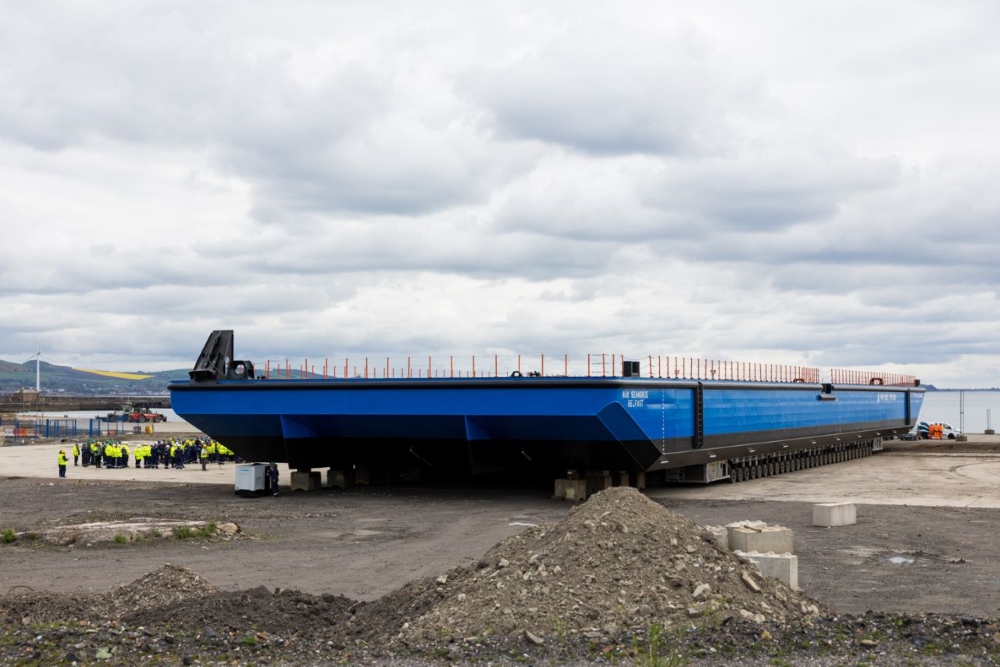
Navantia UK has christened a newly built transport barge, SEAHORSE, at the Methil facility in Fife, Scotland.
The barge is 85 meters long and 25 wide, weighing approximately 1,400 tonnes and its build began months ago. The 8 million pounds project is part of the wider program for the delivery of 3 new Fleet Solid Support vessels for the Royal Navy. The barge will be used to deliver ship blocks between the shipyards of Appledore and Belfast, both controlled by Navantia UK.
Appledore is building the Bow super-block of all 3 FSS vessels. The block will be assembled directly atop SEAHORSE and then delivered to Belfast where final assembly of the ships will be carried out.
The Methil shipyard in Scotland has seen its headcount grow from 180 to 260, and Navantia UK is on a recruitment drive to fill a further 110 roles. Methil is a site particularly focused on projects connected with offshore energy, but the building of the SEAHORSE barge has been an important part of its regeneration following Navantia’s acquisition of all 4 Harland & Wolff shipyards in January 2025. Navantia UK has invested £26.7 million in upgrading Methil and hopes to secure further defence work in the near future. In particular, all eyes are set – already from before Navantia’s acquisition – on project EUSTON, under which the Royal Navy intends to procure “at least” 2 floating docks to be installed in Faslane for the maintenance of nuclear submarines. Should this important project finally get the go ahead in the Defence Investment Plan to come, Navantia UK hopes that the floating docks will be built at Methil.
Work also continues in the Belfast shipyard, where Navantia says more than £98.5 million have now been invested, “significantly exceeding the £77 million originally committed under pre-acquisition recapitalisation plans for the FSS programme”. Across Belfast and Appledore, Navantia UK says it has now committed a combined £114.4 million, with planned investment across all four UK shipyards (Appledore, Belfast, Methil, Arnish) reaching £157 million.
In Belfast, machinery is being installed into the upgraded fabrication hall, in particular the new mechanised panel lines, robotic plasma cutting systems and automated quality control processes. The new systems should be fully operational in July, making “Harland & Wolff one of the most advanced shipyards in Europe, in line with Navantia’s Shipyard 5.0 concept, which uses robotics and AI to deliver the most modern shipbuilding possible”.
The work for a new automated panel line had begun in 2024, already before Navantia stepped in to acquire the shipyards. During 2024 the first steel frames for a new 5,000 square metres facility for automated flat steel panel manufacture had been erected but then H&W entered administration and the civil works associated with this investment were temporarily paused. Work eventually resumed in March 2025. Robotic welding portals from Finland’s PEMA have been acquired for the new facility: they passed factory acceptance tests in September 2025 in Finland and are now being installed in situ.
The iconic Samson and Goliath gantry cranes that tower over the giant dock will continue to play a vital role in operations, lifting blocks of the future FSS vessels. The revival of the Belfast site will be achieved through technical knowledge transfer from Navantia’s Spanish operations.
The FSS vessels will be built in 3 mega-blocks: the bow block will be built at Appledore, the middle one directly at Belfast, with the stern area built by Navantia in Cadiz, Spain, with final assembly in Belfast. At 39,000 tonnes, 216 meters of length and 34.5 in beam, the FSS vessels will be the largest in Royal Navy service after the Queen Elizabeth-class aircraft carriers (the only ship type that might come close is the Multi Role Strike Ship currently in concept phase, destined to replace the amphibious assault shipping).
First steel for the first vessel, the future RFA RESURGENT, was cut on 3 December 2025 in Appledore, followed by start of steel work in Puerto Real, Cadiz, in Spain, on 23 January 2026. As of April, Appledore was assembling 9 of the units that will compose the Bow block. The names for the other 2 vessels have not yet been officially announced.




Privacy Policy

Powered by © Mobilbyte s.a.s. Information Technology