



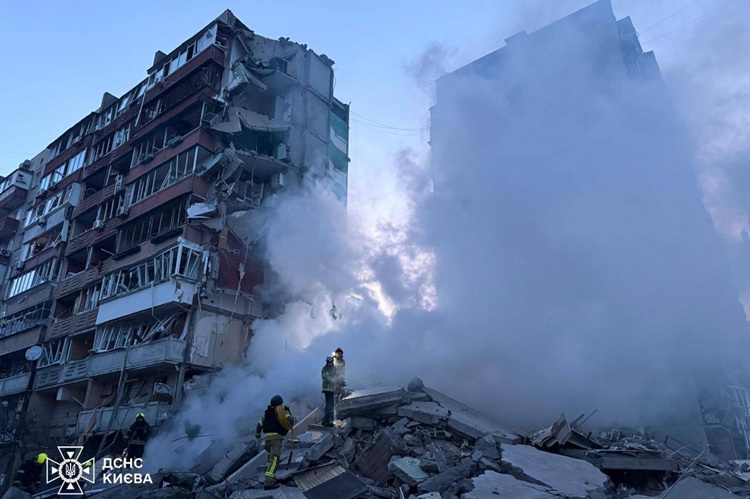
Yesterday, Wednesday 13 May, Russia carried out one of the most massive aerial attacks since the beginning of the full-scale invasion, with a total of roughly 890 drones launched within a single day. The assault then continued through the night, bringing the total to over 1,300 drones in 24 hours.
To be accurate, the waves began on the night between 12 and 13 May, when Russia launched at least 139 drones (SHAHED/GERBERA, ITALMAS and PARODIYA decoy drones) from different directions: Kursk, Bryansk, Millerovo, Primorsko-Akhtarsk and Chauda (occupied Crimea). Ukrainian air defences shot down or suppressed through electronic warfare 111 of these (around 80%), while 20 drones hit 13 targets and further debris from intercepted drones fell in 4 additional locations.
During daylight hours on 13 May, between 8:00 and 18:30, Russia launched at least another 753 drones, bringing the day's total to over 892 units according to the General Staff of the Ukrainian Armed Forces. Air defences, again according to Ukrainian AF figures, neutralised or suppressed 710 targets. Overall, 36 drones reached their objectives, with debris from intercepted drones reported in another 26 locations.
The daytime attack developed in at least 8 successive waves, some of which also overflew Belarusian territory, and included a few examples of GERAN-3 jet-powered drones as well as swarms operating in "mesh network" mode, albeit in limited numbers. Ukrainian sources have confirmed the presence of missiles in the attack, but definitive data on types and quantities has yet to be released. The actual missile strike, as Ukrainian authorities themselves expected, then took place on the night between yesterday and today, and is analysed in a separate article.
The Office of the President confirmed damage to 23 railway facilities across Ukraine, involving 3 locomotives, 7 suburban passenger carriages, 8 freight cars, 5 traction substations, 5 railway depots and 2 bridges. NAFTOGAZ also confirmed attacks on gas infrastructure across several Oblasts, including a gas production site in the Kharkiv Oblast and an industrial plant in the Zhytomyr Oblast.
Zakarpattia, the region bordering Slovakia, Hungary, Romania and Poland (and therefore NATO), suffered the most intense targeting ever recorded since the beginning of the full-scale invasion. Among the objectives in this region were at least one transformer at a railway station and industrial facilities in the Svaliava and Uzhhorod areas.
One drone came dangerously close to the Slovak border before crashing onto Ukrainian territory near Perechyn. Slovakia closed its crossings with Ukraine for several hours, leaving queues of civilians trapped in the neutral border zones. Hungary, for its part, summoned the Russian Ambassador, with newly-elected Prime Minister Peter Magyar describing the attack as the most serious ever launched against a region with a Hungarian minority.
Beyond the numbers — which speak for themselves as to the scale of these waves — the entire episode fits within a pattern of progressive escalation against the western regions of Ukraine, and therefore those closest to NATO's eastern flank. In recent times, Russia has begun striking Zakarpattia with increasing frequency using single drones or small waves, systematically testing the reactions of neighbouring countries.
As long as Russia retains the capability and the will to saturate Ukrainian air defences with waves of this magnitude, the security of neighbouring countries cannot be taken for granted — particularly if subsequent attack waves confirm the growing Russian focus on Zakarpattia.




Privacy Policy

Powered by © Mobilbyte s.a.s. Information Technology