



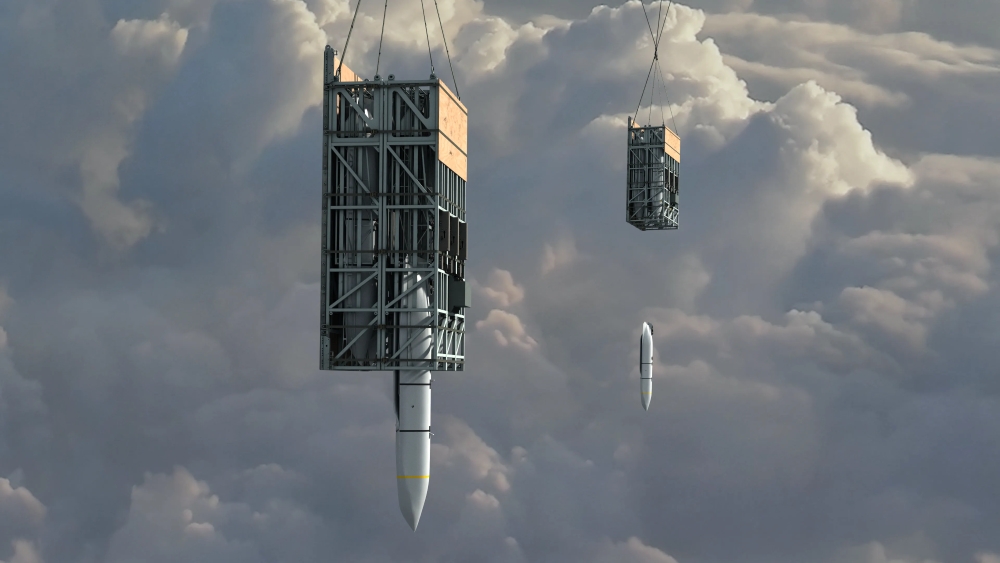
The USAF’s Air Force Life Cycle Management Center announced at the end of April the establishment of a new program of record, named DRAGON CART, to bring into active service the capability to launch great numbers of cruise missiles using pallets to be dropped by C-130 and C-17 cargo aircraft.
DRAGON CART builds on the earlier experiment known as RAPID DRAGON, launched originally in 2019. It will employ a container frame holding cruise missiles, placed on a standard airdrop platform. The container is released as if for normal airdrops but once it deploys its parachute it proceeds to release the cruise missiles, which fall out, ignite their engines, pull up, and proceed toward their target.
The precedent RAPID DRAGON program performed several tests on the C-130 and C-17, including a live-fire event at Eglin AFB, Florida, in December 2021. It demonstrated a 6-missile container system for carriage on the C-130 and a 9-shot container for use in the larger cargo bay of the C-17s.
Using cargo aircraft to launch great numbers of cruise missiles eases pressures on the bomber and fighter fleets and, to a degree, on the air refueling fleet as well. The launch of missiles at stand off ranges from the cargo planes will contribute to saturation of adversary defences, helping to provide open access to strategic targets and depleting the opponent’s air defence munitions stockpile.
Prototype contracts for DRAGON CART are to be awarded before the month ends, with the goal of fielding already in 2027. One additional advantage of DRAGON CART is that government will own the data rights and technical solution, which will enable internal freedom to develop and upgrade the system over time.
Importantly, the main munitions to be used in DRAGON CART will also be new, innovative and low cost. The missiles will be procured as part of the Family of Affordable Mass Missile (FAMM), a project which anticipates the procurement of 29,910 missiles in the space of 7 years.
1,000 missiles have been funded in FY2026 with 355 million USD of Mandatory (Reconciliation) funding. Another 355 million (55 discretionary, 300 mandatory) are provided in the FY 2027 budget for the procurement of another 1,000 missiles. In 2028 the purchase plan calls for 5,300 missiles, becoming almost 6,000 in 2029 and climbing further to get to an annual buy of 7,990 in 2031.
The FAMM is a family of missiles that includes both “lugged” (FAMM-L) weapons for carriage on fighter jets (specifically the F-16, at least at first) and “palletized” (FAMM-P). Selected vendors for FAMM-L are Zone 5 Technologies, CoAspire and Anduril Industries and last month Zone 5’s solution, the AGM-188A RUSTY DAGGER, has been tested at Eglin on F-16s.
Anduril’s entry is the BARRACUDA, which already received a USAF designation (AGM-189A) while CoAspire’s entry is the Rapidly Adaptable Affordable Cruise Missile (RAACM).
Various missile formats are being pursued, with the Extended Range missile offering a 1,000 nautical miles range. In late April, the USAF published a new Request For Information calling for a new Palletized variant, the FAMM BAR for “Beyond Adversary Reach”, which is to have a range superior to 1,000 nautical miles and a speed of over 0.7 Mach. Vendors should be able to produce over 1,000 per year.
The first variant of FAMM missiles to become operational is expected to be the palletized baseline configuration, followed by the lugged variant. Both types will include weapon to weapon communications capability.
The budget documentation adds that “future increments will be defined based upon user demand and are likely to include a Beyond Line-of-Sight (BLOS), Extended Range (ER), Long-Range Kill Chain (LRKC) communications, different payloads, sub-systems or employment options, etc”.
Of the FAMM missiles being procured in FY 2027, the 55 million USD in Discretionary funding “will be used for the Extended Range variant”; further details are withhold and only available to lawmakers on a higher classification, upon request.
Follow us on Telegram, Facebook and X.



Privacy Policy

Powered by © Mobilbyte s.a.s. Information Technology