



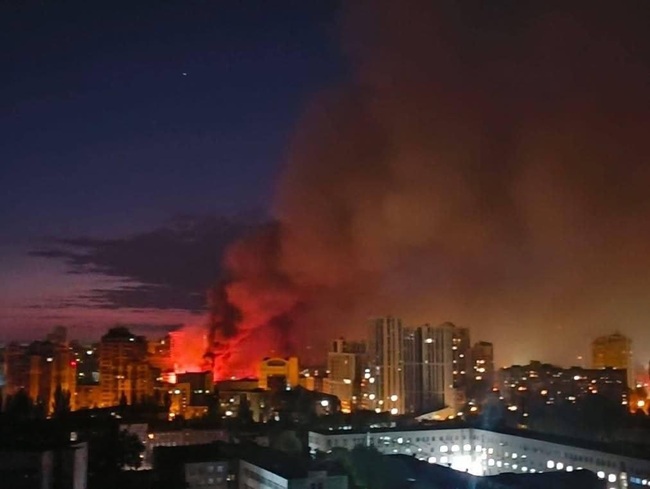
On the night of 23-24 May, Russia launched a massive missile attack against Ukraine.
According to official Ukrainian figures, the Russians fired roughly 90 missiles (our own count puts the figure at no fewer than a hundred, Ed. note) and 600 drones. The primary target was Kyiv and its surrounding oblast, although the wave of strikes also hit other parts of the country. At least 4 killed and over 83 wounded have been reported nationwide.
The attack involved an extraordinarily diverse missile arsenal, comprising roughly:
- 20 Kh-101 air-launched cruise missiles, fired by at least 4 Tu-95MS bombers from the western Kostroma region. Notably, these cruise missiles deployed both flares and, in all likelihood, chaff on a wide scale (though not for the very first time);
- around 30 ISKANDER-K cruise missiles, ground-launched from Bryansk and Kursk oblasts;
- 18 KALIBR cruise missiles, launched by 3 surface units of the Black Sea Fleet at Novorossiysk;
- around 30 ISKANDER-M/S-400 ballistic missiles, from Bryansk, Kursk, Voronezh and Crimea;
- 6 ZIRCON hypersonic missiles, fired from ground-based systems in western Crimea;
- 5 KINZHAL aeroballistic missiles, launched by MiG-31K aircraft taking off from Tambov;
- 1 ORESHNIK intermediate-range ballistic missile (IRBM), fired from Kapustin Yar in Astrakhan Oblast against Bila Tserkva (Kyiv Oblast).
Ukrainian air defences intercepted at least 24 missiles (8 KALIBR, 6 ISKANDER-M, 5 Kh-101 and 5 ISKANDER-K) and shot down or electronically suppressed around 549 drones.
In detail, the raid opened around 23:30 Italian time with 3 KINZHAL aeroballistic missiles fired at the Starokostyantyniv air base (Khmelnytsky Oblast). Around midnight came the attack on Kyiv: a salvo of about 10 ISKANDER-M ballistic missiles against the capital, combined with the launch of 1 ORESHNIK IRBM directed at Bila Tserkva (Kyiv Oblast, some 80 km to the south), carrying 6 MIRV warheads each fitted with 6 submunitions, as confirmed by several videos. Of the ISKANDER-M, only 4 were reportedly intercepted by Ukrainian defences. Around 01:00, another 2 KINZHAL struck Starokostyantyniv air base again, while Black Sea Fleet units launched 18 KALIBR cruise missiles in parallel — the first operational employment of the Russian naval component since mid-March. Some vectors struck in Kirovohrad Oblast, others reached their targets in Kyiv around 02:00. Also around 02:00, a further 2-3 ISKANDER-M were fired at the capital with confirmed impacts, while 4 ZIRCON hypersonic missiles were launched from Crimea, again against Kyiv. Shortly after 02:00, 20 Kh-101 air-launched cruise missiles entered Ukrainian airspace, followed at 02:30 by 10-12 ground-based ISKANDER-K cruise missiles. The Kh-101 and ISKANDER-K began impacting from 02:30-02:50 on the eastern, north-eastern and northern outskirts of Kyiv, with around ten impacts in total. In the same window, some ISKANDER-M struck Dnipro. The attack then continued with further ISKANDER-K launched at Kyiv and several more impacts, finally winding down around 04:30 Italian time.
Several strikes caused damage on which no details are available (not even traceable through social media or other open sources, since these were military targets), particularly in Khmelnytsky Oblast (the Starokostyantyniv air base, hit by KINZHAL in 2 distinct waves, Ed. note), Kirovohrad (possibly Kanatove air base), Zhytomyr, Odesa (near Mayaky), Poltava (in the north-western part of the oblast), and Dnipropetrovsk (south of Dnipro).
As for Kyiv — the main target of the attack, as noted — the following sites were definitely hit: the SBU district office in Podil; the Darnytska industrial zone (where the ZIRCON missiles reportedly impacted); a number of industrial facilities (most of them disused); a business park; a supermarket; the buildings housing the Council of Ministers, the Ministry of Foreign Affairs, as well as several embassies and United Nations buildings (all with minor damage); and various residential, commercial and entertainment buildings in the central districts (especially in the Podil neighbourhood).
The area around the Lukianivska metro station (and the station itself), close to the Artem armaments plant (probably not hit), was shrouded in persistent smoke for hours, and eyewitnesses reported cracks in the ceiling of the metro platforms being used as shelter by the civilian population.
The ORESHNIK: third combat use
At Bila Tserkva — a city of around 200,000 inhabitants located 70 km from the capital — a single ORESHNIK (not 2, as initially reported) released 6 multiple re-entry vehicles, each carrying 6 submunitions, for a theoretical total of 36 warheads on the target area.
It is unclear what the actual target was: Russian channels claim it was the air base on the western edge of the town, while other sources indicate the industrial zone. The physical result: a destroyed garage cooperative, some industrial buildings damaged, 3 garage boxes burnt out. Zero casualties. An IRBM with a unit cost estimated between 50 and 100 million dollars, the ORESHNIK produced such limited damage because its warheads were entirely inert — essentially iron slugs with no conventional explosive charge whatsoever.
This had already been the case in the 2 previous instances of its use: at Dnipro on 21 November 2024, when an industrial facility was struck with minimal physical damage, and near Lviv on 9 January, when the target was a repair plant for Ukrainian MiG-29s and F-16s. In that case, the confirmed damage involved limited penetration of a few concrete structures, craters in an adjacent wooded area, and the flooding of an underground archive where, ironically, the complete works of Lenin are said to have been destroyed (a colourful detail occasionally cited, though perhaps somewhat apocryphal…).
It is worth noting that in every instance of ORESHNIK use, Russia has provided advance notice to the United States through nuclear risk-reduction channels, and the U.S. Embassy has duly issued a warning the day before — because, with its range of over 5,500 km (this being, after all, one of the weapon systems developed in violation of the 1987 INF Treaty, central to the various dynamics that led to the collapse of the related arms-control regime) and its MIRV configuration, every ORESHNIK launch carries the intrinsic potential to trigger escalation that goes well beyond Ukraine.
For a long time it was estimated that Russia possessed only 3-4 pre-series launcher units for this IRBM, with actual serial production having begun last year at a rate of 5 missiles per year (there are, however, no reliable figures on the production of additional launchers). Whether this is genuinely the case remains to be seen. Before the war, the KINZHAL too was said to exist in only 12-20 units at most. Be that as it may — why employ a hugely expensive system, adapted to carry mere inert warheads capable of producing less physical damage than an ISKANDER-M costing 3 million dollars and carrying 700 kg of high explosive? The cost-effectiveness ratio is undeniably terrible. Several interpretations dominate the debate:
- A capability demonstration aimed at European backers of Ukraine, in the form of an implicit threat about how the missile could, if needed, be armed in its primary configuration — that is, with nuclear MIRVs. Personally, we are not particularly convinced: that the Russians are capable of launching nuclear missiles is hardly a great revelation, nor something that needs periodic reminding (moreover, several missiles Russia has been using against Ukraine for over 4 years now also have nuclear capability, Ed. note);
- Operational testing under real-world conditions: every launch would be aimed at gathering technical and dispersion data impossible to collect at testing ranges. We are not convinced by this interpretation either. The Russians have entirely adequate ranges to test these missiles, and there is no added value in doing so within the Ukrainian war context, since Kyiv's forces field no air defence system capable of countering the ORESHNIK — meaning there are no particular "combat test" data to gather and process;
- Psychological pressure: the announcement of an ORESHNIK launch should (or so the Russians may hope) produce, in time, hours of alerts, mass evacuations, and economic paralysis. This interpretation convinces us a little more, because — mutatis mutandis — it is essentially what Moscow has been trying to achieve after every bombing campaign of any significance (the winter ones, for instance, or in any case those targeting energy infrastructure). And yet, as with those, no destructive effect on Ukrainian morale has materialised. The American announcements of imminent ORESHNIK launches (the missile is never mentioned by name; the communications are instead phrased in convoluted language entirely intelligible to those living and operating in Ukraine) have produced no terror effect either — and indeed, the irrelevance of the damage that consistently follows almost provokes a sense of the ridiculous among the Ukrainian population.
On this last point, it is also worth recalling that analysis of debris from the previous 2 ORESHNIK strikes has revealed a reality far removed from any "Wunderwaffe" status for this IRBM: vacuum-tube technology dating to the Gagarin era, analogue gyroscopes, circuit boards with components from the late 1990s. None of this, however, entitles us to join the chorus of ORESHNIK mockery.
The Russian approach to weapons sometimes follows logic that can appear odd but actually makes a certain kind of sense. For example, the fact that some of the missile's subsystems use dated analogue components, resistant to electromagnetic pulse (EMP), may not stem from supply-chain problems under sanctions, but rather from a deliberate choice: while modern transistors and chips are vulnerable to EMP, vacuum tubes are far less so. By the same token, this may not necessarily reflect any particular technological backwardness, but potentially a design choice geared towards ensuring the system's survivability in intense electronic-warfare environments.
And then there remains the fact that no one in Europe (probably not even what is left, or is destined to remain, of the American presence on the continent) is capable of defending against the MIRVs (inert or otherwise) of an IRBM, except through deterrence mechanisms. All told, then, there is precious little to laugh about.
Follow us on Telegram, Facebook and X.




Privacy Policy

Powered by © Mobilbyte s.a.s. Information Technology