



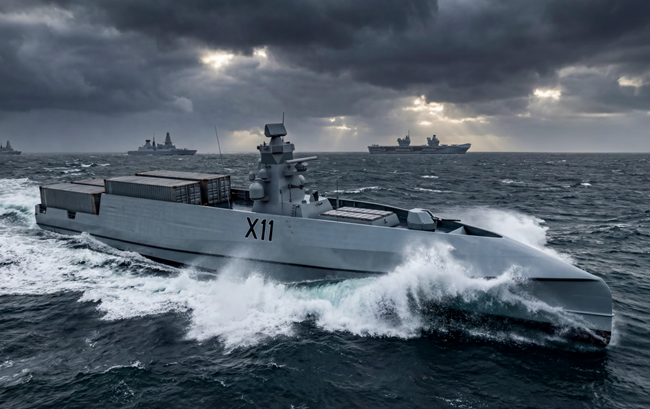
Navantia UK has showcased the model of its proposal for an uncrewed escort ship at the Combined Naval Event in Farnborough. Dubbed LASV-75, from its length of 75 meters, the ship is designed from the outset to be uncrewed, dispensing with crew spaces to maximize payload capacity.
Displacing more than 1,000 tonnes, the LASV-75 is intended to carry out a wide range of missions, either independently or as part of a task group.
Simon Jones, product development director at Navantia UK, says that this ship proposal was matured by the company’s Bristol-based design team. It is obviously and openly targeted at the Royal Navy “hybrid fleet” ambitions and represents Navantia UK’s vision of what such a plan would need to field in order to deliver serious operational capability.
The model and images released by Navantia UK show a stealthy hull with a pronounced inverted bow, equipped with an integrated, modular mast for sensors, a permanent VLS silo and a BAE-Bofors MK4 40 mm gun for close defence. The silos is shown fitted with 4 MK-41 VLS modules for a total of 32 cells.
The rear area of the ship is shown equipped with standard interfaces for capability modules in containers, such as the Royal Navy’s own NavyPODS or alternative industry entries. Eight containers are shown mounted on 2 deck levels. This would enable the LASV-75 to carry other sensors, weapons and/or specialized mission payloads on the stern for MCM or ASW and seabed surveillance.
The LASV-75 clearly tries to respond to both of the “known” Royal Navy concepts for large USVs, aka the Type 92 SLOOP, ASW-focused in the context of the ATLANTIC BASTION plan for an autonomous anti-submarine barrier; and the Type 91 “arsenal ship” that should support Type 45 and its future replacement, the Type 83, in the context of ATLANTIC SHIELD (anti-air and anti-missile defence) and ATLANTIC STRIKE.
Navantia UK is collaborating with a number of partners in the field of autonomy and mission systems to mature the concept.
Importantly, Navantia UK proposes to build ships of this kind and general dimensions at its Appledore shipyard, which being limited to hulls not longer than 120 meters had essentially been overtaken over time by the dimensions of modern crewed vessels.
The First Sea Lord, Royal Marine General Gwyn Jenkins, is on record repeating constantly, including at CNE again, that his “aim is to have the first of our uncrewed escort ships sailing alongside our Royal Navy warships within the next 2 years… And to launch the first jet-powered drone from a carrier next year”.
He has publicly re-exposed his vision for ATLANTIC BASTION as recently as April, insisting that Type 26 frigates will be more or less routinely flanked by a couple of “uncrewed escorts, both using AI to work with the warship. They will protect the parent ship, adding sensors, weapons and decoy capabilities”.
He also recommitted to the accompanying Type 93 uncrewed submarine concept, too, the “CHARIOT”.
In September 2025, speaking aboard HMS PRINCE OF WALES in Tokyo, the First Sea Lord had outlined his vision for an uncrewed escort as many as 90 meters long escorting the carrier on its next deployment to the Indo-Pacific. In theory, that would mean within 4 years or so.
While industry proposals are multiplying, concerns remain over what the Royal Navy will actually be able to do since the publication of the Defence Investment Plan continues to be delayed, leaving all questions about the future of UK defence unanswered.
The circa 40 meters-long experimental ship XV PATRICK BLACKETT is working towards Autonomy level 4 demonstrations and there have already been RFIs in the past about containerized, modular sensor payloads for large USVs in the realm of MCM and ASW, as well as more recent projects launched for sensors and C-UAS solutions (HORUS, METIS, TALON).
A demonstration at sea with an USV “over 24 meters” is planned during 2027. A notice to industry was released earlier this year with the anticipation that a contract award would come by the end of September 2026. The demonstration is connected to developing plans for the Future Air Dominance System (FADS) programme, which is to determine the mix of sensors and weapons for the Type 45 destroyer replacement.
Much remains to be seen, tested and demonstrated, and first of all the Royal Navy desperately needs to see the DiP and know what kind of true budget and ambition will be backed by Government.




Privacy Policy

Powered by © Mobilbyte s.a.s. Information Technology