



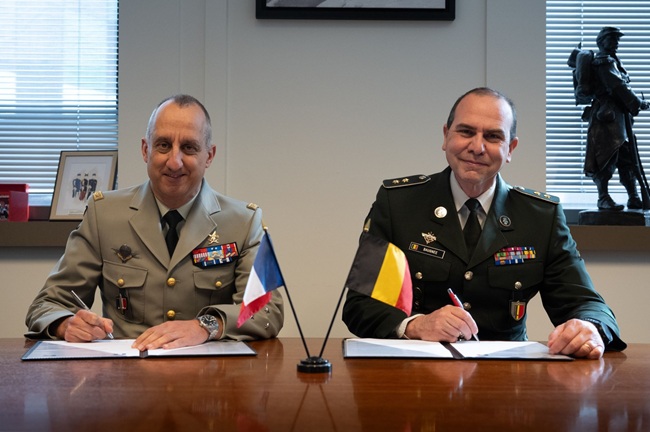
On May 19, the French Général de Corps d'Armée Patrick Justel and the Commander of the Belgian Land Component, Major General Baugnée, jointly signed a document that defines the key characteristics required of the future Véhicules Blindés d'Aide à l'Engagement (VBAE), which the 2 Nations intend to jointly procure.
This new milestone builds on the well established close cooperation between the Belgian and French staffs, which rests on the CaMO (Capacité Motorisée) strategic partnership which already saw Belgium adopt the French JAGUAR, GRIFFON and SERVAL armoured vehicles.
The VBAE is intended to be a light armoured combat vehicle, designed for high-intensity engagements, capable of supporting JAGUAR by detecting and contributing to the neutralization of threats. It will be smaller and lighter than JAGUAR, more attuned to a “stealth” type of deep reconnaissance missions. It will be expected to gather specialized intelligence within the extended tactical depth and should also serve, in the appropriate variant, as a command and liaison vehicle.
In France, the VBAE is to be the successor to the existing VBL 4x4 and attempts to get this project moving have been underway for over a decade. During this time, the French industry has presented a number of concepts, but none have yet become a production solution.
The agreement between France and Belgium on a list of characteristics is a much needed positive development for VBAE which comes after far less positive developments evidenced in April by the 2026 actualization of the "Loi de Programmation Militaire".
Until last year’s edition of the plan, the acquisition of a first batch of 180 VBAE was to be completed by 2030, with 886 vehicles delivered by 2035. Those numbers have been revised sharply downwards, to 0 and 332 respectively, in the new LPM.
The VBAE saw budget cuts and deferral in order to free up funds for other, more urgent priorities, but the Chief of the General Staff, General Pierre Schill, was clear in his LPM audition: the Armée de Terre is “not satisfied at this stage” with the proposals that industry put forward in response to the initial studies. The proposals were assessed to be too expensive, too late to need and “too technological” to respond to battlefield realities.
Schill said the Army was in the process of redefining the program with a renewed focus on cost-effectiveness, sustainability and eventually time to production.
As the OCCAR reports in its Business Plan for 2026, a consortium formed by ARQUUS, KNDS and JCD has been working on the pre-design of the VBAE in the frame of the VBAE Stage 1 contract awarded to them in December 2023. The first step of this VBAE predesign was achieved at the beginning of 2025 setting the preliminary architecture of the VBAE and establishing some key features.
During the course of 2026, according to the OCCAR, the team should finish Stage 1 activities by “establishing the detailed architecture, the technical-economic analysis and delivering the complete system requirements”; produce an ergonomic mock-up and then begin preparations and negotiations for the VBAE Stage 2 contract (covering development / production / delivery) to follow in the course of 2027, if approved.
It’s not yet clear what the impact on the progress of this Stage 1 work will be from the “dissatisfaction” that Schill so recently and so unambiguously set out to French lawmakers.




Privacy Policy

Powered by © Mobilbyte s.a.s. Information Technology