



In the hours before the NATO political and military meetings last week, unease spread within the Alliance. Reports surfaced of a planned redeployment of 5,000 US troops outside conventional Europe, including the withdrawal (without replacement) of an Armored Brigade Combat Team and a reduced long-range artillery battalion. European capitals grew concerned about Washington's strategic priorities.
The announcement that extra US forces would go to Poland to anchor the eastern flank brought relief - especially in Warsaw - but soon it was clear to others that this deployment offered only partial reassurance amid a wider transatlantic drawdown.
This deployment reflects a wider transformation. The two meetings in Helsingborg and Brussels both pointed to a deeper issue - whether this change is merely an adjustment to circumstances or signals a broader redefinition of US-Europe relations - with a view to the forthcoming NATO Leaders' Summit in Ankara.
The issue is sensitive as NATO undergoes a strategic transition. After the Cold War, NATO shifted from eastern enlargement to counterterrorism post-9/11, then back to conventional deterrence after Crimea. Russia's invasion of Ukraine has further pushed the Alliance to confront high-intensity war, great-power rivalry, energy security, hybrid threats, and rapid technological change.
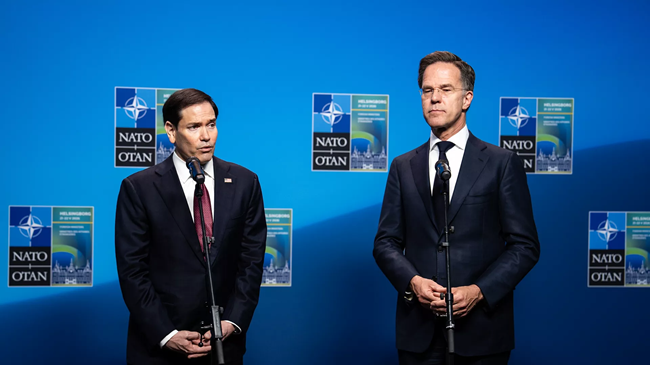
At the Helsingborg ministerial - Sweden's first as a NATO member - NATO's Secretary General Mark Rutte downplayed any rupture with the past, saying: "A new start? I don't know if I would phrase it a little bit differently." He called it a "rebalancing". Rutte also noted: "I always felt that it is strange that a very rich part of the world - Europe is a very rich part of the world - needs to support another part of the world to defend itself against the Russians to the extent it has now."
This debate is not new. Obama's era introduced the pivot to Asia; Trump 1 then criticised European defence spending. Now, the trend is towards not just spending more, but taking on more strategic responsibility. Rutte called this shift a natural evolution: "What you will see over the coming years is a credible shift, European states taking bigger responsibility with the United States firmly anchored in the transatlantic relationship."
From the Washington side, the relationship appears more transactional. US Secretary of State Marco Rubio called the upcoming NATO summit "probably one of the more important leaders' summit in the history of NATO" and reminded allies: "Like any alliance, it has to be good for everyone who's involved. It has to be a clear understanding of where the expectations are."
This logic goes beyond burden-sharing. Rubio said: "We simply are not able to produce munitions today at a rate that are necessary for future needs," while Rutte agreed: "We know that today our industries are not able to produce everything we require." Greater European autonomy is now a necessity for the Alliance's sustainability.
Rutte also highlighted global risks, warning about the Strait of Hormuz, where Iran threatened global trade by disrupting maritime chokepoints. For NATO, securing trade and energy routes in the Gulf is now part of its strategy. Still, political and military leaders agree on a fact: Ukraine remains the top priority, anchoring NATO's core posture.
The military side: from the NATO of promises to the NATO of capabilities
While politicians redefine NATO's language, military leaders are already transforming its operations in practice.
In Brussels, the Military Committee tackled the shift from theory to practice. Instead of abruptly revising the NATO Force Model, they tried to match ambitions with available capabilities. The Pentagon and allies have been working to redefine the quota of high-readiness forces Washington assigns to NATO during crises. Rutte said this process has been under way for over a year, managed by the military.
The result is clear. With fewer US assets available, European allies must speed up the strengthening of their own capabilities. The reduced presence of the United States confirms this strategic realignment. Countries like Poland and the Baltics are boosting their ground forces to fill the gap, letting the US shift assets to other global priorities without breaking regional defence plans.
This leads to the idea of "NATO 3.0". Admiral Pierre Vandier, Supreme Allied Commander Transformation, summed it up: "That was the buck. Now comes the bang." The challenge is no longer how much money allies pledge, but how spending translates into real deployable capabilities, interoperability, and credible deterrence. The focus shifts to the defence industry's ability to produce at scale, integrating legacy systems with new technology.
The war in Ukraine speeds up this change. Drones, AI, electronic warfare, and data-centricity compress decision-making and alter how wars are fought. Algorithms and unmanned systems have cut engagement cycles to minutes or seconds. Admiral Giuseppe Cavo Dragone, Military Committee Chairman, said: "Time is an essential strategic resource in competition, crisis and conflict."
This revolution means moving beyond a focus on tanks or ships, embracing a flexible, software-driven ecosystem that can update rapidly to face asymmetric threats and bolster civilian resilience.
Ultimately, the key question from the two ministerials is more political than military: not whether the Alliance has enough means, but whether trust and strategic alignment remain. The Alliance must address this at the next NATO Leaders' Summit in Ankara.



Privacy Policy

Powered by © Mobilbyte s.a.s. Information Technology