



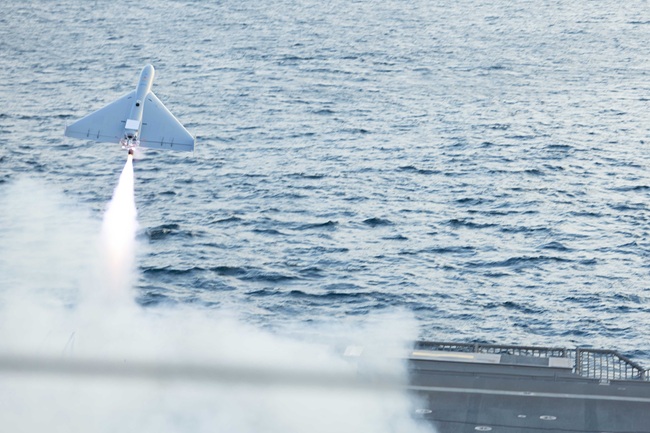
During Operation EPIC FURY against Iran, the United States deployed the LUCAS (Low Cost Unmanned Attack System) which – ironically – appears to be a project "inspired" by Iran's SHAHED-136 and its Russian clone GERAN-2, which have become some of the most widely used weapons in the war against Ukraine.
As its name clearly suggests, this new weapon offers an extremely low price tag of $35,000, while delivering operationally very effective range (roughly 600-700 km) and lethality.
New details have also emerged, including the imminent adoption of an AI-based software package (HIVEMIND Autonomy Software) that enables coordinated swarm attacks. The HIVEMIND "package" has already been extensively tested by Ukrainian forces, who have deployed it on hundreds of drones. According to its developers, the success rate has grown by an order of magnitude, jumping from one target hit out of 10 attacked to nearly 10 out of 10.
Using HIVEMIND, the drones navigate fully autonomously and coordinate with each other to execute the attack mission. Thanks to satellite communications, the operator can step in and even reassign the target at any moment. The combination of AI and a coordinated swarm shortens the critical window between target detection/identification and engagement within the Kill Chain, while also cutting down the adversary's reaction time. There are, however, current legal and ethical limits on full swarm autonomy, which require human operator intervention or supervision whenever lethal weapons are employed. One interesting aspect is that by using one or more drones as SATCOM communication relays, the entire swarm can effectively be controlled from a command post located anywhere in the world.
Another interesting aspect is that the LUCAS was also launched from the flight deck of a warship – in this specific case, the USS SANTA BARBARA (LCS-32). For its part, the Iranian Navy had previously demonstrated on several occasions its ability to launch attack and reconnaissance drones from the decks of amphibious units or modified commercial vessels.
These drones are lightweight, compact, and pose no significant blast issues at launch, meaning they can represent a substantial boost to the strike capabilities of a conventional naval unit without requiring costly and demanding modifications. For example, many years ago, several Italian Navy units routinely launched the BARC (Bersaglio Aereo Radio-Comandato – Radio-Controlled Aerial Target) for gunnery exercises, and the BARC (today's MIRACH-100, MIRACH-40, BANSHEE, and their predecessors) is to all intents and purposes a drone, albeit built on different technology than today's attack drones.
The world is moving forward, technology and tactics are changing, and consequently doctrine, planning, and procurement should take note…




Privacy Policy

Powered by © Mobilbyte s.a.s. Information Technology