



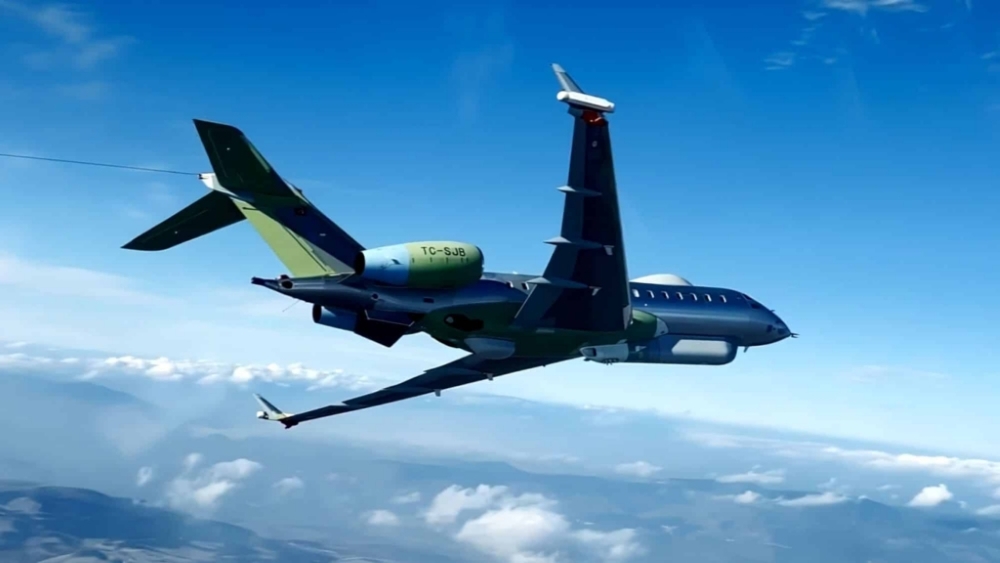
The HAVA SOJ airborne stand-off jammer, equipped by Aselsan, first broke cover 3 months ago when some images were captured of a test flight from the Turkish Aerospace Industries (TAI) facility in Ankara.
Now, better and more detailed footage of the new aircraft is available thanks to a promotional video released by the Turkish Ministry of National Defense in commemoration of the Turkish Air Force’s 115th anniversary.
The HAVA SOJ is based on a modified Bombardier GLOBAL 6000 business jet fuselage and is also known by Turkish sources as the ASOJ 23-A. It is an important national capability and a project that can trace its roots all the way back in the late 2000s. The process to replace the old jammer capability installed on Transall C-160 aircraft with a more modern and more sovereign solution has not been smooth and saw a number of false starts over the years.
Even the currently ongoing project went through a number of setbacks, not unusual for projects of this complexity. When Aselsan was awarded the contract for HAVA SOJ payloads back in 2018, the plan had optimistically expected deliveries in 2023 which, clearly, did not happen. The first Canadian-made Bombardier GLOBAL 6000 airframe for HAVA SOJ was delivered to TAI’s facilities back in 2019.
The Turkish firm Aselsan is responsible for most of the secretive mission payload, although not for systems. The aircraft is known to use Leonardo’s MYSIS Directed IR Counter Measures (DIRCM) as part of its self-defense suite. TAI is responsible for integration.
The Electronic Warfare payload is reportedly based upon the Koral/Kara SOJ systems, also by Aselsan, that are deployed on land and moved by tactical trucks.
4 aircraft have been acquired and are due for conversion, with the delivery of the first expected later this year, with operational capability presumably in 2027. Little is known about the electronic systems that will be installed on the aircraft, but the SOJ is intended to locate and suppress enemy air defence surveillance systems, creating “corridors” for friendly combat aircraft to enter and exit hostile airspace.
Obviously this requires substantial radar detection and triangulation capability; a powerful jamming suite and, probably, a degree of COMINT / ELINT collection capability.
The aircraft very prominently features a large fairing underneath the forward fuselage, probably containing the main jammer; plus a dome atop the forward fuselage presumably for satellite communications. Notably, pods with possible AESA arrays are located at the wingtips, possibly to support the triangulation of adversary emissions. The aircraft is expected to feature 6 to 8 workstations, with an endurance in the region of 8 hours.
Dedicate stand-off jammer aircraft are a powerful, valuable tactical capability that few Nations field and even fewer Countries produce in-house. Turkey’s jammer aircraft could in the future find export success with countries such as Pakistan and Saudi Arabia; Aselsan already is promoting it in the Kingdom through a joint venture with the local Taqnia.




Privacy Policy

Powered by © Mobilbyte s.a.s. Information Technology