



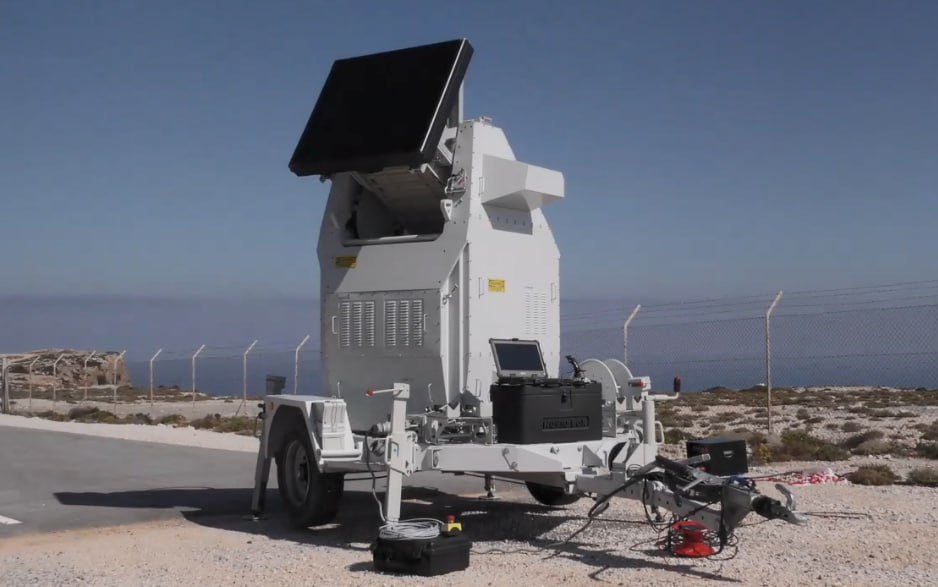
Thales UK announced the successful conclusion of a new phase of trials for its “RapidDestroyer”, a radio frequency directed energy weapon (RFDEW) designed to counter the threat of drone swarms. The system was born under a UK MoD project known as EALING which saw a number of previous, smaller scale demonstrations.
The latest trials took place in April at the Pershore range in Gloucestershire and involved Teledyne E2V, partner in the weapon’s maturation. The demonstration used an enlarged, more powerful system using a 4 panel effector rather than the single panel of the early prototype.
The larger antenna enhanced the focus of the effectors power, increasing the energy on target and extending the range of engagement. According to Thales’s forensic analysis post-engagements, the system demonstrated “consistent, near-immediate defeat of each drone, removing the chance that the drones could re-engage.”
Thales also says that the system is being enhanced with the addition of Artificial Intelligence software for optimal threat response and autonomous operation, but with operator in the loop. 80 drones were defeated in successive, individual scenarios.
Thales has not, at the time of writing, released photos of the 4-panel effector but only a Computer Graphic image showing it carried on the load bed of a WOLFHOUND 6x6 protected logistics vehicle as employed by the British Army. In the image, RapidDestroyer is still shown supported by Qinetiq’s OBSIDIAN radar system, which employs two very recognizable domes containing purpose-designed 3D staring radar, able to work on the move and detect and track multiple aerial threats from as much as 3.5 km away. OBSIDIAN, complete of an electro-optical camera element, had already been used during Project EALING’s earlier phases.
The early prototype under EALING was first test fired around the end of 2024, with more demanding trials following with more than 100 drones tracked, engaged and defeated in various events, including simultaneous destruction of groups and swarms of drones. The system as a whole should work also on the move.
EALING was developed by an industrial team led by Thales UK, supporting around 100 highly skilled engineering and manufacturing staff in the Thales sites in Northern Ireland as well as a further 30-35 supply chain jobs in Chelmsford, Essex, that directly contributed to the development of the weapon demonstrator.
The entire EALING system is demountable. It can be carried on a flatrack on a common HX-60 MAN SV truck used by the British Armed Forces or dropped to be operated from a fixed position. The UK Government has invested more than £40 million in the development of RFDEW, but current plans for adoption of the system as an operational capability are unknown.
In December 2024, then Defence Procurement Minister Maria Eagle said in a written answer that the MoD was “committed to the continued investment in UK Sovereign Radio Frequency Directed Energy Weapons (RFDEW) technology” and that it was “exploring options to exploit the existing UK developed RFDEW project as a C-UAS Minimum Deployable Capability at increased pace”.
In the same occasion she also reported that £184 million had been committed “over the next three years” to the development of Direct Energy Weapon technology. Since then, substantial investment has been announced to start fielding laser weapons (in particular DRAGONFIRE, on board of Royal Navy Type 45 destroyers beginning sometime next year) but the status of RFDEW plans is not clear.




Privacy Policy

Powered by © Mobilbyte s.a.s. Information Technology