



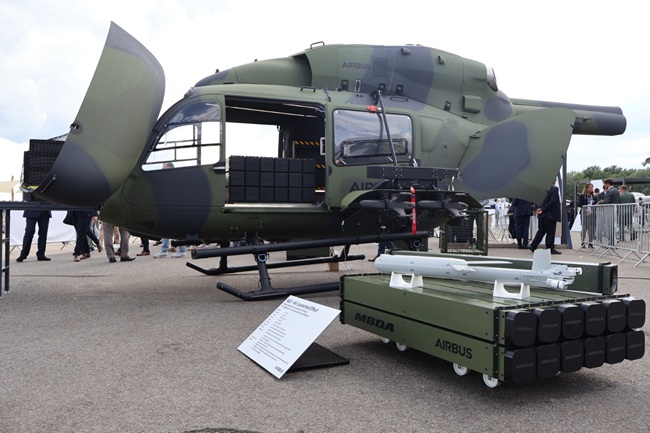
At ILA 2026 in Berlin, Airbus Helicopters has unveiled the U-145, an unmanned variant of its H-145 helicopter. The announcement had been previewed on the eve of the show through an official press release.
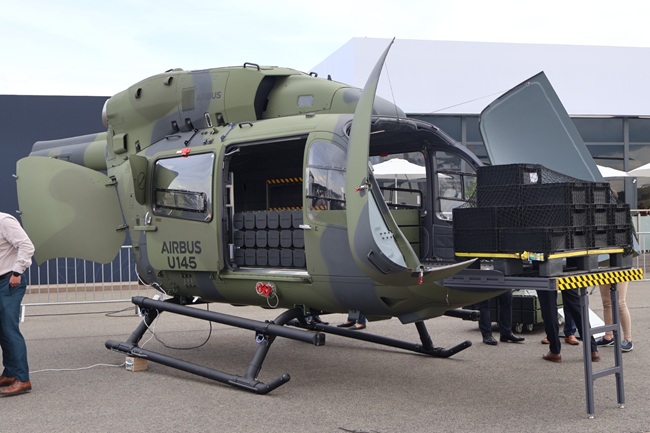
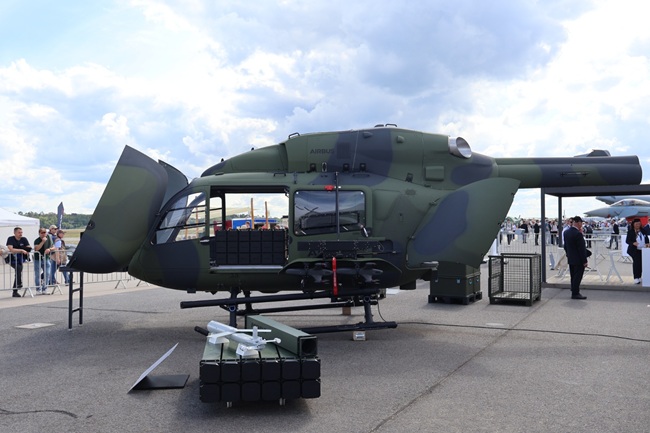
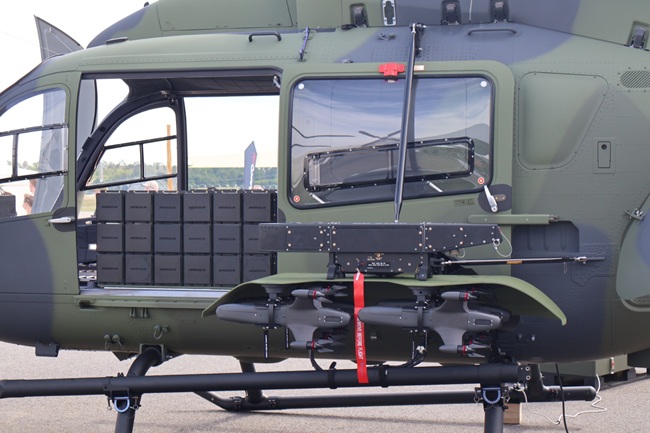
A full-scale mock-up of the aircraft is on display at the show (pictured). A first flight — with a safety pilot on board — is scheduled for late 2026, with entry into service expected in the early 2030s. Matthieu Louvot, CEO of Airbus Helicopters, indicated that the development of the U-145's multi-mission capabilities will proceed in partnership with specialists in autonomous operations, with the broader aim of consolidating the European UAV ecosystem.
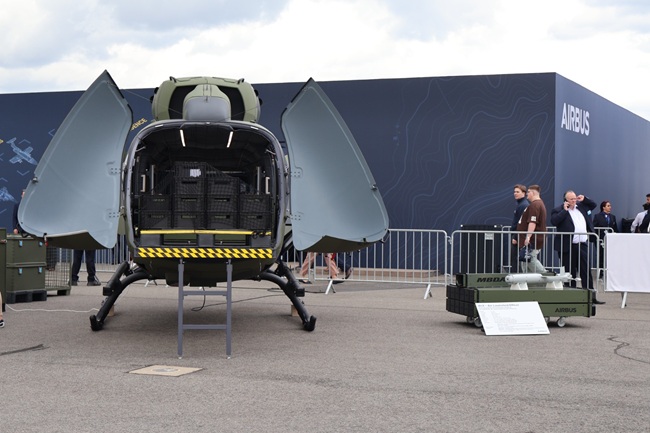
The U-145 is the 2nd crewed helicopter that Airbus has converted to an unmanned configuration, following the VSR-700 — derived from the CABRI G-2 by Hélicoptères Guimbal and ordered by the French Navy (Marine Nationale). Compared to the piloted H-145, the U-145 eliminates the physical cockpit and integrates a nose door that opens in 2 sections, along with a dedicated cargo floor. The standard rear opening and 2 lateral sliding doors are retained. Autonomous decision-making is enabled by artificial intelligence solutions.
The platform has a maximum take-off weight (MTOW) of 3,800 kg, a payload capacity exceeding 1,200 kg, and a range of 400 nautical miles. The U-145 is designed as a mission-agnostic platform, primarily intended for high-volume cargo transport in both civil and military applications. Its modular architecture supports additional roles: emergency management, firefighting, MEDEVAC, armed scout, surveillance, and drone mothership for Air Launched Effects (ALE) — the latter being an area in which Airbus is collaborating with MBDA.
On the ALE and combat capability front, the mock-up was displayed with 18 ALE launchers per side, housed within the cargo bay and configured to deploy through the lateral doors. The ALEs are being developed by MBDA Germany; a full technical treatment will appear in the complete ILA reportage in the next issue of RID. In addition to the ALE launchers, the aircraft carries 4 STRILA 2 interceptor drones by Quantum Systems, mounted on a pylon beneath a small stub wing on the left side of the helicopter.
On the other side of the Atlantic, Airbus US Space & Defense is proposing a dedicated variant to the US Marine Corps (USMC): the MQ-72C, developed in partnership with Shield AI, L3Harris, and Parry Labs. This is a fully autonomous variant of the LAKOTA UH-72B, tailored to US customer requirements.
The H-145 family currently numbers over 1,800 aircraft in service across military and civil missions, accumulating more than 8.5 million flight hours.




Privacy Policy

Powered by © Mobilbyte s.a.s. Information Technology