



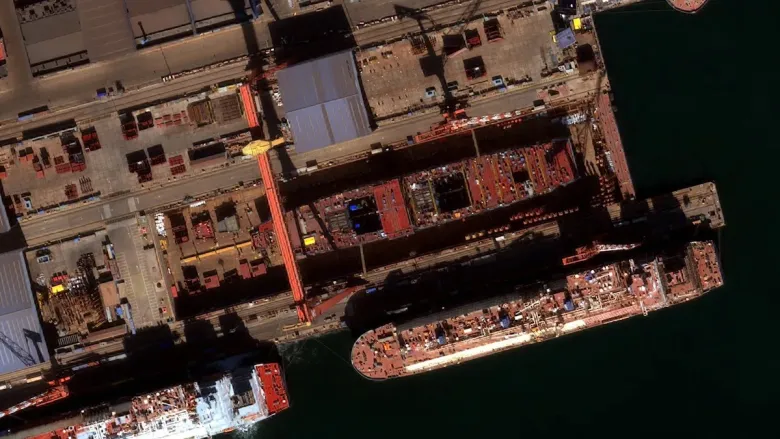
Recent satellite imagery of the Dalian Shipyard in northern China indicates rapid progress on the construction of the country’s first nuclear-powered Type 004 aircraft carrier. Within less than a year, prefabricated hull sections have been assembled into a clearly defined structure, with internal layouts suggesting the presence of twin containment spaces consistent with a double nuclear reactor configuration.
If verified, this development would represent the first successful transition of People’s Liberation Army Navy (PLA-N) nuclear propulsion technology from submarine platforms into major surface combatants. The design is expected to be heavily influenced by experience constructing the first domestic supercarrier, FUJIAN, which entered service in November 2025. Compared to FUJIAN, the next generation longer ranged supercarrier is expected to not only be larger – potentially up to 325 m in length - and incorporate nuclear propulsion, but also a 4th DC-supercapacitor electromagnetic catapult system and 1 or 2 more elevators. These enhancements could increase sortie generation rates by approximately 33%.
The Type 004 is also expected to support a larger and more diverse embarked air component of fixed-wing (FW) and rotor-wing (RW) aircraft than previous Chinese aircraft carriers, including J-15T and J-35 fighters, Xian KJ-600 AEW&C aircraft, HZ-20 utility/ASW helicopters and stealth attack drones such as the GJ-21. At this stage, as stated by retired PLAN Rear Admiral Zhang Zhaozhong at the CCTV, it is unlikely that the J-20 aircraft would be embarked noting the aircraft was not structurally designed to operate on the aircraft carrier.
China’s fourth aircraft carrier is the latest step in the PLAN’s rapid modernization drive and underline Beijing’s ambition to develop a larger, more capable blue-water fleet. The 2025 US Department of Defense report on China’s military power assessed for the first time that China aims to field 6 additional aircraft carriers by 2035, bringing its total to 9. Such expansion would narrow not only the quantitative gap with the US Navy’s 11-carrier fleet, but also the qualitative one. If China does build out such an extensive carrier fleet, and the relative escort platforms (cruisers, destroyers, frigates, large replenishment ships, and sometimes nuclear-powered attack submarines), it would represent a sea change in the global balance of military power, fostering Beijing’ interest expansion dreams.




Privacy Policy

Powered by © Mobilbyte s.a.s. Information Technology