



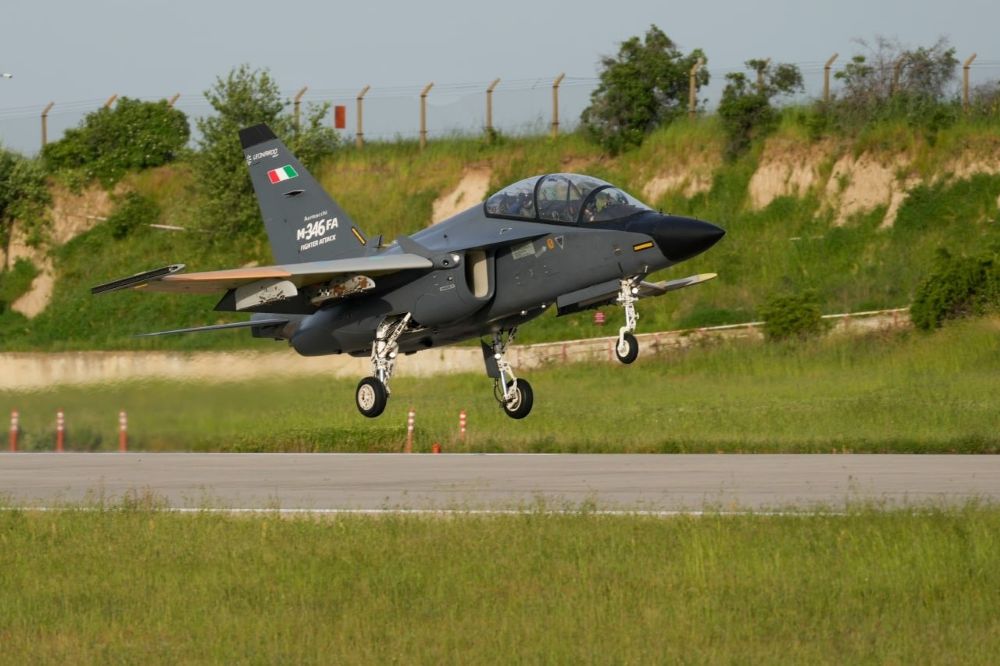
Under the K-SWARM program, Leonardo and Baykar have completed a series of tests to assess the integration between the Italian group's M-346 light fighter/trainer and Turkey's KIZILELMA UCAV.
The program aims to develop interoperability between manned and unmanned aircraft and Manned-Unmanned Teaming (MUM-T) capabilities. The flight trials assessed and confirmed the feasibility of coordinated operations between manned and unmanned platforms through advanced algorithms, demonstrating the maturity of both the program and the technologies involved.
The tests were conducted in May 2026 at one of Baykar's flight and test centers in Çorlu, Turkey. They involved 2 M-346 aircraft — one belonging to Leonardo in the Fighter Attack (FA) variant and one from the Italian Air Force (Aeronautica Militare) in the T-346A training variant — together with the unmanned KIZILELMA. The primary objective was to verify the effectiveness of the algorithms, tactics, and procedures developed by Leonardo at the Avionic Flight Control Innovation Lab and the Product Capability Concept Laboratory (PC2Lab) in Turin, alongside the M-346 Full Mission Simulator in Venegono (VA). Baykar's software and hardware were also tested, together with KIZILELMA's advanced autonomy capabilities, whose maturity facilitated the integration process.
In-flight data exchange between the 2 platforms was enabled by an advanced radio frequency system protected by Leonardo's GCC Tactical Platform, an advanced cyber defense suite developed by the Italian group.
During the flight campaign, the KIZILELMA drone was able to rejoin the M-346 FA after an autonomous taxi and takeoff phase thanks to the Smart Fleet Autonomy algorithms developed by Baykar's Hardware-in-the-Loop (HIL) Laboratory. Once the 2 aircraft had joined up in the air, the Leonardo fighter took full control of the KIZILELMA through a new-generation avionics suite, allowing the pilot to issue commands that were promptly executed by the unmanned aircraft through the manned-unmanned integration algorithms.
The trials followed months of intensive preparation for both pilots and technicians on each side, and the integration between the 2 teams allowed all campaign objectives to be met. The data collected at this stage define the current status and the next steps within the K-SWARM program, which is moving toward ever-tighter integration between manned and unmanned platforms. Central to this goal is the development of increasingly advanced AI systems capable of reducing pilot workload and expanding the drone's autonomous capabilities.
Further tests are scheduled in the coming months with progressively higher levels of complexity. The trials conducted so far have demonstrated the collaboration between Leonardo and Baykar, 2 companies at the forefront of their respective sectors with the shared goal of developing capabilities critical to the evolution of weapon systems.
Interoperability between manned and unmanned aircraft is becoming an increasingly central element of modern air warfare. This capability is no longer seen as exclusive to 6th-generation fighters but as a tool to enhance the capabilities and extend the operational life of earlier-generation platforms, as in the case of the M-346.




Privacy Policy

Powered by © Mobilbyte s.a.s. Information Technology