



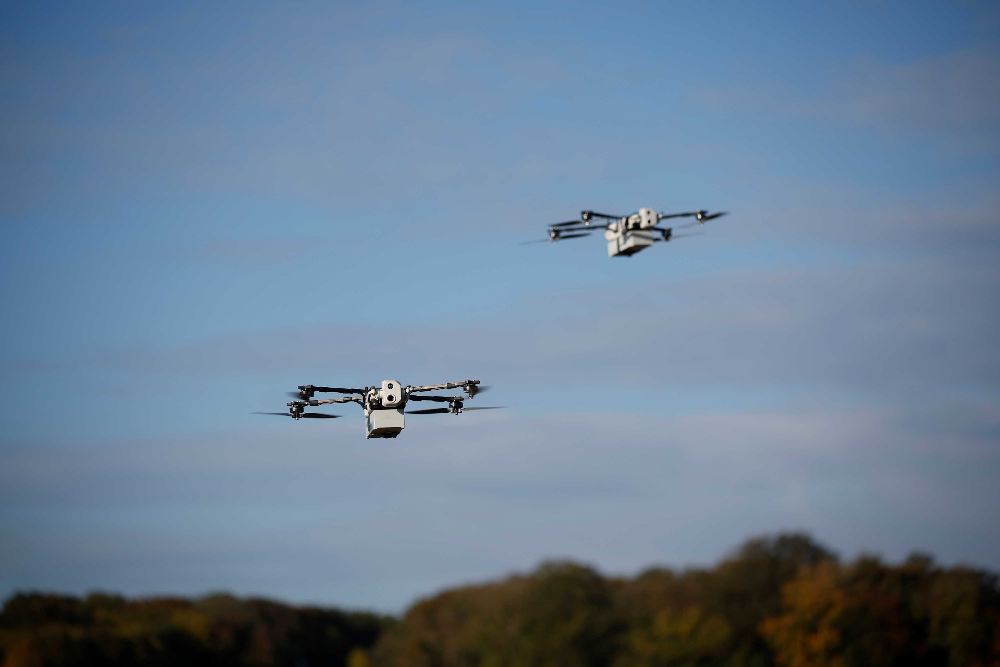
According to a press release disseminated today by the French Ministère des Armées, on 28 May 2026 the DGA formally ordered 5,000 DELCO (Drone du combattant à coût maîtrisé) systems from Harmattan AI, with deliveries to the Armée de Terre scheduled by early 2027 at the latest. The contract represents France's first genuine mass-production order for a front-line infantry drone, signalling that the French military has crossed the threshold from experimental fielding to industrial-scale integration of unmanned ground-support systems.
Until now, France had been conspicuously behind its NATO allies and, indeed, its adversaries in fielding small tactical drones at scale. The 5,000-unit contract follows an initial batch of 1,000 DELCO drones ordered on 30 June 2025 and delivered to the Armée de Terre in January 2026 — themselves a first, though at a scale more suited to operational evaluation than sustained warfighting. The new 5,000-unit order, five times larger, represents the transition from pilot programme to industrial reality. It also establishes a new procurement benchmark, as from the launch of the European competitive tender in February 2025 to the delivery of the first 1,000 units took less than one year (a speed rarely associated with French defence acquisition).
Harmattan AI, founded only in 2024, won the open tender and has since rocketed to become France's first defence-sector unicorn, reaching a valuation of $1.4 billion following a $200 million Series B round led by Dassault Aviation in January 2026. That Dassault Aviation has chosen to anchor its investment in a two-year-old drone startup speaks volumes about where the French industrial ecosystem sees the future of air-land combat.
As far as the drone is concerned, the DELCO is a compact, AI-assisted micro-drone weighing just 1.8 kg, with a range exceeding two kilometres and a flight endurance of 40 minutes. Designed explicitly for the dismounted soldier, it is equipped with optronic observation systems enabling rapid surveillance and reconnaissance of large areas or difficult terrain, by day or by night. Its role is fundamentally one of organic, unit-level intelligence, as it is thought for giving squad and platoon commanders an immediate, persistent eye beyond the next ridgeline or urban block without relying on higher-echelon ISR assets.
Lessons from Ukraine have made this capability an operational imperative. Across the Donbas and in the corridors of contested cities, small infantry drones have consistently demonstrated their value for target identification, for artillery adjustment, and for force protection. The DELCO is France's answer to that lesson: a low-cost, mass-deployable platform that embeds situational awareness at the lowest tactical level. The drone is designed and assembled entirely in France, with infrared cameras supplied by French optronic specialist Lynred, reinforcing both sovereign production and supply-chain resilience.
The DGA's structural ambition: the Pacte Drones
The DELCO order did not emerge from a conventional procurement cycle. Instead, it is the direct product of the Pacte drones aériens de défense, a landmark framework signed at the Eurosatory 2024 exhibition by then-Minister of the Armed Forces Sébastien Lecornu and DGA head Emmanuel Chiva. The Pacte was designed to close what French ground forces openly acknowledged as a capability gap by fundamentally restructuring how the State and industry collaborate on drone development and acquisition. Piloted by the DGA with support from the Groupement des industries françaises de défense et de sécurité terrestres et aéroterrestres (GICAT), the Pacte brought together nearly 100 French industrial actors — large primes, SMEs, start-ups, and research bodies including the ONERA and the CEA — into a single working collective. Rather than imposing rigid specifications from above, the DGA adopted a streamlined expression de besoin simplifiée (simplified requirements statement), allowing industry to propose solutions grounded in operational reality and proven technology rather than laboured by bureaucratic constraint. As a result, the procurement cycle compressed from years to months, delivering real capability to real units at genuine pace.
The Pacte also broke new conceptual ground in French armaments culture. For a procurement institution historically associated with long-cycle, high-specification programmes — think FREMM frigates or Rafale — adopting agile, iterative acquisition logic for small drones required an institutional shift of some consequence. The fact that the DGA has moved from concept to 6,000 delivered drones within roughly 18 months of the Pacte's operational launch suggests that shift is now embedded.
Industrial scale-up as a strategic signal
The ambition behind the 5,000-unit order extends beyond immediate military utility. Delivering this volume requires Harmattan AI to execute a significant industrial ramp-up, a challenge that the DGA explicitly acknowledges given the company's youth. The company invested ahead of contract award in production capacity, embedding scalability constraints directly into the DELCO's design architecture. This represents a product philosophy that treats mass manufacturability as an engineering requirement instead of an afterthought.
This approach mirrors the industrial logic that Western nations are increasingly applying across the defence sector as the return of large-scale conventional warfare forces a recalibration of production priorities. France, through the DGA's Pacte framework and this latest order, is positioning its defence industrial base to sustain high-tempo drone consumption typical of wartime, when industry is demanded to regenerate capability under attrition conditions.
Harmattan AI's broader portfolio — encompassing air defence systems, strike drones, electronic warfare tools, and C2 software — and its growing partnership with Dassault Aviation on manned-unmanned teaming for the RAFALE F5 suggest that the DELCO contract is only the first chapter in a longer strategic relationship between the French State and its most dynamic new defence entrant. For the Armée de Terre, 5,000 new eyes in the sky by 2027 represent a genuine leap in tactical capability. For the DGA, the order is proof that France's defence acquisition culture can move at the speed of modern warfare when the institutional will exists to make it so.




Privacy Policy

Powered by © Mobilbyte s.a.s. Information Technology