



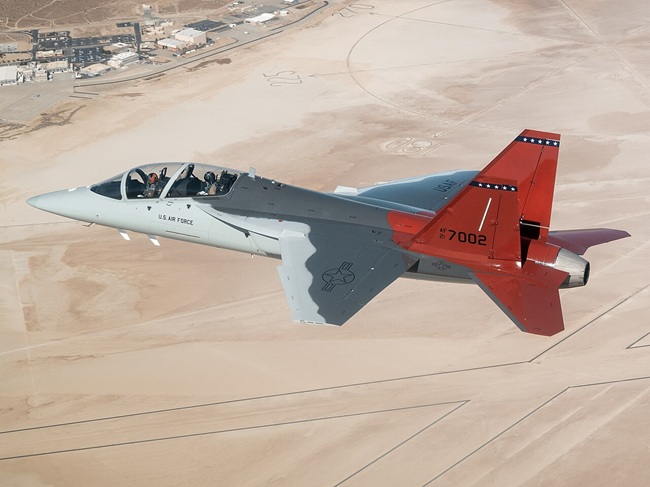
Boeing has decided not to continue its participation in the U.S. Navy's Undergraduate Jet Training System (UJTS) competition to replace the T-45 GOSHAWK jet trainers. The unilateral decision came following "careful consideration," with the company determining that the T-7A RED HAWK did not meet UJTS requirements. The USN issued a formal request for proposals for UJTS in March, with a plan to acquire 216 new jet trainers to replace the current fleet of just under 200 T-45s. With Lockheed Martin (LM), Korea Aerospace Industries (KAI), and now Boeing out of the running, the Sierra Nevada Corporation - partnered with Northrop Grumman and General Atomics with the FREEDOM JET - and a team led by Leonardo and Textron with the Beechcraft M-346N, are the only known remaining competitors.
In detail, it appears that Boeing's decision is linked to the General Electric F404 turbofan, which fails to meet UJTS engine qualification requirements despite its millions of flight hours on multiple platforms, including the T-7A and the TF-50N presented by LM and KAI. The single-engine configuration has always been less attractive for a naval jet. The T-7A has also experienced various technical and programmatic issues during its development, causing delays to the USAF, which is still waiting to reach Initial Operational Capability (IOC).
It is worth noting that the new trainer will no longer require carrier qualifications or even simulated touch-and-go carrier landings at shore-based facilities. Requirements for Field Carrier Landing Practice (FCLP) training have historically been structured to "simulate, as near as practicable, the conditions encountered during carrier landing operations," according to the USN. The service has also argued that virtualized training and assisted carrier landing capabilities - such as "Magic Carpet" and its evolutions - have meaningfully contributed to reshaping naval aviator training. The U.S. Navy's decision, however, remains controversial.
For Boeing, dropping out of the UJTS competition will allow the company to focus on the sixth-generation F/A-XX carrier-based fighter competition. For Leonardo and Textron, Boeing's exit removes the only credible UJTS competitor and eliminates the risk of a U.S. defense policy push toward a single trainer jet line for both the USAF and the USN.




Privacy Policy

Powered by © Mobilbyte s.a.s. Information Technology