



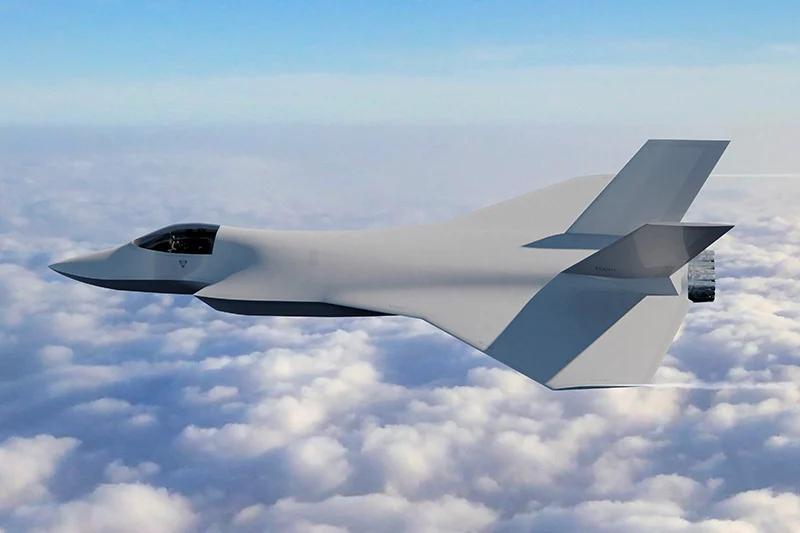
BAE Systems has made great progress in its Samlesbury plant in the manufacture of the major structural sections of the national demonstrator aircraft connected to the GCAP programme. The aircraft still has no name and is referred to as the Future Combat Air Demonstrator (FCAD).
Samlesbury is the factory where BAE Systems already manufactures the rear fuselage section for all F-35s produced globally, along with vertical and horizontal tails, and unsurprisingly is the site that is also handling the construction of the major sections for the new aircraft. According to BAE, circa 75% of the demonstrator “by volume” has now been manufactured and the target remains to roll the aircraft out by the end of 2027.
As already been estimated previously, the demonstrator is at least one-third longer than a Eurofighter TYPHOON, making it the largest aircraft to be assembled in the UK since the defunct NIMROD MRA4. The GCAP proper that will go into production is anticipated to be larger still: this national demonstrator is not yet truly representative of the tri-national jet and is only going to be a supportive side-project.
The FCAD demonstrator is the first wholly-UK built aircraft of its of its kind since the Experimental Aircraft Program (EAP) that was a key precursor to the Eurofighter TYPHOON. In August, BAE will celebrate the 40th anniversary of the EAP’s first flight.
The FCAD, importantly, marks a return to complex fighter wing manufacture in the UK after many years in which these parts have come from partner Nations and suppliers. FCAD is also obviously meant to demonstrate the stealth features intended for the 6th Gen fighter and to prove the launch of weaponry from internal weapon bays, something that was not carried out with the TARANIS UCAV demonstrator years ago.
The FCAD has two large, deep weapon bays at its center, taking up a large portion of the fuselage. They, and even more so the weapon bays on the “final” GCAP, are intended to be much more capacious than the F-35A’s own bays, able to take weapons larger in diameter and in length.
Last year, in informal discussions within the “Future Horizons; the TEMPEST podcat”, Group Captain Bill, Royal Air Force, leads the Requirement and Concepting team for the UK MOD in the context of FCAS (Future Combat Air System); Dave Morris Head of Campaigns for Future Combat Air, GCAP at Leonardo UK; and Mark Tivey, from Rolls Royce, Business Development Director, Future Programmes, Combat Air; had discussed the GCAP ambitions in broad strokes. In the occasion, payload was described as “twice that of an F-35A”, with range described as “maybe” enough to cross the Atlantic on one internal fuel load, whereas TYPHOON needs 3-4 “plugs” to an air tanker to make it.
The serpentine air ducts for the engine – that in the FCAD’s case will be 2 EJ200, same as for TYPHOON – wrap over the weapon bays. There is still not clarity on the detailed arrangement of the engines as the rear fuselage is the part still kept more “under wraps” so far.
It’s not clear, in particular, how close or widely spaced apart the two engines will be. BAE Systems has released a new low-detail, side-view CGI of the FCAD which suggests the engine nozzles will not be particularly stealthy, even though BAE has confirmed that there will be modifications compared to those found on TYPHOON.
BAE is using hot isostatic pressing (HIP) to manufacture the intake-fuselage junction as a single component, as well as to produce titanium actuator cradles cradles for the aircraft's large trailing-edge control surfaces. FCAD is going to have very prominent vertical control surfaces, with “fins” proportions that might recall those found on the Panavia TORNADO, an aircraft that literally got its nickname from it.
The composite “skins” for the FCAD have a claim to being the largest carbon-fiber structures ever produced by the UK aerospace industry. Final assembly will take place at BAE Systems Warton, where the still-active Eurofighter Typhoon assembly line operates.
An extra wing and an extra vertical stabilizer have been produced to be used for structural testing. The FCAD’s cockpit will feature a large area display and side stick. News of the progress of FCAD came just before the much-delayed publication of the UK’s Defence Investment Plan, which sets out a commitment to provide £8.6 billion to GCAP over the next 4 years alone.
The confirmation of the UK’s funding profile has in turn finally enabled the signing of the tri-national contract for the next phase of development. This massive international deal, announced on July 3, has a value of £4.6 billion over 18 months and will “enable completion of the advanced concept and assessment phase of the programme, and further joint detailed design and development”.
The contract has been awarded by the GCAP Agency (GIGO), which manages GCAP on behalf of the three Governments, to Edgewing, the trinational prime contractor and design authority for the GCAP aircraft. This deal follows an earlier, short-term “stop-gap” £686 million contract that was placed in April 2026. That short-duration arrangement was due in no small measure to the UK funding uncertainty.




Privacy Policy

Powered by © Mobilbyte s.a.s. Information Technology