



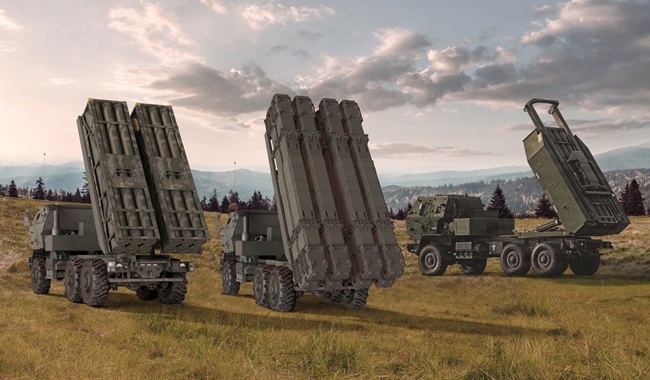
During Eurosatory 2026, Lockheed Martin announced HIMARS FLEX, a modular evolution of the M-142 HIMARS high-mobility rocket artillery system.
The variant introduces a configuration with an additional MFOM launcher capable of carrying twice the ammunition load of the standard HIMARS, retaining the same chassis and hull, while adding the capability to launch air defense and missile-defense interceptors, including the PAC-3, and incorporating optional autonomous operational capabilities through what the company calls the "FLEXFires" technology ecosystem. The system retains transportability aboard C-130 aircraft, compatibility with various NATO munitions, and the ability to integrate into joint fire control networks.
A standard HIMARS carries a single launcher pod, armable, depending on requirements, with 6 GMLRS/GMLRS-ER rockets — GPS-guided munitions capable of reaching 70 and 150 km respectively — with one ATACMS ballistic missile, with a range exceeding 300 km, or with 2 PrSM missiles, with a range exceeding 500 km, and is operated by a crew of 3 from an armored cab mounted on the hull of the M-1140 medium tactical vehicle. FLEX doubles the payload, increasing the number of GMLRS/ER GMLRS rockets from 6 to 12, ATACMS missiles from 1 to 2, and PrSM missiles from 2 to 4.
The dual-launcher configuration introduced by HIMARS FLEX is operationally significant, as it addresses one of the standard system's limitations: the need to return to a resupply point after depleting the ammunition in the single launcher before being able to engage further targets. Beyond doubling the number of targets a single firing unit can engage, the second pod allows the load to be split between offensive missile munitions in one launcher and interceptor missiles in the other. A single vehicle is therefore able to both strike long-range ground targets and defend against incoming missiles and aircraft, a capability the current single-pod configuration lacks.
The munitions compatibility list announced by Lockheed Martin for HIMARS FLEX covers the entire HIMARS and GMLRS family (base and ER), PrSM and ATACMS missiles and, as noted, adds PAC-3 MSE interceptor missiles and munitions associated with the Indirect Fire Protection Capability program for air and missile defense roles.
As mentioned, Lockheed states that the FLEXFires suite can add autonomous capabilities to the launcher, though the exact level of autonomy has not been made public.
The timing of the HIMARS FLEX announcement at Eurosatory 2026 was not coincidental, coming at a moment when European NATO members are evaluating — or have already acquired — new artillery systems, including HIMARS itself, the South Korean CHUNMOO system, or the Israeli PULS system. HIMARS FLEX aims to influence the acquisition evaluations currently underway across the continent. A system offering greater firepower, air and missile defense capability, and autonomous operating options compared to the standard HIMARS, while maintaining full compatibility with the current NATO munitions supply chain, represents a compelling case for any armed force weighing whether to acquire HIMARS or alternative systems.
The modular design philosophy Lockheed Martin has built into HIMARS FLEX also responds to the economic reality that not every country needs, or can afford, the full dual-pod configuration with air-defense functions from the outset. Operators can start with a base single-launcher configuration and progressively add the FLEX dual-pod load and autonomous capabilities according to budget and operational needs, reducing initial cost while preserving upgrade potential. In effect, HIMARS FLEX represents a modular evolution of the HIMARS family rather than a replacement for systems already in service.




Privacy Policy

Powered by © Mobilbyte s.a.s. Information Technology