



On 10 July 2025, the UK announced that a new “Entente Industrielle” was being forged with France, reinforcing the collaboration on joint projects in particular in the field of missiles.
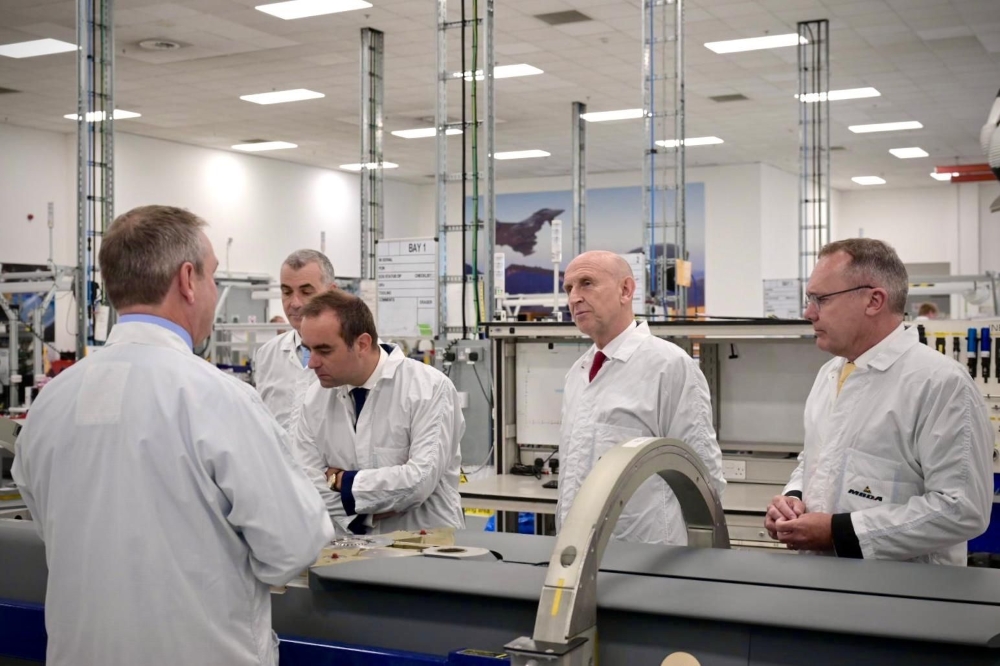
French defence minister Le Cornu visited MBDA UK Stevenage alongside then UK Secretary of State for Defence John Healey as the two Countries announced the joint resumption of production of STORM SHADOW / SCALP missiles.
The news release at the time promised that “upgrading the existing Storm Shadow cruise missile production lines in Stevenage to bolster national stockpiles” would support “more than 300 jobs within MBDA and the wider supply chain”.
With the Defence Investment Plan publication, however, STORM SHADOW became a “victim” of budget shortages. While the MoD is carefully avoiding to provide an up to date Out of Service Date for the weapon, the document signals a “pivot” away from STORM SHADOW in favor of STRATUS (which however won’t arrive in service before the “early 2030s”) and an as yet unidentified “low-cost cruise missile” towards which 300 millions are promised over the next 4 years.
The Opposition has since tried to determine what this means in practice and has asked to the Defence Industry Minister, Luke Pollard, “what progress has he made in procuring SCALP”. The answer is as always pretty evasive, yet eloquent: “the recently published Defence Investment Plan stated the UK will pivot from the joint French and UK procurement of New Build STORM SHADOW and SCALP Mark 2, to next-generation low-cost cruise missiles and the future Complex Weapon programme, STRATUS”. In practice, the UK is already out of the production restart affair.
In July 2025 the two Nations had also reaffirmed their commitment to the long running Future Cruise and Anti-Ship Weapon project, which has since received the name STRATUS from MBDA. The joint project completed the jointly funded assessment phase at the end of 2024 but the start of the Demonstration and Manufacture phase has repeatedly slipped. With the July 2025 announcement, UK and France confirmed they would eventually sign the contract to progress the project, which has been carrying on for the whole of 2025 with interim funding measures.
To this day, the tri-national contract (Italy is due to join) remains unsigned and it’s unclear how soon this will change. The UK’s Defence Investment Plan does signal a £1.4 billion investment into STRATUS over the 4 years to 2030 and key figures are being hired ahead of ground trials of STRATUS, but the same document also notes that a non better specified “review” is underway between the MoD and MBDA. Meant to conclude by September 1st, the review must ensure the project can “deliver on time and budget”, which clearly implies that some serious concerns remain, as always flagged in the past by the National Infrastructure and Service Transformation Authority (NISTA).
Apart from this, there is no sign of either Country intending to order each other’s missile within the STRATUS family. As know, STRATUS is a complementary solution comprising 2 missiles, the LO and RS: the former is subsonic, highly stealthy and optimized for strikes against hardened targets while the RS is supersonic and capable of anti-radiation use, both against enemy radars on the surface and in the air (long range AWACS killer).
The LO is mostly based on British content, the RS is mostly French. According to the French DGA, the split is in the order of 90 to 10 percent in terms of industrial content per Nation, for each missile. The UK is planning to acquire the STRATUS LO for both air launch, to replace STORM SHADOW on TYPHOON (and maybe one day on F-35) and for vertical launch from MK41 cells on Type 26 and Type 31 frigates.
France is focused on the “anti-radar” STRATUS RS to enter service by 2035 on the RAFALE standard F5. Instead of adopting the STRATUS LO, France is content to carry on with production of the SCALP Mark 2 from which the UK is “pivoting away”. The UK, even worse, will continue to miss out on a supersonic strike option and an anti-radar missile, a capability that is a gap since the 2013 withdrawal of ALARM.
Again, UK and France had also committed in July 2025 to work together on “the next generation of beyond visual range air-to-air missiles”, in other words the METEOR successor. While a joint 12-months study for this was launched earlier this year, it’s unclear how joined up the process truly is, between the announced French COMET aimed already at 2030 and the UK’s announcement that it will not fund a METEOR Mid-Life Upgrade aiming instead to leap directly towards a successor system. The Entente Industrielle is not looking very healthy.




Privacy Policy

Powered by © Mobilbyte s.a.s. Information Technology