



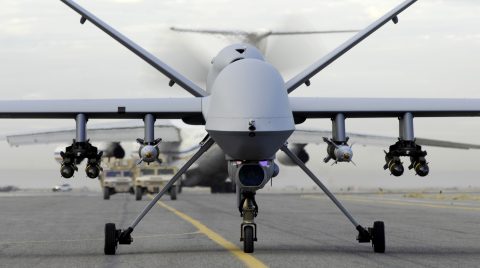
In a solicitation open to both US and international vendors, the US “Joint Force”, not just the Air Force, ask industry for their proposal for building a new type of uncrewed aircraft that must be much cheaper than MQ-9 and operate in greater numbers, absorbing “inevitable” losses while continuing to deliver effect in a more cost-effective way.
The solicitation opens by acknowledging that relaying on “high-value "exquisite" (>$30 million) manned and unmanned aircraft is unsustainable against adversaries utilizing layered defenses enabled by increasingly low-cost antiaircraft capabilities”. This forces the Joint Force into unacceptable compromises, either operating “safely” outside a threat zone at the expense of mission effectiveness, or maneuver inside it but taking expensive levels of attrition.
This solicitation openly admits that attrition is “inevitable” and that this new type of uncrewed aircraft will have to operate through the deployment of “larger numbers of less-expensive unmanned platforms” designed from the start “with the expectation that some will be lost in combat”.
The Massed Modular Aircraft are envisioned as in-theater reconfigurable platforms for long-range payload delivery. “Crucially, MMA must retain the ability to be outfitted with a variety of payloads, including Full Motion Video (FMV) sensors, to execute missions that the MQ-9A performs today”, the solicitation notes, in what is the passage that more openly connects MMA with plans for replacing today’s REAPERs. The key, defining requirements for the MMA tell us more about the US’s current thinking.
In terms of payload, the MMA must carry “at least” 2,800 lbs. This is significantly less than the MQ-9A REAPER’s payload of 3,850 pounds (1,746 kg), consisting of up to 850 pounds (386 kg) internal and 3,000 pounds (1,361 kg) external. This is, however, a threshold requirement and greater detail on the eventual separation between internal and external fits might reduce the extent of this apparent gap.
Combat radius unrefueled must be at least 2,300 nautical miles with payload on board; the aircraft must be able to self-deploy in one-way travels of “at least” 8,000 nautical miles. Crucially, a single operator must control “many” UAS, drastically reverting the very manpower intensive model the MQ-9 has traditionally employed during the entire “global war on terror” era, in which a single MQ-9 has been controlled by crews of 2 or more operators rotating in shifts.
Control of the MMA is to be ensured via an hybrid solution of SATCOM and mesh network connecting to the Department of the Air Force-Battle Network (DAF-BN). It must also be possible to execute locally the airfield operations (taxi, takeoff, landing, and divert) where satellite communications are highly degraded or denied.
“Sufficient” available size, weight, power (25kW), and cooling (5kW) margins are required to support flexible internal and exernal payload approaches with “rapid” exchange of systems. The aircraft must fly at “at least” 200 knots true airspeed and is required to operate from 6,000 foot runways but also, ideally, shorter and even semi-prepared surfaces.
The platform must ensure interoperability and ease of integration by complying with agreed standards for hardware and software, in particular the Government Reference Architectures. The machine must be built to Modular Open Systems Approach (MOSA) such as Model Based Systems Engineering and formal methods-based software verification.
The solicitation wants mature proposals that are capable of transitioning to a full-scale flying prototype within 21 months of contract award. An Initial Operating Capability consisting of 20 mission-ready aircraft in an operational, deployable unit is targeted for Fiscal Year 2031.




Privacy Policy

Powered by © Mobilbyte s.a.s. Information Technology