


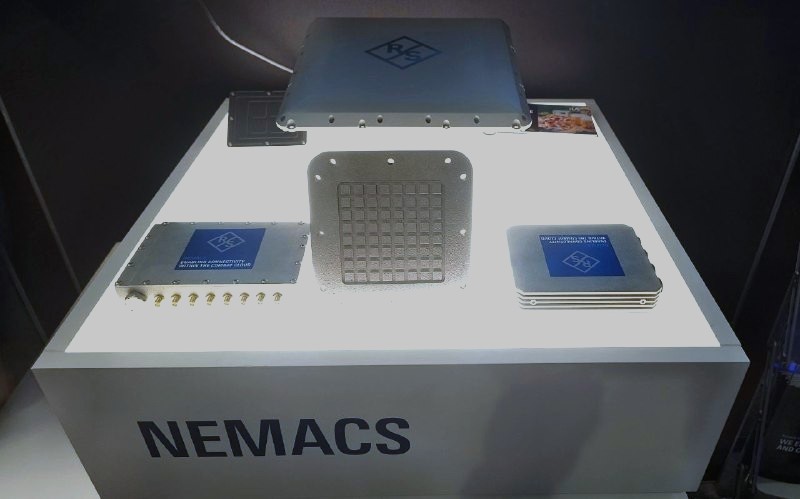
During the ILA Berlin Air Show 2026, German technology group Rohde & Schwarz unveiled NEMACS (Networked Multipoint Array Communications System), a new directional datalink designed to serve as the communications backbone of the multi-domain combat cloud, enabling high-throughput data exchange among crewed and uncrewed platforms across air, land, sea, and space.
The system is built around a powerful Communication Management Suite (CMS) orchestrating a family of line-of-sight directional datalinks operating on 2 frequency bands: C-band, already developed, and Ku-band, in development with delivery readiness targeted for 2029 (with projects also for Ka band). The directional principle relies on narrow, electronically steered beams generated by AESA (Active Electronically Scanned Array) antennas integrated with Software-Defined Radios (SDR). The result is a resilient, multi-link mesh network in which every node is reachable from multiple directions and traffic can be dynamically rerouted around jammed sectors, eliminating any single point of failure. The declared range in C-band is 200 nautical miles (around 370 km). Link bandwidth is dimensioned to carry high-resolution video and real-time sensor feeds, in marked discontinuity with the previous-generation TDMA omnidirectional tactical data links (LINK 16 chief among them) designed for symbolic track exchange in permissive electromagnetic environments. The beam directionality reduces the spatial signature of the emission, while SDR waveform processing reduces its signature in frequency: the resulting link exhibits pronounced Low Probability of Detection (LPD) and Low Probability of Interception (LPI) properties, a central requirement in heavily contested electromagnetic environments typical of peer and near-peer conflicts.
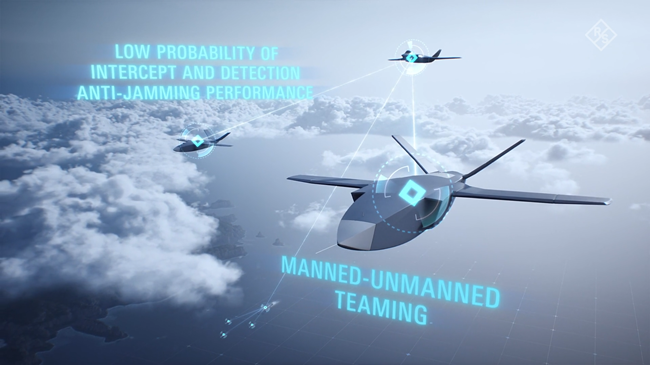
The CMS also handles the interfacing with legacy onboard datalinks - including LINK 16, tactical radios and sensor outputs - and orchestrates a SATCOM channel for beyond-line-of-sight (BLOS) extension of the network, ensuring connectivity continuity when nodes are too far apart for the direct LOS links. The system also supports multi-band operation in VHF/UHF for interoperability with legacy tactical radios. NEMACS supports both NATO and national encryption standards, allowing the system to be grafted onto existing avionics architectures without redesign.
NEMACS is offered as a modular product family, scaled to the size, weight and power constraints of the host platform: a larger C-band AESA terminal for frontline combat aircraft and naval surface units, and a compact Ku-band variant in which the shorter wavelength allows the same number of active elements to be packed into a substantially smaller aperture: a configuration optimized for Collaborative Combat Aircraft (CCA), Unmanned Combat Air Vehicles (UCAV) and remote carriers. The architecture is explicitly positioned as the connectivity layer for Manned-Unmanned Teaming (MUM-T), drone swarming and Multi-Domain Operations (MDO), all functions historically associated with 6th Generation air combat requirements.
Also at ILA 2026, Boeing announced the expansion of its German MQ-28 GHOST BAT industry team, welcoming Rohde & Schwarz and Diehl Defence alongside existing strategic partner Rheinmetall. Within Boeing's offer to the German Air Force (Luftwaffe), Rheinmetall will act as the systems integrator of German technologies, Diehl Defence will lead weapons integration (including the IRIS-T missile) and Rohde & Schwarz will provide mission and communications systems integration through NEMACS. On the German drone, NEMACS will play a role analogous to that of the MADL (Multifunction Advanced Data Link) on the US F-35: a narrow-beam directional link in Ku-band, with structural LPI/LPD properties, for high-capacity data exchange among low-observable platforms. Delivery to the Luftwaffe, if the platform is selected, is targeted for 2029.




Privacy Policy

Powered by © Mobilbyte s.a.s. Information Technology