



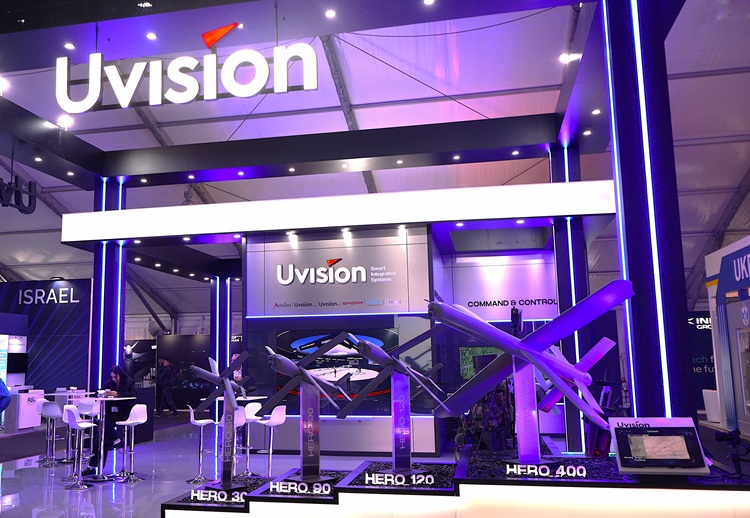
Two announcements central to Israel’s UVision current strategic phase converged at ILA Berlin 2026: the public launch of CORTEX, an AI-enabled Battle Intelligence and Mission Management platform (Battle Management System, BMS) announced on June 1; and the operational confirmation of UVision Europe GmbH, the Munich-based European subsidiary announced in March 2026 and now ramping toward full activity in 2027.
Read together, the 2 announcements describe a single strategic bet - UVision's pivot from loitering munition manufacturer to European system integrator with sovereign industrial standing — that FW Mag was able to discuss at ILA directly with Roman Didenco, the appointed CEO of UVision Europe GmbH.
The timing is not coincidental. With the EU's Security Action for Europe (SAFE) instrument channelling up to €150 billion in EU-backed loans toward joint procurement from contractors headquartered in the EU, EEA-EFTA or Ukraine, the European Defence Fund (EDF) funding research and development conditional on European establishment and design authority, and the German Zeitenwende driving the largest national defense build-up since reunification, the market pull for a non-European prime to relocate industrial substance to the continent has never been stronger — provided the entity is structured to capture it. UVision Europe is structured exactly for that purpose.
From hardware to ecosystem
UVision's portfolio — the HERO, VIPER and PEREGRINE families of loitering munitions — is already fielded by NATO and allied customers and carries assigned NATO Stock Numbers (NSNs). The expansion into mission management software reflects what the company's leadership describes as a shift in customer expectations: Armed Forces no longer require point-to-point solutions but operational ecosystems that connect sensors, command structures, and effectors into a single decision loop.
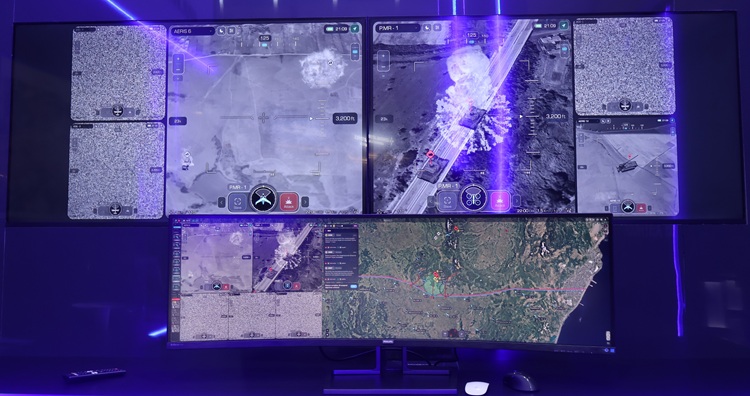
CORTEX is exactly that ecosystem. Building on the company's previously presented Common Operating System concept — originally conceived to manage heterogeneous loitering munitions from a single C4I — CORTEX extends the same logic outward, adding multi-source sensor fusion, AI-driven decision support, and continuous battle damage assessment under one mission-level interface. The architecture is structured in 3 modular layers: sensing and detection, fusion and decision-making, and response and mission execution. The sensing layer is explicitly sensor-agnostic, designed to ingest data from EO/IR payloads, radar, RF detectors, acoustic sensors, and external intelligence feeds regardless of provenance — meaning customers can integrate CORTEX into existing sensor infrastructure without hardware overhaul. The fusion layer applies proprietary AI models to perform multi-source data fusion, threat classification, behavioral analysis, and anomaly detection, generating a unified situational picture in real time. The response layer then orchestrates the coordinated deployment of HERO, VIPER, and PEREGRINE systems (or other systems/effectors) based on target type, priority, and engagement conditions, while maintaining human oversight at all kinetic decision points.
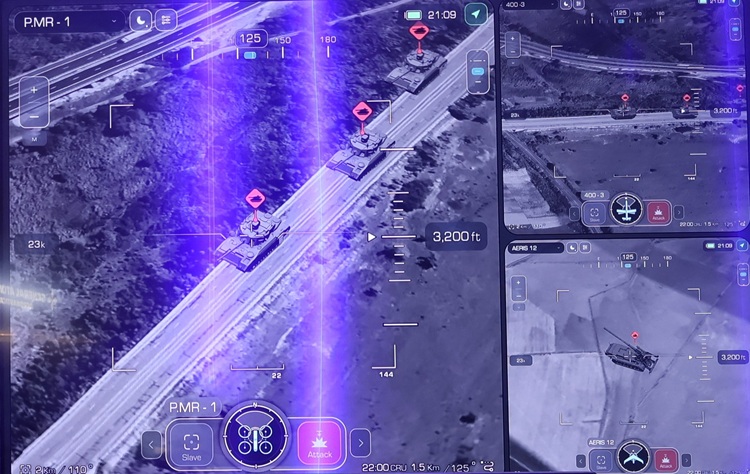
The interface runs a continuous operational loop — Detection, Classification, Decision Support, Engagement, BDA, Re-Task — designed to shift the operator from platform-level control to mission-level supervision. UVision representatives at ILA indicated that basic mission management can be achieved within hours of training, while full operational proficiency takes days. A single operator can oversee multiple simultaneous missions across heterogeneous platforms deployed on land, air, and maritime domains. One capability that operational analysis of the Ukraine conflict has identified as decisive is the ability to redirect a loitering munition in flight to a higher-priority target: in a scenario demonstrated at the stand, a HERO 400 already en route to an artillery position is dynamically redirected to intercept a closer tank column, with the system computing time-to-target for both options and presenting the operator with a double-swipe authorization.
Architecture and interoperability
CORTEX does not replace existing BMS or C4I architectures; it connects to them. Communication infrastructure — whether fiber optics, cellular, or military radio links — is provided by the customer; CORTEX sits as an intelligence and decision-support layer on top of it. The system integrates with C5ISR ecosystems and third-party battlefield management platforms through an open architecture. All engagement authorization remains with the human operator: UVision confirmed the system is technically capable of operating in a more autonomous mode, but the current configuration maintains human-in-the-loop control for all kinetic actions, consistent with European regulatory and ethical requirements.
The AI models underpinning the fusion layer are proprietary and theater-specific. Effective deployment requires training the system on data relevant to the expected operational environment — adversary equipment, terrain, weather conditions, and engagement profiles. This theater-specificity is a deliberate design choice: the same underlying architecture can be adapted to different operational contexts through targeted data ingestion.
UVision Europe GmbH: Munich as anchor
Announced on March 26, 2026, UVision Europe GmbH is the company's first direct industrial presence in Europe and wholly-owned European entity, and is structured to carry its own German intellectual property. The IP point is not cosmetic: EDF eligibility rests on a package the industry commonly synthesises as "European IP": the contractor must be legally established in the EU as a European company, controlled by EU-based entities, and hold design authority over the funded product — meaning the unrestricted ability to modify, adapt and evolve the design without third-country interference. SAFE applies analogous logic at the procurement stage, prioritising contractors that meet the same headquartering and design-freedom criteria, with tighter conditions still for Category 2 projects (which include drones and counter-drone systems). Without a German-IP entity, neither funding channel would be accessible to a company whose core IP sits in Israel.
The Munich entity is distinct from the existing European production footprint operated under the 2021 strategic partnership between UVision and Rheinmetall. HERO 30, HERO 120, and HERO 400 are currently manufactured at full rate by RWM Italia, a Rheinmetall subsidiary, at 2 sites in Sardinia — Musei for assembly and electronics, Domusnovas for warhead production — against a backlog exceeding €200 million for 8 European countries (NATO and non-NATO). Munich adds a different capability layer under direct UVision control: final integration, engineering support, Integrated Logistics Support (ILS), training, and a locally anchored development program generating German-IP products tailored to European sovereign requirements.
The choice of Munich was deliberate on multiple counts. The city hosts a major aerospace technology university and the Airbus Defence and Space headquarters. The facility itself is a 15,000-square-meter building currently under lease. According to the company, executive-layer recruitment was scheduled for completion by end of June 2026; production and technical staff recruitment is planned for Q3 2026, with 3 to 4 months of specialized training before operations begin. The target start date for full activity is Q1 2027.
The rationale for treating Germany as the anchor market is both economic and political: German defense procurement volumes and Germany's influence within European defense structures mean that successful delivery to the Bundeswehr creates conditions for broader European adoption. As Didenco stated at the time of the announcement: "As European armed forces accelerate procurement and modernization efforts, the need for trusted, responsive, and locally anchored defense partners has become increasingly important. UVision Europe is established to address that need, bringing the company closer to its customers and creating the foundations for a progressively independent European operation."
A Software-Defined European foothold
First CORTEX deliveries are expected in the first half of 2027, concurrent with the start of full activity in Munich. The system is already in an advanced testing phase with customers UVision did not disclose. Beyond the schedule, what the combined CORTEX-Munich move signals is more structural: the European defense market is no longer accessible to non-European primes purely through partnerships and licensing. Sovereign IP, local production, and software-defined integration capabilities are becoming the conditions of entry — and UVision is reorganizing itself to meet them on all three fronts simultaneously.




Privacy Policy

Powered by © Mobilbyte s.a.s. Information Technology