



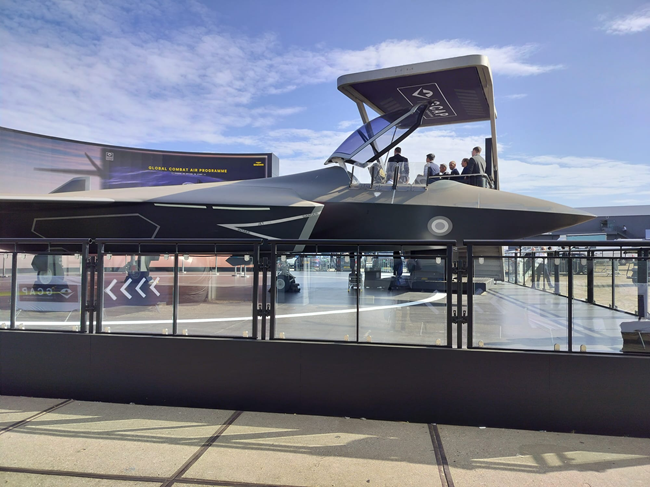
The award follows months of concern over British difficulties in allocating funds to keep the program running, but the new DIP (Defence Investment Plan) has confirmed GCAP's centrality for London as well. Hence the funds, amounting to just under €10 billion over the next 4 years, and the resolution of the impasse with the EdgeWing contract signature.
Quite a few had been questioning British intentions, going so far as to cast doubt on the fate of the programme. For London, GCAP is essential to preserving industrial and technological sovereignty and operational freedom of maneuver. It would have been absurd to scrap a program on which London has already invested billions of pounds, starting well ahead of its Italian and Japanese partners, developing a national demonstrator with the clear aim of shaping GCAP's design — thus replicating the exact strategy already adopted with the EUROFIGHTER TYPHOON and the EAP (Experimental Aircraft Program). Assembly of the demonstrator will begin at the end of the year, with first flight expected by late 2027 or early 2028.
All is well that ends well, all the more so given that the program could soon add a new partner, Canada, which for the time being would come in as an observer — an official announcement could arrive tomorrow. Meanwhile, the rival SCAF program appears buried under the insatiable industrial appetite of Dassault and its unshakeable CEO Eric Trappier, who is aiming at a super-loyal-wingman derived from the NEURON and at a RAFALE 3.0 — decidedly less ambitious, but more sustainable and more exportable. A real gamble for Paris, and we shall see how it plays out, but also a strategy of pragmatism and realism that acknowledges the need to strike the right trade-off between technological sophistication and operational and life-cycle sustainability.
Beyond GCAP, this first day of the show has no shortage of takeaways. Drones, drones, and drones again — that is the leitmotif, evidence of a now firmly consolidated trend, riding the wave of lessons continuously coming out of theaters from Ukraine to Iran, as already seen at the recent Eurosatory and ILA.
On drones, the new British Defense Secretary Luke Pollard announced shortly before the show's opening the programme for the RAF's adjunct, designated STORM FIGHTER, for which the DIP has already allocated over €400 million. The aircraft is intended to operate as a wingman for fourth-, fifth-, and sixth-generation fighters. It remains to be seen whether a national solution will be chosen or foreign products will be picked: standing out in this regard on the static display is Boeing's GHOST BAT, shown with the multipurpose air-to-surface missile BRIMSTONE.
LBA Systems, the joint venture between Leonardo and Baykar, as previously reported, has launched the ASTORE LEVANTE, the Italian variant of the Turkish TB-3. Full details will be provided in the complete report in the magazine. Leonardo and Baykar themselves held a briefing today on the MUM-T (Manned-Unmanned Teaming) trial conducted with an M-346 and 2 KIZILELMA adjunct/UCAVs: project K-SWARM. This is a significant "first" in the development of an adjunct — the adjunct component is not part of the trinational Italy-UK-Japan cooperation on GCAP — and of its integration/cooperation with manned platforms, whether sixth-generation, fifth-, or fourth. In the trial, whose complexity will further increase in the coming months, the airborne M-346 flawlessly controlled the 2 KIZILELMA in autonomous formation flight, using a CUC-T (Crewed Uncrewed Teaming) Computing Unit fully integrated into the aircraft's avionics and purpose-developed algorithms. In essence, the pilot in the M-346 issued only high-level commands to the formation, with the 2 KIZILELMA following the "mothership" through its flight maneuvers entirely autonomously. Full details will follow on this as well. The Leonardo-Baykar cooperation confirms itself as solid, even after the change at the top and the handover from Roberto Cingolani to Lorenzo Mariani. It will be interesting to see whether the KIZILELMA will really be the Italian adjunct, as had emerged under Cingolani, or whether Leonardo will instead seek a standalone positioning in the drone segment beyond its partnership with Baykar.
As far as drones are concerned, Anduril, in partnership with Archer Aviation (a leader in commercial e-VTOLs for air taxis), has unveiled an innovative unmanned tiltrotor designated THUNDER. The aircraft features hybrid-electric propulsion, wingtip tilting rotors, and an open V-tail. Another notable feature is its modular internal bays — one above the nose and 2 on the sides — which can be reconfigured with different payloads. Anduril mentions a configuration capability with 10 air-to-surface missiles (HELLFIRE, JAGM, or BARRACUDA-100M) or 16 ALE (Air Launched Effects), among others. The aircraft, which is genuinely large, falls into Category 5, and judging from the mock-up presented, wingspan is on the order of 10-12 m, with weight potentially ranging between 4 and 6 tons, if not more. THUNDER features retractable landing gear and is being presented as a wingman for helicopters, particularly the US Army's MV-75 CHEYENNE II (FLRAA).




Privacy Policy

Powered by © Mobilbyte s.a.s. Information Technology