



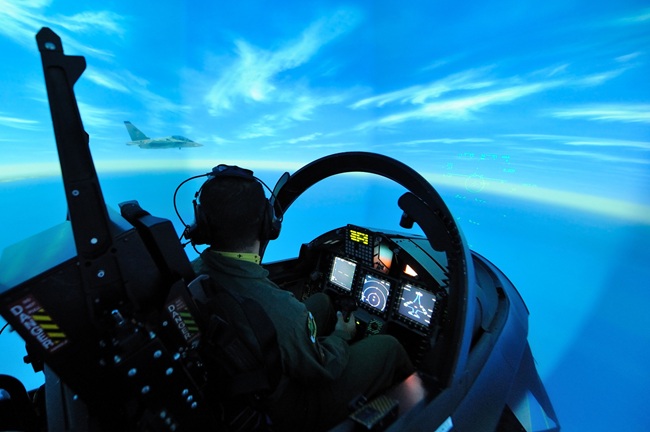
Farnborough International Airshow 2026 opened yesterday with a Western defence industry that has never been under more pressure to deliver, and never been more exposed to the mismatch between the pace of platform procurement and the time it takes to train the crews to operate them. Training and simulation, historically the least glamorous corner of any airshow, has quietly become one of the strategic bottlenecks. CAE — the world's largest platform-agnostic training and simulation provider, with more than 300 full-flight simulators in operation across some 240 sites in over 40 countries — sits at the centre of that shift. Ahead of Farnborough, FW Mag met Pascal Grenier, President of CAE Defence & Security, at ILA Berlin 2026 in mid-June to discuss CAE's agnostic training model, its partnerships with Saab and TKMS, and the future of Live-Virtual-Constructive training.
Future Warfare Magazine (FW Mag): CAE is best known in the civil market, where more than 80% of the world's airline pilots train on your simulators. Less is known about the defence side, particularly in Europe. How is the company structured on this side of the Atlantic?
P. Grenier: CAE has been operating for nearly 80 years. The first contract, in 1947, was with the Royal Canadian Air Force to install radars in the Arctic. Today the company employs around 13,000 people at some 240 sites in more than 40 countries, with civil aviation and defence and security as the two main pillars. Germany is our European hub: we have been present here for 65 years, with a team of about 600 people. The defence model differs from the civil one in a key respect. In the civil world we train pilots. In the defence world we train pilots and missions. Mission training is the more demanding and more strategic component, and it is what shapes most of our partnerships with platform manufacturers.
FW Mag: At CANSEC you announced a Canada-specific teaming agreement with Saab on the GlobalEye, on the same week Canada selected the platform as preferred supplier for its future AEW&C capability. What does CAE bring to the table?
P. Grenier: CAE is already the default training provider for the Bombardier Global 6500, the platform on which GLOBALEYE is built: pilots flying that aircraft worldwide train on our simulators. With Saab we are extending the cooperation to mission training, which is where the operational value of GlobalEye is concentrated. The partnership was formalised globally in November 2025 and reinforced with a Canada-specific teaming agreement at CANSEC. Canada has now designated GlobalEye as the preferred solution for six aircraft in a programme worth more than 5 billion CAD. France ordered two aircraft with two options in December 2025 for 1.3 billion USD; the UAE has five in service; Sweden operates the platform. NATO is evaluating GlobalEye to replace its E-3A Sentry fleet (Ed. note: On 7 July 2026 NATO opened negotiations with Saab for up to 10 GLOBALEYE). Recognizing early that mission training dictates GLOBALEYE’s operational timeline, Saab embedded training from the program's inception rather than treating it as a post-delivery phase. Our competitive advantage on programmes like this is the installed base: CAE operates more than 360 full-flight simulators worldwide, and that network is what allows us to plug a new platform into an existing global training footprint rather than build it from scratch.
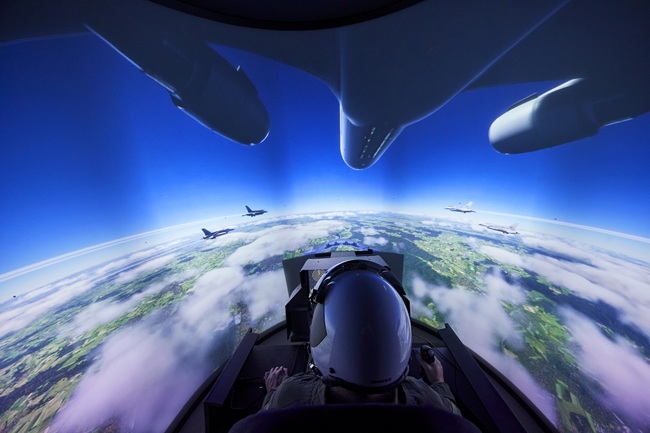
FW Mag: The other CANSEC announcement was the expanded cooperation with TKMS on naval training and simulation. At the same time CAE has agreements in place with TKMS's competitor Hanwha Ocean for the Canadian submarine programme. How does that work?
P. Grenier: This is the model. CAE does not want to be tied to one single company. In the civil world Airbus, Boeing, Embraer and Bombardier all come to us for training: none of them sees us as a competitor, because none of them is in the training business. We operate as the OEM of training. The same applies to defence. The Canadian Patrol Submarine Project is the clearest example: up to 12 conventional submarines, a final decision expected by mid-2026, 2 qualified bidders — TKMS with the Type 212CD, together with Norway and Kongsberg, and Hanwha Ocean with the KSS-III Batch II. CAE has teaming agreements in place with both. Whichever platform Canada selects, we will provide the training. Being agnostic is not a slogan: it is what allows us to support whichever solution a sovereign customer chooses.
(Ed. note: On 6 July 2026 Canada selected TKMS as preferred supplier for the CPSP)
FW Mag: Another flagship partnership on the platform-manufacturer side is the International Flight Training School at Decimomannu and the joint venture with Leonardo. How central is it to CAE's defence portfolio?
P. Grenier: IFTS is a flagship operation, for Leonardo, for the Italian Air Force, and for CAE. More than a dozen partner air forces currently send their student pilots there, including Canada, which no longer trains fighter pilots domestically: Canadian pilots destined to the F-35 are now training at Decimomannu. The United States joined last year. The USAF and the Italian Air Force signed a Concept of Operations in August 2025, and the first ten American students began the syllabus in September — it is the first time in USAF history that initial pilot training is conducted in a foreign NATO school. The combination works because Leonardo provides a frontline lead-in fighter trainer with the M-346, the Italian Air Force provides the operational framework, and CAE provides the simulators and the curriculum integration. The simulators communicate with the real aircraft, which is what most impresses the visiting pilots. Demand for fighter pilots is rising worldwide and the IFTS model is one of the few that scales: with Leonardo we are working to replicate it where demand emerges.
FW Mag: Beyond initial pilot training, Live-Virtual-Constructive and distributed simulation are reshaping how Western air forces train together at the operational level. Where is CAE on this curve?
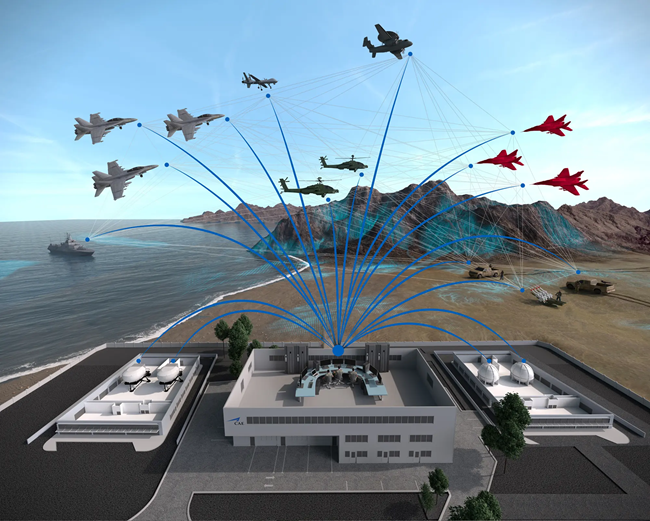
P. Grenier: We have recently run a demonstration that gives the idea. A real drone operating in Hawaii fed sensor data into an F-16 simulator in Texas, while a JTAC operator in Orlando participated in the same exercise. The F-16 crew saw synthetic data, but the data originated from a real platform thousands of kilometres away. The principle is that every asset in operation today is a sensor, and every asset in training must be part of the same synthetic environment in real time. This enables joint training first, and then coalition training, which is where the operational payoff is highest. We have a software framework that connects different simulators from different OEMs and different countries into one common environment, while preserving the sovereignty of each participating force over its own data. That agnostic interconnection is the architectural choice that makes coalition training possible.
FW Mag: European defence spending is rising sharply, with NATO members committed to reaching 5% of GDP. What does this mean for the training pipeline?
P. Grenier: The bottleneck is shifting. With defence spending rising across Europe, Canada and globally, the procurement of platforms is accelerating, but having the equipment is not the same as having the capability. Buying a platform does not give you readiness. Crews must be ready to operate it, and training takes time. Speed and readiness are now the priorities, and the industry has to deliver them in parallel with the platform deliveries. That is where partnerships with OEMs make the difference: the earlier training is integrated into a programme, the shorter the gap between delivery and operational capability. Everything is moving much faster than before, and the training side of the equation has to keep up.
-------------------------------------------------------------------------------------------------------------
Future Warfare Magazine thanks Pascal Grenier, President of CAE Defence & Security, and CAE for their time and for the openness of this conversation.

Privacy Policy

Powered by © Mobilbyte s.a.s. Information Technology