



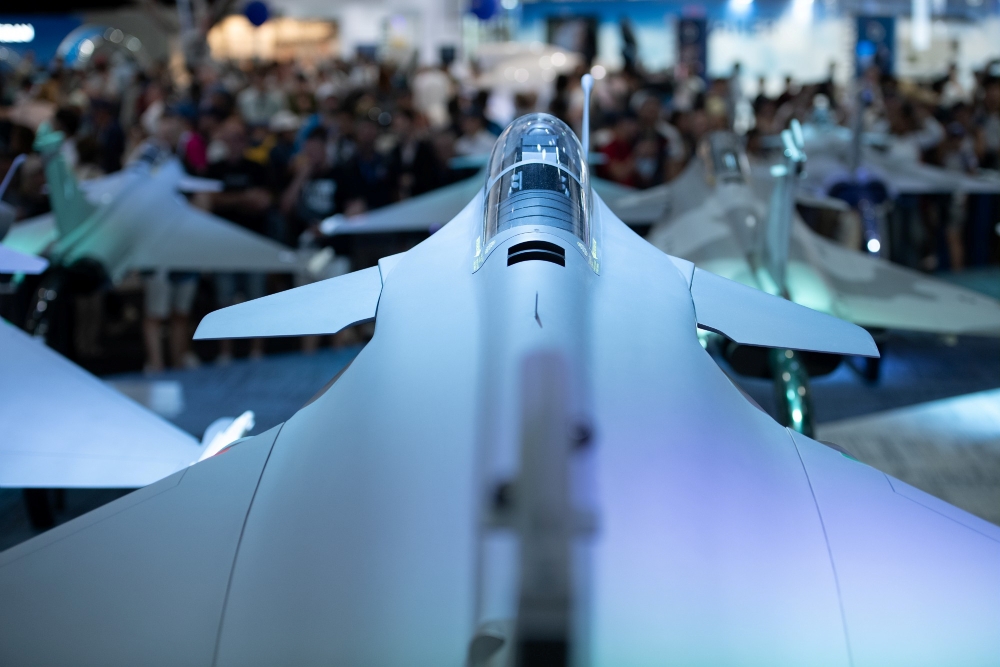
Dassault Aviation used yesterday’s press conference in Saint Cloud to signal that, despite a turbulent strategic environment, the group is entering the second half of 2026 with robust figures, a busier RAFALE roadmap, and an increasingly ambitious vision for both next generation combat air and spaceplane programmes.
A SOLID FIRST SEMESTER
Opening the session, Eric Trappier framed the company’s performance against the backdrop of continued war in Ukraine, tensions in the Gulf and an updated French defence planning law that raises national defence spending. In that context, Dassault closed the first semester with consolidated adjusted revenues of €4.157 billion, up 46 per cent year on year, driven primarily by additional RAFALE export deliveries and associated development and support milestones. The adjusted operating result reached €330 million, with a margin of 7.9 per cent, while adjusted net profit stood at €496 million. Available cash climbed to just over €10.1 billion, largely thanks to RAFALE export down payments.
On the programmes side, the semester saw the delivery of 12 RAFALE, 10 for export customers and 2 for France, and 13 FALCON business jets, as well as orders for 23 FALCONs that more than doubled the previous year’s intake. The consolidated order book on 30 June amounted to €45.36 billion, covering 291 aircraft: 208 RAFALEs (165 export and 43 for France) and 83 FALCON, underlining the long term visibility of the production pipeline. Trappier confirmed guidance for 2026 with revenues expected to rise to around €8.5 billion, based on deliveries of 40 FALCON and 28 RAFALE over the year.
RAFALE: FROM F4 “BRIDGE” TO A MUCH DEEPER F5
The CEO devoted a significant portion of the briefing to RAFALE, underscoring how the aircraft continues to anchor Dassault’s defence business while its future standard is being re imagined. Since programme launch, 533 RAFALE have been ordered, including 323 for export, with 208 aircraft still to be delivered as of end June.
Paris has asked to defer delivery of 20 aircraft from 2031 2032 to 2033 2034, a move designed to free budgetary room for ongoing F4.3 work and risk reduction on F5.
Back in early 2020s, the French Ministry of Armed Forces, DGA and Dassault saw RAFALE F4 as the “bridge” to FCAS: a fifth generation way of fighting packed into a fourth generation airframe, built on deep connectivity, enhanced SPECTRA and incremental radar and sensor evolutions rather than a new platform.
That evolution was underpinned by a suite of “Plans d’Étude Amont” (PEA) – preliminary study programmes that the DGA regularly awards to de risk key technologies, sustain specialist know how and prepare future upgrades. CAPOEIRA (Connectivité Améliorée POur les EvolutIons du RAfale) focused on improved connectivity and produced the prototype of the on board connectivity server; CARAA (CARAA (CApacités Accrues pour le Radar RBE2 à antenne Active) and MELBAA (Modes et Exploitation Large Bande pour l’Antenne Active) matured active array radar hardware and wide band modes; INCAS (Introduction des Nouvelles CApacités SPECTRA) and DEDIRA (Démonstrateur de DIscretion du RAfale) explored new digital sensors, jamming techniques and signature reduction measures for SPECTRA and the airframe.
The working assumption was that these PEAs would mainly feed RAFALE F4 and a relatively modest F5, conceived as a final “non regression” update to keep the aircraft aligned with FCAS and avoid obsolescence. Trappier’s remarks in Saint Cloud confirm that this logic has shifted markedly. Originally conceived as a last evolution of F4, F5 is now set to become a much more transformative step.
Indeed, Dassault is working towards a standard with new engines, a new radar, an updated mission computer and weapons suite, and expanded connectivity, implying a significantly modified airframe rather than an incremental upgrade.
The development work already under way focuses on de risking F5 capabilities tied to the airborne nuclear component, with an entry into service targeted between 2033 and 2035 – hence the rescheduling of French deliveries – and placing RAFALE on a capability trajectory much closer to a de facto “5th generation” system than the previous plan suggested.
Beyond near term sales, Trappier highlighted how the envisaged autonomy functions and predictive maintenance capabilities associated with F5 - supported by sovereign, in house AI tools and big data driven health monitoring – are meant to sustain RAFALE’s relevance well into the 2040s, effectively extending the RAFALE family’s role as France’s main combat air pillar far beyond the 2040 horizon that framed FCAS planning four years ago.
This is all the more necessary given that Dassault has confirmed that new negotiations are under way with potential new customers for the French fighter jet.
THE POST SCAF FIGHTER: NATIONAL LEAD, OPEN PARTNERS
The most politically sensitive part of the press conference addressed the future of European combat air following the termination of the SCAF/NGF framework.
In 2018, French planners aimed to have a binational demonstrator financed by around 2022 and flying by 2026, with SCAF/FCAS replacing RAFALE and EUROFIGHTER around 2040, under a governance architecture carefully balanced between Paris and Berlin. That timeline has now given way to a national reset: Trappier confirmed that the French president and German chancellor have “by mutual agreement” decided to stop the SCAF NGF programme, forcing Paris to chart an alternative course.
Dassault is in discussions with the French state to launch a new fighter demonstrator built on a Franco French basis, with the goal of a first flight around 2031 if a governmental decision is taken before the next presidential election. If this were confirmed, the new fighter could still enter service in 2040, despite the FCAS setback. This leads us to two observations: on the one hand, Dassault would demonstrate that it has effectively mastered all the necessary technologies; and on the other, as FW MAG has always assumed, the national option – as a last resort – has never been ruled out and has always been under consideration.
Crucially, Trappier stressed that Dassault is structurally open to partnerships, both European and non European, but insisted that choices on allies and architectures remain a sovereign prerogative of the French state. Talks with Saab are among the most visible options, and would, in effect, bring together Europe’s most experienced combat airframers on a project shaped by converging needs: a smaller, less expensive aircraft than GCAP, compatible with carrier operations (French key requirement) and short runways (Swedish key requirement). In early 2026, Trappier had predicted that an all-French fighter would cost around €50 billion in research and development, which is less than the approximately €70 billion currently expected for the GCAP.
From FW MAG’s vantage point, this architecture and the deepening industrial strategic ties seen in the Gulf suggest that actors such as the United Arab Emirates – already positioning themselves as major players in the European market and advanced airpower ecosystems – could seek a role in the programme if Paris chooses to open the door, though this remains an external hypothesis rather than a stated Dassault objective.
Indirectly responding to French president Emmanuel Macron’s recent statements asking defence industry companies to “do more, take more risk”, Trappier pushed back, albeit diplomatically, pointing out that when Dassault advanced roughly a quarter of research and development on the basis of state assurances that did not fully materialise, the company ultimately “lost” that money, reinforcing his call for a clearer alignment between governmental ambitions and industrial realities.
Against that experience, the new fighter path is being designed to preserve national freedom of action – correcting the dependency risks highlighted in the FCAS gestation phase – while remaining modular enough to absorb partners when, and if, state level decisions allow.
SPACEPLANES AND DUAL USE ORBIT: VORTEX D AND VORTEX S
In space, Dassault is quietly building a two track capability around reusable “avion spatial” concepts under the VORTEX banner.
VORTEX D is a reduced scale demonstrator, currently backed by a support agreement with France’s defence procurement agency (DGA). Is general definition has been completed, and initial equipment orders have been placed, opening the way for development of a full demonstrator.
VORTEX S, by contrast, is the first operational version offered to the European Space Agency, with Dassault leading an industrial team that includes OHB and acting as overall architect and integrator of the spaceplane, while OHB takes responsibility for the service module.
Trappier made clear that Dassault is seeking both European and non European partners for the follow on phases of VORTEX S, aligning with broader French ambitions for a more autonomous yet networked presence in orbit. Although framed as spaceplane projects, VORTEX D and VORTEX S form part of a wider vision of civil military convergence in space, where reusable flight platforms, sovereign control over trajectories and payloads, and robust industrial partnerships support both strategic and commercial missions. In that sense, Dassault’s space activity mirrors its approach in combat air: securing national design authority while remaining open to external capital, technology and markets.
INDUSTRIAL FOOTING AND DIGITAL BACKBONE
Underpinning these programme ambitions is a continuing modernisation drive across Dassault’s industrial footprint. The company is doubling production space at Mérignac, building a new DRAL facility in India, upgrading runways at Istres to accommodate the FALCON 10X, and installing 22,000 square metres of photovoltaic panels across sites such as Argonay, Cergy, Poitiers and Mérignac, with self consumption of generated electricity improving resilience and sustainability.
In parallel, Dassault is harmonising engineering data and tools around Dassault Systèmes’ 3DExperience platform, modernising factory execution systems with APRISO, and rolling out secure internal cloud and collaboration solutions such as BLEU and Microsoft Teams.
On the digital side, Trappier highlighted the deployment of sovereign, internally hosted generative AI capabilities in Dassault’s own data centres, integrated as “agentic” assistants to accelerate access to knowledge, translation, document improvement and software development.
For RAFALE F5, these tools will underpin the design of autonomy functions and human machine teaming concepts, while predictive maintenance based on aggregated “big data” from military fleets aims to enhance aircraft availability. Taken together, the industrial and digital investments sketched in Saint Cloud suggest that Dassault is preparing not just for the next RAFALE standard, but for a broader ecosystem in which combat air, spaceplanes and advanced support systems operate on a shared, sovereign technological spine.



Privacy Policy

Powered by © Mobilbyte s.a.s. Information Technology