



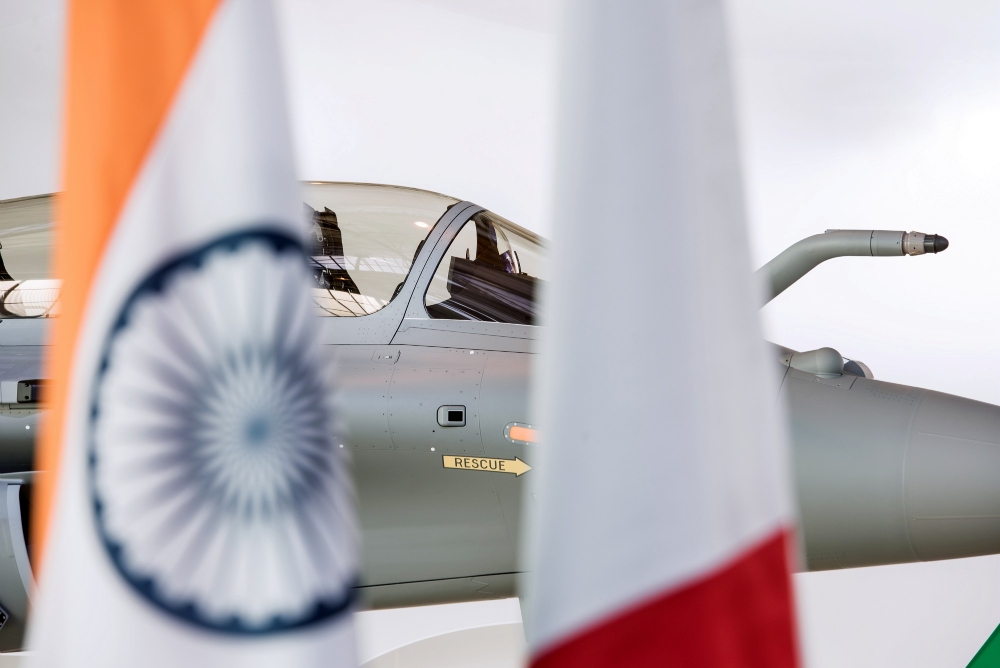
In its 22 July 2026 press conference, Dassault’s CEO Eric Trappier stated that the company is actively expanding its industrial footprint and partnerships in the country, with a clear split of responsibilities across multiple firms. Therefore, “Make in India” is no longer a slogan, but a structured industrial strategy built around a growing ecosystem of local partners.
DRAL has been once more highlighted as the primary hub for FALCON activities, signalling that business aviation work is anchoring a permanent manufacturing presence beyond the RAFALE campaign. DRAL in Nagpur has for several years been manufacturing major FALCON 2000 structures – nose cones, cockpit/front fuselage sections and other sub assemblies – that are then shipped to France for completion. Dozens of FALCON 2000 series nose/front assemblies have already been produced locally, and Dassault explicitly describes DRAL as a centre of excellence for Falcon components. In June 2025 Dassault and Reliance announced that FALCON 2000 LXS business jets will be fully assembled in Nagpur, with the first “made in India” aircraft targeted around 2028 and a projected capacity of up to roughly 20 plus jets per year.
Tata Advanced Systems is identified as the partner for establishing a dual production source for RAFALE fuselage sections, a critical step towards genuine risk shared industrialisation rather than simple offset assembly.
Dynamatic is tasked with producing the rear fuselage section of the FALCON 6X, while Hical is engaged on components for the RAFALE flight control system, pointing to a progressive transfer of high value, safety critical work packages into the Indian supply chain.
In comparison to earlier statements, Dassault explicitly refers to studies of an industrial scheme “going as far as aircraft flight” for the planned 114 RAFALE for the Indian Air Force. This language suggests Dassault and its Indian counterparts are exploring a model in which at least part of final assembly, ground testing and possibly initial flight tests would be conducted in India, under local operational and regulatory control.
Such an evolution would mark a significant deepening of technology transfer compared with previous RAFALE export contracts and would align closely with New Delhi’s ambition for greater sovereignty over combat aviation capabilities. It also implies a medium term rebalancing of RAFALE production flows between French sites and Indian facilities, with Tata, DRAL and others integrated into a wider multinational manufacturing network.
In fact, India is also emerging as a second source pillar in Dassault’s global supply chain strategy, a role explicitly acknowledged by Eric Trappier at side of yesterday’s press conference, amid continued disruption affecting European subcontractors and raw material flows.
Therefore, India looks positioned not only to secure its own RAFALE and FALCON programmes but to act as an alternative manufacturing base that can stabilise output for other export customers when traditional suppliers are constrained. This dual function – national industrial partner and global resilience hub – reinforces New Delhi’s ambition to be a strategic aerospace supplier rather than a mere licence production site and gives Dassault a structurally diversified hedge against future shocks in its European and transatlantic value chains.
Beyond the RAFALE, it is would be logic that Dassault’s reinforced industrial footprint in India created a natural revolving door for renewed marketing of the FALCON 2000 based maritime patrol variants to New Delhi.
France/Dassault started formally pushing FALCON series MPAs to India around 2005 with the FALCON 900 concept and have revived and updated that offer in 2024/2025 in the FALCON 2000 MRA form, now embedded in a “Make in India” industrial logic.
In effect, with production work already anchored at DRAL and potential second source roles for Indian partners, a FALCON 2000 MPA/MRA line in India would dovetail with the Navy’s and Coast Guard’s medium range surveillance needs and offer a higher performance complement – or, over time, partial successor – to the Dornier DO-228s that today shoulder most short range patrol, SAR and coastal security tasks.
While current contracts focus on upgrading and expanding the DO 228 fleet, any future recapitalisation window for these light patrol aircraft would give FALCON 2000 based MPAs – especially if locally produced – a credible platform to argue for a tiered, mixed fleet rather than a pure DO-228/C-295 solution.
For India, the emerging architecture promises not just licensed production but an opportunity to build enduring expertise in structures, systems and mission ready aircraft, with industrial roles spanning business jets and combat aircraft alike.
For Dassault, it secures a long term industrial anchor in one of the world’s most dynamic defence and aerospace markets, tying future RAFALE evolution and support more closely to Indian partners and capabilities.




Privacy Policy

Powered by © Mobilbyte s.a.s. Information Technology