



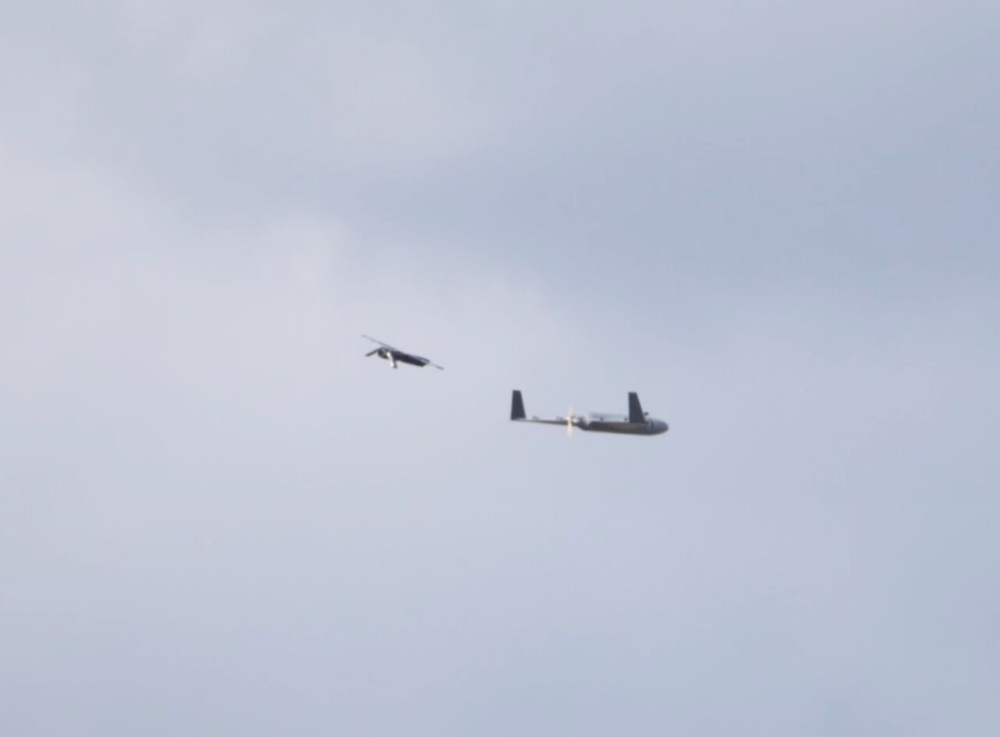
The Ministry of Defence has awarded £3.16 million to 3 companies to support their development of new low cost interceptors designed to shoot down drones and other airborne threats. The awards fall under a programme named Low-Cost Air Defence Effectors and is being delivered by the National Armaments Director Group as part of a wider European effort known as Low-Cost Effectors and Autonomous Platforms, or LEAP.
LEAP is a multinational initiative that was agreed at the European Group of Five (E5) meeting of Friday 20 February, in Krakow, Poland. In the occasion, Britain set up the project alongside France, Germany, Italy and Poland. These UK awards are the first initiatives to emerge within LEAP. The companies are Cambridge Aerospace, Frankenburg and Greenjets. In the case of the first company, we have to remember that the UK has already ordered a substantial amount of their drone interceptor SKYHAMMER with a contract awarded in April. Deliveries were expected to begin in May.
SKYHAMMER is a subsonic, tube-launched interceptor powered by a turbojet engine. It weighs approximately 18 kilograms, measures under 1 metre in length with a wingspan of 1.3 metres, and reaches a top speed of 700 kilometres per hour. The system is equipped by an X-band radar seeker enabling all-weather operations and uses a blast-fragmentation warhead to destroy drones in flight. It has been extensively tested in the UK and also demonstrated in Jordan.
The UK is believed to have urgently deployed it in the Gulf as part of wider efforts to defend bases and Allies in the region from the Iranian drone attacks. Cambridge Aerospace claims that these awards are backing work for a new facility which enable production to scale up to as many as 2,500 units per month.
Cambridge Aerospace also has plans for a more ambitious, supersonic interceptor with greater usefulness also against cruise missiles, the STARHAMMER. It’s not clear if the latest UK award will back this further development.
Greenjets will advance maturation of its KESTREL interceptor, with plans to begin demonstration trials “later this year”.
KESTREL is electric powered and uses two ducted fans for propulsion. It is aiming at speeds as high as Mach 0.8. Frankenburg’s work is particularly intriguing as it will focus specifically on air-launched drone interceptors. In their press release they announce that they will “ocus on “further developing, integrating and trialling the air-launched version of our guided Mark I air defence missile”. The solution for the UK contract will “build on Project LOAD”, which was carried out earlier with Airbus Defence and Space, resulting in the carrying of up to 4 Mk 1 mini-missiles on the Airbus BIRD OF PREY uncrewed aircraft (itself based on the based on the Airbus Do-DT25 airframe).
This combination was first test flown earlier this year and at the end of March 2026 it searched for, detected and classified a medium-sized one-way attack drone before engaging it with a Mark I missile during a end to end engagement tests flown in a military training area in northern Germany.
Further trials are planned during 2026. UK ambitions for some form of airborne counter-drone solution had first become apparent with the announcement in December 2015 of some £12 million invested “to support development of an air-launched collaborative Uncrewed Air Vehicle (UAV), increasing UK’s effectiveness against air-to-air threats." No further clarification was provided by the MOD at the time, but it seems reasonable to assume that the December 2025 work related to work on a possible launch platform while Frankenburg now confirmed to be working on the air-launched interceptor proper.




Privacy Policy

Powered by © Mobilbyte s.a.s. Information Technology