



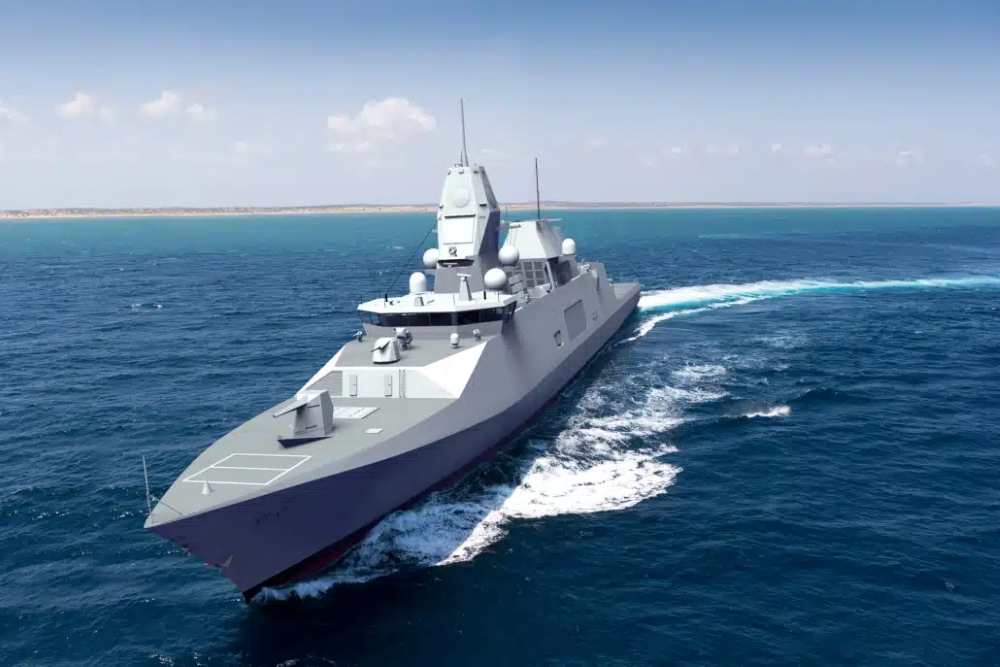
Speaking to VTM Nieuws, the daily news broadcasts on the Flemish television network VTM on July 19, Belgian Defence Minister Theo Francken was scathing about the state of the joint program with the Netherlands for the design and construction of new ASW frigates.
The Anti-Submarine Warfare Frigate (ASWF) programme is led by Dutch shipbuilder Damen and is intended to deliver 4 ships, 2 for each Navy, in order to replace the existing Belgian and Dutch KAREL DOORMAN-class frigates.
Francken said in the interview that discussions with the Netherlands continue, but he also called the project a disaster and confirmed earlier reports that Belgium is looking for alternatives that can hopefully contain the ballooning price and at least partially restore the original schedule.
He announced that Brussels will launch a Request for Information (RFI) to get the input of other European frigate builders. He openly named Italy, France, Germany, Spain and Turkey as potential suppliers.
He noted that the ASWF frigates started out targeting a unitary price of €600 million but are now up to €1,300 billion each. The Minister mentioned that Belgium actually wants to buy a third ship on top (the Netherlands announced in September 2024 they would aim to double their own plan to 4 hulls) but cautioned “not at that price”.
The ASWF original schedule called for the commissioning of the new ships around 2031, however this target suffered a first setback and then, again according to what Francken had stated to the Committee on July 1st, a new delay of another 2-3 years was flagged by Damen earlier this year.
Belgium has a right to refuse to accept “contractual adjustments for cost increases that were not contractually foreseen”, but decisions of this magnitude are normally taken jointly with the Netherlands by unanimous vote in the Joint Steering Committee, as provided for in the memorandum of understanding.
The ASW frigate project is, after all, only the latest component in the close and historical integration of the two Navies that emerged from the Belgian-Dutch Naval Cooperation (BENESAM), dating back essentially all the way to 1948. Unless it is shared by both Nations, a decision to terminate ASWF will have a profound impact and will inexorably set back the near “merger” of the two Navies as operating different classes of warships inexorably pulls many procedures and supply lines apart.
Francken said that within this summer it must become clear whether the current cooperation model with the Netherlands can be continued, or whether Belgium must make other strategic choices to avoid a serious gap regarding maritime capabilities. A decision on the way ahead, he indicated, is due by October.
It should be noted that no straightforward path exists that ensures frigates can be delivered with comparable ASW capability in the kind of timelines and pricetags that Belgium insists on. Most alternative designs available from other countries come with their own, very significant pricetag. Germany’s MEKO ASW frigates, which Berlin is now planning to build instead of the troubled DAMEN F126 project now terminated, have a hefty pricetag pushing towards €1.66 billion per hull. Italy’s FREMM EVO, if entered as alternative, would also be expensive, although Italy could also offer its PPA design, which is cheaper and arguably closer to the relatively modest capabilities ASWF is aiming for (VLS numbers, artillery...).
France would presumably put forward Naval Group’s FDI design, while Navantia is likely to promote its F-110 frigates. We assume a Turkish entry would be based on their ISTANBUL (or simply “I”) class frigates, although their ASW credentials are more uncertain.




Privacy Policy

Powered by © Mobilbyte s.a.s. Information Technology