



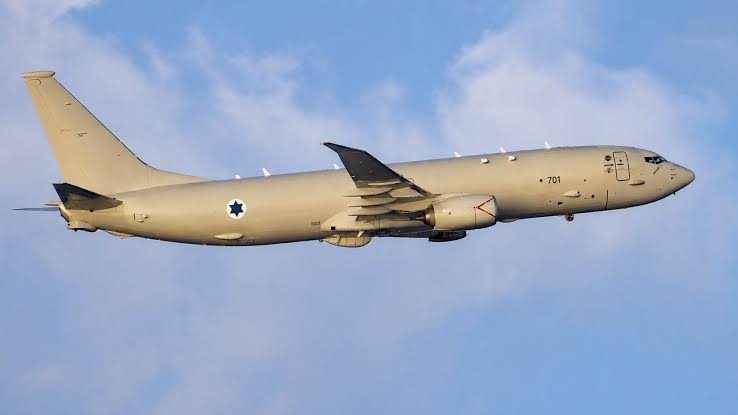
Israel is evaluating the potential acquisition of Boeing P-8A POSEIDON maritime patrol aircraft to establish its first dedicated anti-submarine warfare (ASW) unit and strengthen its regional undersea detection capabilities, driven in particular by the deployment of modern AIP diesel-electric submarines by Turkey and Egypt.
The P-8A would allow Israel to conduct continuous acoustic surveillance and target tracking without diverting platforms better suited to other roles. The various G-550 derivatives operating in EITAM, ORON, and SHAVIT configurations perform BMS, CAEW, ELINT, IMINT, and SIGINT missions over Gaza, Lebanon, Syria, Iran, and the Red Sea; none of them are optimized to hold station for hours over a single ASW search area or to engage submerged targets.
A POSEIDON unit would deploy both active and passive sonobuoys—active buoys transmit acoustic pulses and measure reflected energy to estimate target range and bearing; passive buoys detect machinery noise, propeller cavitation, and hydrodynamic wakes, feeding data to onboard computers that calculate submarine speed, course, and probable next position. The aircraft can classify contacts, localize submerged targets, and convert a detection into an engagement using Mk 54 324-mm lightweight torpedoes or naval mines, freeing the G-550 fleet for its primary multi-domain ISR tasks.
Acquisition depends on integration into Israeli-American military financing structures to offset high costs: platform purchase price, sensor integration—much of which will likely require Israeli-specific customization—and long-term sustainment. At present, Israel officially acknowledges no immediate ASW capability gap; its current combination of surface combatants, submarines, helicopters, coastal sensors, and airborne ISR is still considered adequate. Unofficially, however, the operational requirement centers on the need to detect and track, within a short time window, a diesel-electric submarine running slow on batteries, minimizing engine use, exploiting Eastern Mediterranean commercial traffic density, shallow-water reverberation, and thermal layering to complicate acoustic detection. AIP propulsion further reduces snorkel requirements and diesel engine runs, eliminating one of the few windows when a conventional submarine is most exposed to radar, infrared, and visual sensors.
In this operational environment, a P-8A could lay passive sonobuoy barriers off Haifa, Ashdod, offshore gas fields such as Leviathan, and naval transit corridors, then reposition those barriers in response to changing depth, speed, or course data. The aircraft can also develop a contact first detected by a DOLPHIN-class submarine, a SA'AR 5 or SA'AR 6 corvette, or a shipborne helicopter without requiring the detecting unit to remain on station. Transit speed is operationally critical: the P-8A can reposition between 2 search areas separated by several hundred kilometers far faster than either a helicopter or a turboprop maritime patroller. Its 2,200-km range enables operations beyond Israel's immediate coastline, including the quadrants south of Cyprus and Crete and the central Eastern Mediterranean.
Beyond its core ASW role, the P-8 is an effective multispectral intelligence platform. Its radar and electro-optical systems can classify frigates, corvettes, fast attack craft, merchantmen, and auxiliaries, providing the Israeli Navy with an expanded maritime picture during periods when submarine activity is only one component of the threat.
The Turkish submarine fleet is the primary driver of Israel's POSEIDON evaluation. The Turkish Navy operates over 10 active diesel-electric submarines, principally TYPE 209 variants, and is transitioning to the REIS class—based on the German Type 214—which introduces AIP propulsion, modern sonar suites, and extended submerged endurance. Egypt adds a second modern conventional submarine fleet in the same region: 4 TYPE 209/1400mod boats and 4 older ROMEO-class units. The accumulation of quiet submarines is less a question of hostile intent than one of tracking workload: a denser submarine environment increases the number of contacts requiring continuous classification and monitoring. Acquiring P-8As would address exactly that requirement.
Fleet size is a critical variable, though current estimates remain speculative. A force of 2–3 aircraft could support periodic operations but would struggle to maintain continuous coverage once maintenance and training cycles are factored in. A force of 4–6 aircraft—the more plausible acquisition range for Israel—would provide credible availability but proportionally higher procurement, infrastructure, and personnel costs.




Privacy Policy

Powered by © Mobilbyte s.a.s. Information Technology