



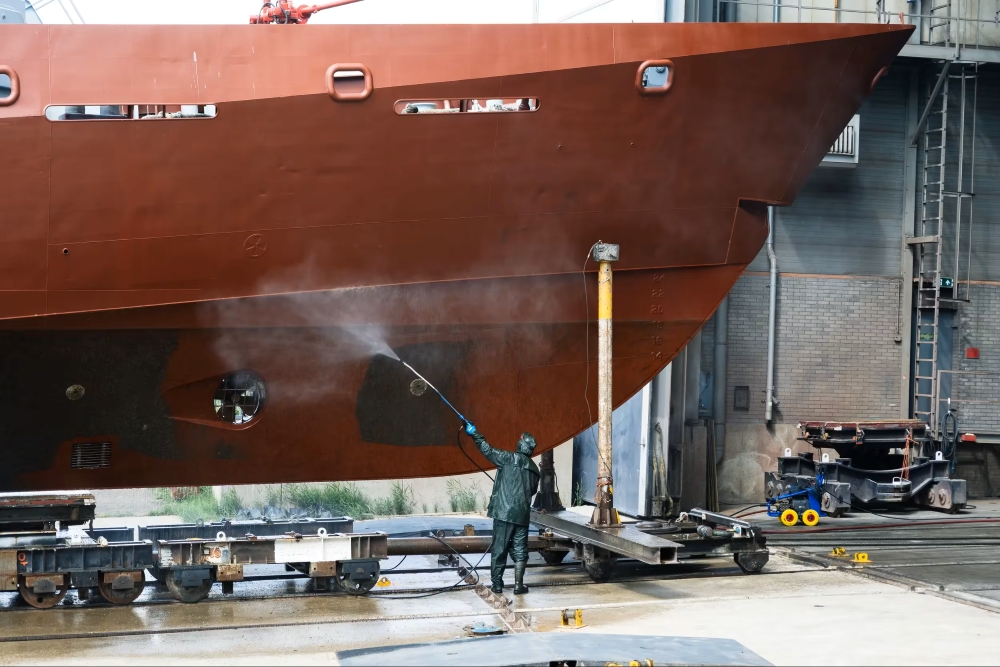
The Dutch shipyard Damen has announced a new contract to refit four vessels operated by the Royal Bahamas Defence Force’s (RBDF) Coast Guard. Damen already has a strong presence across the Greater Caribbean as various regional armed forces and coast guards sail Damen-made ships. As for the RBDF, a modern fleet is mandatory for patrolling its waters and cracking down on maritime crimes, particularly drug trafficking.
According to a company 27 July press release, Damen will restore and extend the operational life of the ships: offshore patrol vessels HMBS ROLLY GRAY and HMBS ARTHUR DION HANNA (Stan Patrol 4207), the patrol vessel HMBS CASCARILLA (Stan Patrol 3007), and the logistics support vessel HMBS LAWRENCE MAJOR (Stan Lander 5612). The three patrol vessels will be refitted in Damen’s facilities in the Netherlands, while LAWRENCE MAJOR will be modernized by the Colombian shipyard COTECMAR in Colombia.
At press time, Damen had not replied to a query from FW MAG about the expected timeline for modernizing and delivering the ships back to the Caribbean state.
Besides the RBDF, the Dutch shipyard has another ongoing programme in Colombia: Damen and Cotecmar have teamed up to build frigates for the Colombian navy, a program called the Strategic Surface Program (Programa Estratégico de Superficie, PES). The frigates will replace the ALMIRANTE PADILLA-class, which is over four decades old and is the cornerstone of the fleet’s surface power.
On 13 July, the company announced a contract with Norway’s Libra-Plast AS “for the delivery of all watertight, weathertight, and gastight doors and hatches for the PES project.” Last year, the Dutch company signed similar contracts with the defence company Terma A/S for the C-GUARD Decoy Launching System, and Alewijnse to manage the “complete integration and installation of all electrical systems on board.”
Construction of the first frigate commenced this past February; the ship (composed of 52 modules and measuring 107.5 meters in length) will be built by 2030, the Colombian shipbuilding corporation explained in a press release. The ship is expected to be delivered to the Navy on said year.
A modern, large surface fleet is necessary for Caribbean countries to patrol their territorial waters and exclusive economic zones, as the region is a well-known corridor for the flow of narcotics. The RBDF Coast Guard will need their modern boats back soon, as the drug threat never ends. In late July, the service announced the results of two major operations: an operation between the RBDF and Operation Bahamas Turks and Caicos (OPBAT) “resulted in the interception of 54 Haitian migrants” and the discovery of drugs (marijuana and cocaine) aboard a vessel in the Northern Exuma area on 27 July.
Two days prior, on 25 July, the RBDF announced that a Go Fast boat was intercepted with three Bahamian males on board and 97 bales of “suspected marijuana.” The US Coast Guard Cutter SEXTON carried out the actual interception, and the RBDF patrol vessel HMBS KAMALAMEE subsequently rendezvoused with SEXTON on 26 July “and successfully completed the transfer of the detained persons, seized vessel, and suspected narcotics.”
The Colombian Navy has similarly reported recent successes during interdiction operations at sea (across the Pacific and Caribbean) and during riverine missions.
Since 2025, the US government has increased pressure on maritime drug trafficking across both the Eastern Pacific Sea and Caribbean Sea. Besides more interdiction operations by the US Navy and US Coast Guard, the US military has also carried out air strikes against vessels suspected of transporting drugs. Washington will certainly praise and encourage its Greater Caribbean partners to continue applying maximum pressure against suspected drug traffickers. Whether these operations will make a long-term impact on drug trafficking (including the demand for drugs) is debatable.




Privacy Policy

Powered by © Mobilbyte s.a.s. Information Technology