



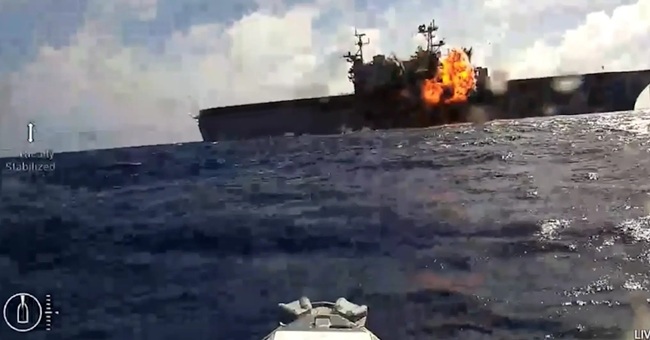
The RIMPAC (Rim of the Pacific) exercise took place from June 24 to July 31, 2026, in the waters surrounding the Hawaiian archipelago. 32 surface combatants and 5 submarines from 31 nations participated.
RIMPAC 2026 culminated with the SINKEX — a live-fire phase in which 2 decommissioned US Navy warships were sunk as targets in 2 separate engagements: the guided-missile cruiser MOBILE BAY (TICONDEROGA class) and the amphibious assault ship PELELIU (TARAWA class). Attacks against the 2 target ships involved multiple surface and subsurface platforms, as well as shipborne, airborne and land-based weapon systems of various nationalities. In addition to US Navy, US Army and USAF units, naval forces from Australia, Canada, Italy (the Multipurpose Offshore Patrol vessel GIOVANNI DELLE BANDE NERE, currently the only THAON DI REVEL-class unit in Full configuration), Japan, New Zealand and Spain took part in the SINKEX phases. The opportunity to engage real targets across a wide sea area — 50 nautical miles off the island of Kauai, over a seabed exceeding 5,000 m in depth — allowed the employment of a diverse array of munitions: at least 1 AGM-158C Long Range Anti-Ship Missile (LRASM) fired from a US Navy SUPER HORNET; HIMARS operated by the 1st Battalion, 623rd Field Artillery, Kentucky National Guard; TYPE 12 anti-ship missiles from the Japanese Army's 8th Surface-to-Surface Missile Regiment; AGM-114N HELLFIRE missiles launched from an Australian MH-60R helicopter embarked for the occasion on the US guided-missile destroyer WAYNE MEYER; Naval Strike Missile (NSM) rounds launched from the Australian destroyer SYDNEY; RGM-84 HARPOON anti-ship missiles launched from the Japanese destroyer KONGO and the Spanish frigate ALVARO DE BAZAN; a PENGUIN anti-ship missile employed by the SH-2G helicopter embarked on the New Zealand frigate TE MANA; and a MARTE MK.2S anti-ship missile from MBDA, launched from the SH-101 helicopter embarked on the GIOVANNI DELLE BANDE NERE. US Army AH-64 APACHE helicopters from the 16th Combat Aviation Brigade, 7th Infantry Division (Multi-Domain Command – Pacific), also participated, firing SPIKE N-LOS (Non-Line of Sight) missiles.
.png)
While full details on which platform engaged which target have not been disclosed, available information indicates that MOBILE BAY was hit by at least 3 air-launched missiles. The finishing blow was delivered by a Mk-48 torpedo fired from the Canadian submarine CORNER BROOK. After listing to starboard, MOBILE BAY sank stern-first on July 11, ending a career that began in February 1987.
Sinking a conventional surface combatant such as a destroyer or cruiser during an exercise is an interesting but relatively common event. The sinking of an amphibious assault ship like PELELIU is far more significant — and far rarer — for at least 2 reasons. First, the sheer size of the platform: PELELIU displaced roughly 40,000 t, making it a substantial target. Second, at least 1 unmanned surface vessel (USV) contributed to its sinking — specifically a GARC (Global Autonomous Reconnaissance Craft), built by BlackSea Technologies. The GARC is approximately 4.8 m long, 1.5 m wide, displaces 2.18 t and carries a 450 kg payload, part of which is a warhead housed in the bow section. During the SINKEX, the GARC operated fully autonomously through Anduril's LATTICE system, which leverages AI-based software for command and control and fusion of data collected during the mission. The USV can operate in sea states up to 5, reaches a top speed of 40 kn and has a range spanning from 700 nm at 22 kn to 1,600 nm at 5 kn. Thanks to a modular payload, the GARC is a multirole platform capable of anti-surface attack, reconnaissance and surveillance, mine countermeasures, anti-submarine warfare, communications relay and support to other aerial and underwater drones.
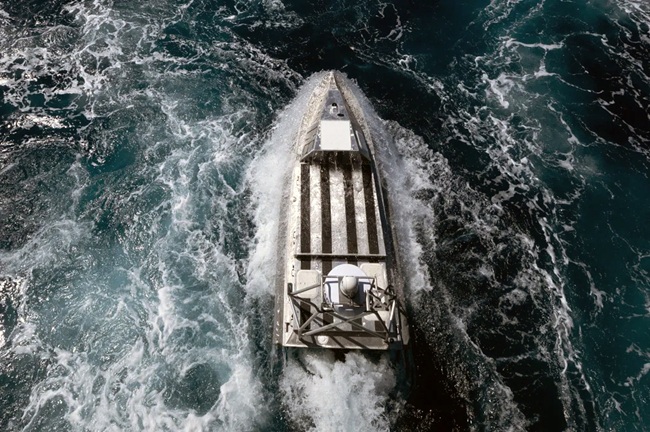
Analysis of photographs and video of PELELIU, combined with information released by the US Navy, does not conclusively establish whether the GARC alone caused the ship to sink. PELELIU was confirmed hit by HARPOON missiles launched from KONGO and ALVARO DE BAZAN (1 each), 2 weapons from the US submarine COLUMBIA, the PENGUIN fired from the TE MANA's helicopter and the MARTE MK.2S fired from the helicopter operating off GIOVANNI DELLE BANDE NERE. Imagery shows that the various missiles and the GARC struck multiple points along the hull. At least 3 sizable breaches are visible on the port side, while at least 1 missile hit the starboard side just below the flight deck and detonated inside the hangar. Given its nature, the GARC likely struck PELELIU at the waterline, contributing significantly to the sinking. In addition to the GARC that struck PELELIU, a second unit filmed the impacts. Both belong to Unmanned Surface Vessel Division 32 (USVDIV-32), a unit stood up in early 2026 to define and test the concept of employment for surface drones serving in the US Navy.
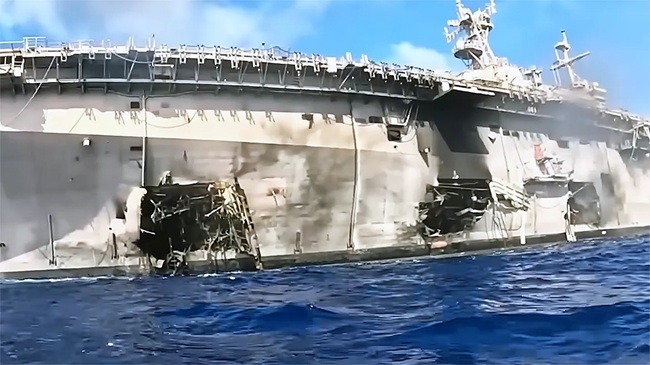
The 3 breaches visible on PELELIU's port side are roughly rectangular in shape (approximately 4 m × 3 m) and caused progressive flooding that ultimately led to the ship's sinking.
The US Navy explicitly stated that the July SINKEX events were designed to refine tactics, target acquisition, coordinated missile salvoes against major surface combatants and the employment of One-Way Attack (OWA) drones, while also providing allied navies with training opportunities in complex maritime scenarios.
The sinking of MOBILE BAY and PELELIU was not the result of a single navy — however powerful — acting alone, but of the integration of diverse capabilities: warships, sensors, shipborne systems and land-based platforms from multiple nations, coordinated through tactics, techniques and procedures developed over time.




Privacy Policy

Powered by © Mobilbyte s.a.s. Information Technology