


The US Army has downselected 5 “industry partners” for Project SUSTAINMENT, a new initiative to “automate supply and distribution” tasks to keep more personnel out of harm’s way.
The project will “leverage medium-sized autonomous robotic platforms” to mature a solution for the delivery of supplies along high-risk delivery routes, ensuring that essential supplies reach the tactical edge regardless of the threat environment.
The US Army writes that American Rheinmetall has been selected to deliver its “advanced tactical autonomous architecture”; AM General for “Integrated platform mobility and ruggedization”; Carnegie Robotics for its “cutting-edge perception and navigation sensors”; HDT Robotics for “modular robotic systems for diverse mission sets” and Stratom for “specialized autonomous cargo handling and logistics”. The contracts have a duration of 18 months. The aim is to mature a solution to begin field testing with operational units next year, in particular with eyes set on the “Transformation in Contact (TiC)” engagement event planned in the Second Quarter of Fiscal Year 2027.
Project SUSTAINMENT builds on lessons from earlier projects and experimentations in terms of load-carrying UGVs, notably the Small and then the Medium Multipurpose Equipment Transports (S-MET and M-MET). S-MET was meant to directly support the Infantry Squad reducing the load on the individual soldier, while M-MET was to bridge the gap between the Squad on the line of fire and larger autonomous logistics vehicles further back in the “echelons”.
Project SUSTAINMENT is to deliver those large vehicles for delivery of supplies close, but not directly to, the line of fire. M-MET has been absorbed into Project SUSTAINMENT.
American Rheinmetall writes that it will work with its partners, including Harbinger, Forterra, and Primordial Labs, to mature a load-carrier UGV. Harbinger is an American industrial manufacturer of “advanced electrification technologies, including all-electric and hybrid medium-duty vehicle platforms” and will provide the vehicle base itself, as well as “scalable production pathways” to ensure the solution can be produced in great numbers.
Forterra brings know-how in the autonomous capabilities that enable distributed, mission-aware, and resilient operations of the UGV in complex, contested environments.
Primordial Labs will supply its next-generation human-machine interface, Anura, to transform the UGV into an intelligent “teammate”, easing soldier-to-robot radio with reduced cognitive burden and heads-up, hands-free operation.
It’s less presently less clear what role will be played by the other downselected companies. HDT Robotics (now operating under the name BLADE) is known to have its own UGV proposal, the 6-wheeled WOLF, which can carry thousands of pounds of cargo and uses pivot steering and non-pneumatic Michelin Tweels to navigate steep slopes, wide gaps, and two-foot vertical steps.
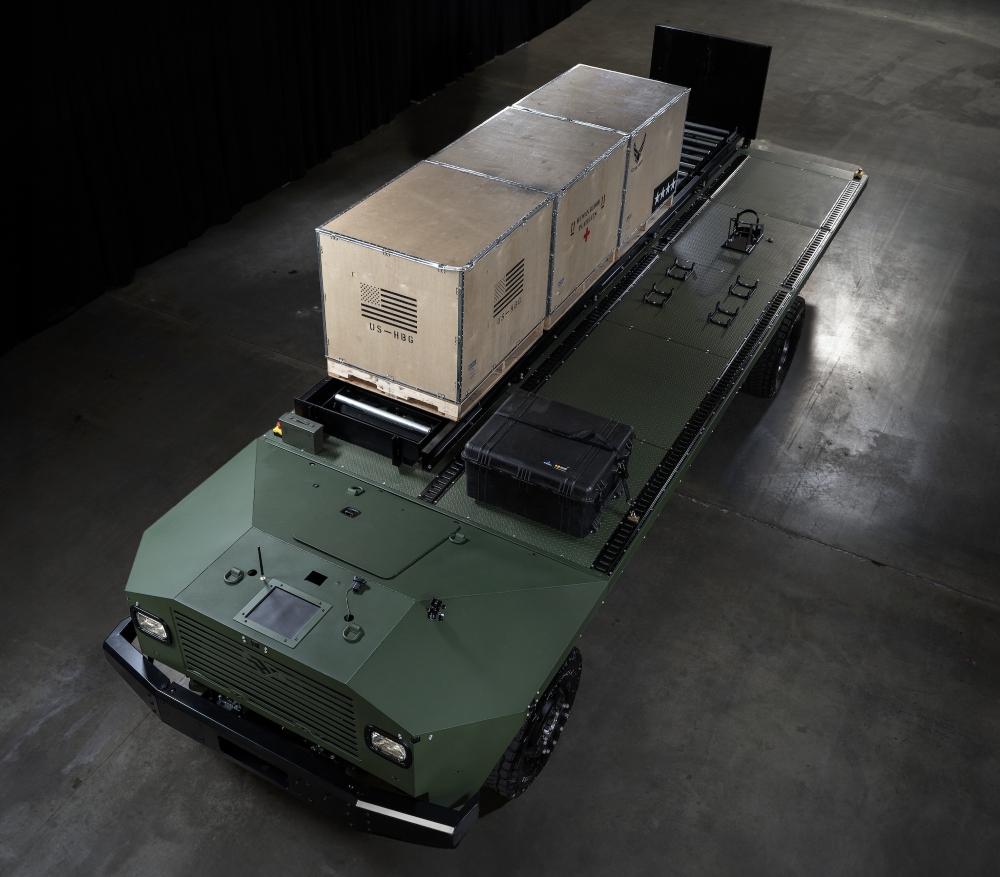
Similarly, AM General has also been pushing its own UGV entry, a 4x4 built on the 13-Series mechanical base, with the crew spaces replaced by a reconfigurable cargo deck for multiple mission sets, which can also be completed with a wireless remote-controlled T-boom service crane.
Follow us on Telegram, Facebook and X.




Privacy Policy

Powered by © Mobilbyte s.a.s. Information Technology