



In November 2024, long before the Strategic Defence Review could actually deliver its indications, the new Labour government announced multiple defence cuts which included the deletion of plans for a Mid-Life Upgrade for the Thales WATCHKEEPER tactical drone used by 47 Royal Artillery Regiment.
The surprise announcement specified that WATCHKEEPER would instead be swiftly replaced by a new fleet of drones. WATCHKEEPER was to leave service from March 2025, replaced by the Land Tactical Deep Find drone, later known as Project CORVUS.
In practice, the Secretary of State for Defence’s decision proved completely unworkable within the originally imagined timeframes and support to WATCHKEEPER was eventually extended contractually to the end of March 2027.
In the meanwhile, an open competition was launched for Project CORVUS, with a first industry day held in early 2025. It became immediately evident to Industry that the requirement was written in a such a way to heavily favour one of the candidates, which led to some early drop out and a long list of clarifications sought from the MoD.
In the intervening months, not much appears to have changed, however. The MoD’s Notice announcing the termination of the Competition and the intent to switch to a Direct Award procedure reveals that only 8 of the 18 firms invited to tender elected to enter a proposal and that none of those 8 were found to be “fully compliant”.
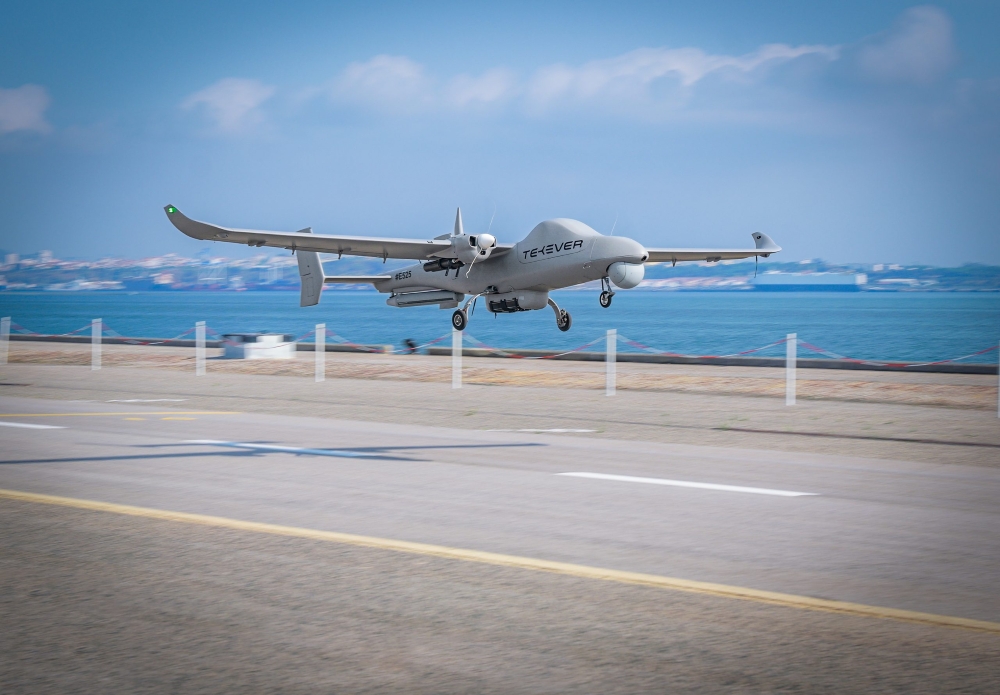
As a consequence, the MoD announces its intent to directly award the Portuguese company Tekever with a contract for their AR5 twin-engine drone. The justification as provided is that Tekever was the "only bidder in the Procurement to pass Stage 1 (Tender Board and Completeness Check), Stage 2 (Affordability Check), and Stage 3 (PASS/FAIL Tender Criteria) Question PF02 (Ability to Deliver Task Line 1) and also to submit detailed evidence supporting all of its technical responses."
The notice goes on to explain that the estimated date for contract signature, subject to approvals, is 31 August 2026. A further notification (type 6 under the Procurement Act 2023) will be released in the near future confirming the intent to award the ‘actual’ contract and initiate a formal standstill period for possible legal challenges from other interested parties.
Ministerial approval seems assured, considering the government already jumped ahead with a press release that presents the contract as a done deal, even while containing the cautionary mention “subject to contract signature and final approvals”.
Some degree of capability is to enter “service later this year, with support sustained for at least five years and options to extend”. The press release says the first order will be for 6 drones, growing to 24 by 2029. The 6 drones are, presumably, what the Army will have available come the end of March 2027 when WATCHKEEPER is to retire.
The aircraft will be built at Tekever’s new facility in the Swindon drone centre. Although Tekever is a Portuguese-born and based company, it has rapidly expanded its UK footprint first of all probably because of UK buys of its drones for onward supply to Ukraine. The Tekever AR3 was subsequently chosen to become the Royal Air Force’s Storm Shroud electronic warfare autonomous collaborative platform, with an order understood to be in the range of 24 machines.
An undisclosed number of AR3 EVO, a more recent version of the drone, capable of vertical take off and landing (unlike STORMSHROUD which is launched with a small catapult and lands with parachute and inflatable airbags) has been procured for 32 Royal Artillery Regiment.
The AR5 has been supplied to Ukraine and a number have already operated in the UK on behalf of the Home Office, delivering immigration surveillance on the waters of the Channel.
Notably, the AR5 and the AR3 EVO were in pride of place in the hangar of HMS QUEEN ELIZABETH days ago for the visit by new Prime Minister Andy Burnham alongside Ukraine’s president Zelenskyy.
Tekever has committed to hundreds of millions of investment in the UK and established sites in Bristol as well as the new factory in Swindon and a presence at West Wales Airport in Aberporth, a key location for UAV testing.
Compared to WATCHKEEPER, which first flew in 2008 and is based on the Israeli HERMES 450, the AR5 is smaller and lighter: 7,3 x 4 m versus 10,5 x 6x1, with a maximum take-off weight of just 180 kg versus 450. Twin-engined, the AR5 declares a mission endurance of 20 hours, versus 14 to 16 hours as the typical WATCHKEEPER mission duration.
The base British Army requirement is very similar, with emphasis on the simultaneous presence of EO/IR and laser designator with a SAR / ISAR radar capability with GMTI target tracking. The AR5’s GMTI capability is usually assured through IMSAR radars of the types NSP-5, 7 or 8. It’s not known at this stage which sensor the British Army is selecting. WATCHKEEPER uses the Thales I-MASTER radar (“VIPER”).
Both drones take off and land on prepared or unprepared airstrips, with AR5 requiring however a much shorter surface of 2-300 meters.
The main advantage of AR5 is that it can be controlled fully through Beyond Line of Sight (BLOS) means whereas WATCHKEEPER entered service as a LOS-controlled machine, limiting typical range to 140 – 150 km. Integration of BLOS solutions, such a Ku-band datalink, were however possible.
WATCHKEEPER saw the acquisition of 54 drones and 15 Ground Control Stations. Originally they had been intended as 30 “operational” airframes and 24 attrition reserve ones, but due to delays and well advertised difficulties in obtaining certifications and adequate reliability, the WATCHKEEPERs have not been flown very intensely.
Still, CORVUS will be delivering only around half of the WATCHKEEPER that remain available even after multiple crashes over the years.
As by now customary with UK MoD documents and announcements, the cost of the enterprise remains unclear: the latest press release talks of a contract worth £400 million over 10 years; the DiP mentions “£310 million of additional investment” for the procurement of CORVUS while also listing, on another page, 450 million in CORVUS expenditure over just the 4 years 2026/27 to 2029/30. This depends primarily on what is and is not included (operations, support, accessory costs...) but certainly doesn’t help transparency.




Privacy Policy

Powered by © Mobilbyte s.a.s. Information Technology