



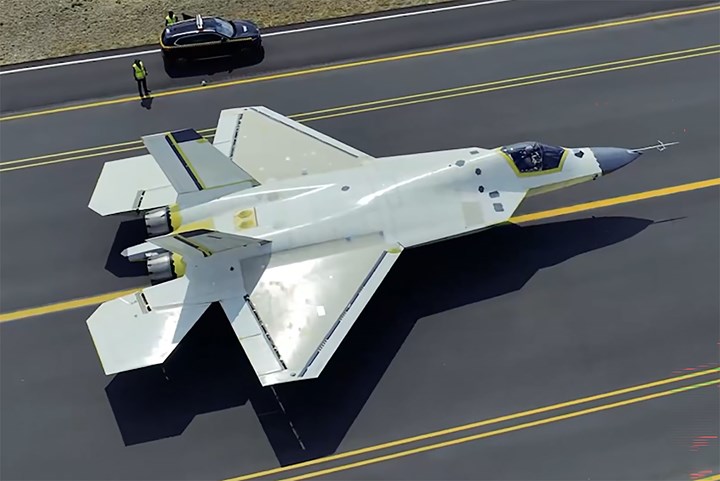
On July 31, Turkish Aerospace Industries (TAI) released a video showing the second airworthy prototype of its next-generation KAAN fighter conducting powered taxi tests. The aircraft shown is P1, the first of 2 airframes that are meant to be “production representative” of the new generation combat aircraft.
P1 and P2 are both meant to progress into flying trials before the end of this year. They follow the earlier P0 prototype, which made its first flight on 21 February 2024.
P1 and P2 show some substantial evolution and lessons learnt from the earlier P0. When they were first unveiled together earlier this year in images posted online by TAI’s Secretary, visual observation immediately revealed a number of significant changes, most notably the relocation of the air intakes which moved back compared to P0, now aligning with the rear end of the cockpit.
Other photographs also immediately evidenced a substantially evolved undercarriage, with the main landing gear legs moving further outward to the edges of the fuselage. Images also suggest the engines have been further distanced one from the other. All these changes should have freed considerable space within the airframe.
The KAAN has been developed in collaboration with the UK’s BAE Systems. The fighter is 20.3 meters long with a 13.4-meter wingspan and is designed for multirole missions with a 55,000-foot service ceiling, a top speed given as Mach 1.8 and a design optimized for low observability.
The national 5th Gen fighter is meant to replace the existing fleet of F-16s in the coming years, with a first batch of around 20 aircraft which is planned to be in the hands of the Air Force before the decade ends.
This very ambitious project represents a major milestone in the growth of Turkish defence industry’s sovereign capabilities, even with BAE’s involvement and with the KAAN being powered, at least initially, by US engines.
General Electric F110-GE-129 turbofans will be employed initially, with US authorization for the export of up to 80 engines secured in July. Turkey intended to secure full US support for license allowing TUSAS Engine Industries (TEI) to manufacture the engines locally in Eskisehir. It is not clear if this particularly ambitious objective will be reached, with Turkish defence outlet TurDef reporting recently that “priority” has shifted from the pursuit of license production towards higher value associated offsets in terms of new technologies, rights, and higher-value work packages instead.
It is intended that from the third production block onwards (Block 30), KAAN will feature domestically produced TF35000, being developed by TUSAS Engine Industries and TRMotor. In February this year, TEI General Manager Prof. Dr. Mahmut Faruk Aksit was quoted saying that the new engine had entered its Critical Design Review (CDR) phase, with integration on KAAN pencilled for 2032.
GE Aerospace owns 46.2% of TEI, making it the company's second-largest shareholder after Turkish Aerospace, but this in itself does not guarantee access to US technology for obvious reasons.
As well as securing BAE Systems’ help in designing the aircraft, years ago Turkey had also pursued a teaming arrangement with Rolls Royce for the development of the new engines.
TAI has an ambitious plan to deliver the first production Batch (Block 10) of KAANs to the Air Force by the end of 2028.
Notably, KAAN features a carbon fiber-reinforced polymer (CFRP) fuselage developed by TAI’s Advanced Carbon Composites fuselage facility. This particular facility had once been commissioned to build centre fuselage sections for the F-35 before Ankara was forced out of the Joint Strike Fighter program following the S-400 controversy.
Follow us on Telegram, Facebook and X.




Privacy Policy

Powered by © Mobilbyte s.a.s. Information Technology