



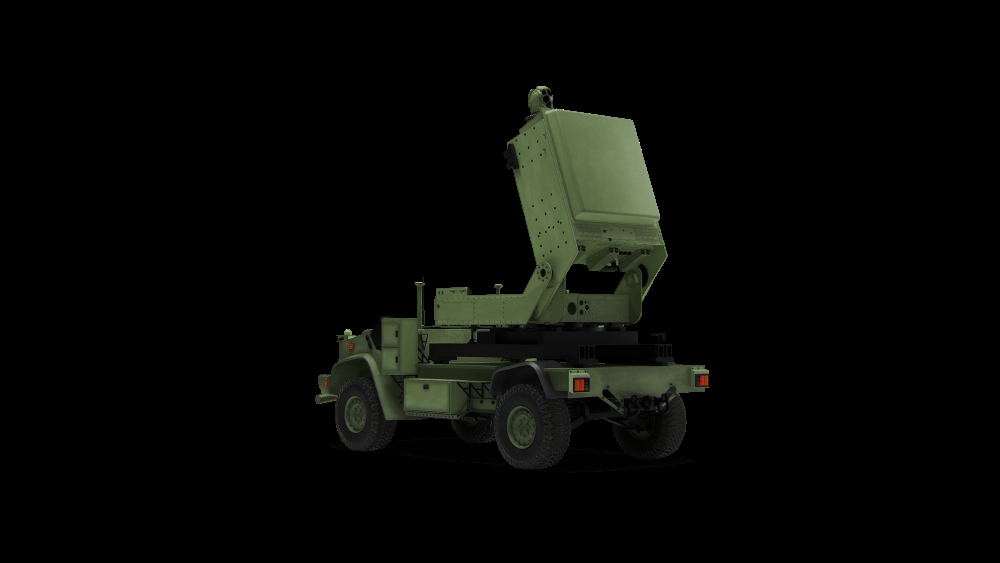
Epirus, producer of the LEONIDAS Counter-Uncrewed Aerial Systems (C-UAS) platform, announced on 10 August a contract with the US Marine Corps (USMC) worth $11 million for the High-power Microwave Autonomous Vehicle Operational Capability (HAVOC) programme.
The contract was awarded via the US Navy’s Office of Naval Research, an Epirus press release explained. A company spokesperson confirmed to FW MAG that “we will deliver the HAVOC system to USMC in Q2 2027.”
Epirus clarified to FW Mag that back in 2025, the company delivered an Expeditionary Directed Energy Counter-Swarm (ExDECS) system to the USMC. “HAVOC is an extension of our work with USMC on ExDECS,” based on the “feedback” received from ExDECS, the company representative added. Another way to see the programme is as HAVOC being the second-generation, autonomy-enabled evolution of ExDECS. The goal of HAVOC is to introduce “significant gains in electronic lethality, reliability and operational efficiency” with an “expanded coverage and power output.”
HAVOC is another example of the US military’s aim to develop the famous multi-layered approach for protecting against uncrewed aerial threats. Via the programme, the LEONIDAS platform can be part of a mobile protection solution and a “resilient, non-kinetic option” for Low Altitude Air Defence (LAAD) formations. Ground locations that can be protected via this enhanced system include ground-based air defence assets, refueling points, radars & communications centers, power equipment, and other forward-deployed assets, Epirus explained in its press release.
The company declined to discuss with FW MAG the specific crewed and uncrewed vehicles LEONIDAS can be installed on but noted that thanks to “a universal sled-mount, the HAVOC system is designed for seamless integration,” with the Marines’ crewed and uncrewed vehicles.
LEONIDAS is a high-power microwave (HPM) system designed for counter-UAS and counter-swarm point defence. In its press release, the company explained that LEONIDAS can be integrated “across the Marine Corps’ manned and unmanned ground vehicle fleets, enabling scalable deployment and flexible mission configurations.”
Epirus defines LEONIDAS as a scalable and modular system, able to be installed on a variety of platforms; for example, the company’s website shows LEONIDAS installed onboard an 8x8 armored vehicle. Meanwhile, at defence expos in Washington, DC, the company has showcased LEONIDAS aboard uncrewed ground vehicles. Moreover, in March, Epirus, General Dynamics Land Systems, and Kodiak AI announced a partnership to develop the LEONIDAS Autonomous Ground Vehicle (AGV): in short, the goal is to put LEONIDAS on the flatbed of an autonomous GDLS 4x4 vehicle.
Integrating counter-UAS solutions aboard mobile platforms and incorporating them into strategies & concepts of operations is an ongoing challenge and objective for all US armed services. The US Marines, for example, announced in early July the creation of the Marine Corps Robotics Integration Group, “responsible for integrating, standardizing, and institutionalizing training for Group 1 and Group 2 small unmanned aircraft systems and counter-small unmanned aircraft systems across the Total Force.”
Besides Epirus, the US Marines are also looking at other suppliers for counter-UAS solutions. For example, Portfolio Acquisition Executive – Marine Corps has released a solicitation which names Anduril’s PULSAR-LITE to be installed onboard the Marines’ amphibious combat vehicles. PULSAR LITE is the “newest variant in the PULSAR family of software-defined Electromagnetic Warfare (EW) systems,” which can “detect, ID, track, and defeat capabilities,” including uncrewed systems.
Moreover, the US-based defence company DRONE ROUND is manufacturing ammo for M4 Carbines and M27 rifles that are specifically designed to shoot down drones. Back in June, the US Marines, via the Department of the Navy, announced their intention to purchase the 5.56 mm Drone Round L Variant.
The HAVOC programme is another example of US armed services aiming to integrate new technologies and also seeking to learn how they can be used at echelon and across a variety of operations, particularly counter-UAS. Epirus’s LEONIDAS HPM counter-UAS system can help protect strategic locations on the battlefield; the system's scalability and mobility mean it can adapt to a shifting battlefield landscape.




Privacy Policy

Powered by © Mobilbyte s.a.s. Information Technology