



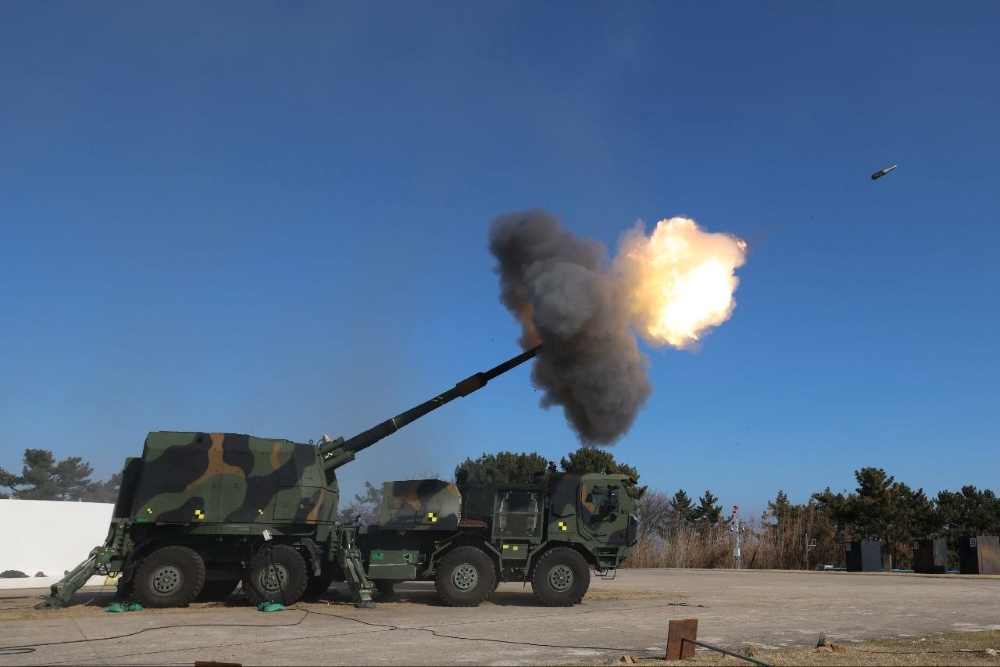
On 18 August, Hanwha Defense USA (HDUSA), the U.S. subsidiary of Hanwha Aerospace, was releaved as the selected supplier for the US Army Mobile Tactical Cannon (MTC) program, an effort that aims to replace the M777 towed howitzers within selected formations.
The award had a total cumulative value of approximately $263 million and calls for the “accelerated” delivery of 6 prototypes, with options for a batch of 12 more that could follow. The MTC program started originally specifically to equip the US Army’s STRYKER brigades with a self propelled, wheeled 155 mm howitzer. Hanwha Defense USA responded by unveiling its K9MH (Mobile Howitzer) platform, first shown to the public back in March.
Development of this wheeled derivative of the highly successful tracked K9 howitzer started in 2024. Using a 8x8 truck base, the K9MH introduces a fully automated gun loader which is not present on earlier K9 tracked variants. The K9MH is capable of a rate of fire of 8 to 9 rounds per minute. The gun module carries 40 ready-to-fire projectiles and 192 propellant charges. The crew of 3, potentially even just 2, can thus ride inside the protected truck cabin.
The automated gun turret of the K9MH essentially come straight from the ongoing work to automate the successful tracked K9 with the A2 variant.
On 30 April this year, HDUSA announced the establishment of a site in Opelika, Alabama, that will serve as the U.S. integration and test facility for Hanwha’s family of K9 Mobile Howitzers. With this first move, Hanwha added to its offer a plan for production and supply chain localization in the US. Phase 1 of the localization of K9MH work includes the creation of approximately 40 jobs in Opelika.
“We’re focused on creating a U.S.-anchored K9 Mobile Howitzer manufacturing network with Opelika, Alabama, as the current phase I launch point; that can deliver advanced Mobile Tactical Cannons at the speed and scale the U.S. Army needs” is what Jason Pak, Hanwha Defense USA Head of Land Systems – Artillery, declared in occasion of the contract award.
This is the first major contract win by Hanwha Defense USA. The South Korean giant has recently been expanding its footprint in the US, particularly in shipbuilding. This is the first major breakthrough in the Land domain.
The first 6 prototypes will be used “in a series of operational experiments to assess performance, reliability, and supportability in realistic combat conditions”, according to the US Army. If the trials will prove satisfactory, the potential follow on buys would be sizeable, even if they were limited to the artillery battalions aligned with STRYKER formations.
The Mobile Tactical Cannon award was contested by several other companies or teams: Elbit America, in team with Anduril and Oshkosh Defense, entered its SIGMA platform. KNDS in team with the US subsidiary of Leonardo DSR entered the French CAESAR MK II; Rheinmetall America pushed its RCH 155 mm system (including potentially the BOXER base) and BAE Systems proposed its ARCHER.
It is important to remember in correlation to this year that earlier this year The U.S. Army Combat Capabilities Development Command Armaments Center (DEVCOM-AC) assigned Hanwha Defense USA a Cooperative Research and Development Agreement (CRADA) to integrate the U.S. government-designed 58-caliber 155 mm cannon into the K9 self propelled howitzer family.
Readers will probably remember that the US Army had initially planned to install the 58-calibre ordnance into a modified M109A7 PALADIN, creating the M1299 Extended Range Cannon Artillery (ERCA). The M1299 project was eventually terminated in 2024 after trials were assessed to show unsatisfactory maturity of the system. One particular issue flagged at the time was excessive wear of the barrel, a problem that would not immediately be solved by changing the base vehicle. Compared to the M109 base, however, K9 has probably greater weight margins to accommodate adjustments.
While the K9MH is at present a 155/52 system, there is a possibility a 58 calibre development might still follow in the future. In addition, HDUSA has entered the tracked K9 in the Self-Propelled Howitzer Modernization (SPH-M) race: this US Army project could lead to the adoption of a new, more capable tracked self-propelled howitzer. While the K9 base entry is, again, a 155/52, having taken over the development of a potential 58 calibre evolution of the weapon system is certainty a significant point in favour of Hanwha.




Privacy Policy

Powered by © Mobilbyte s.a.s. Information Technology